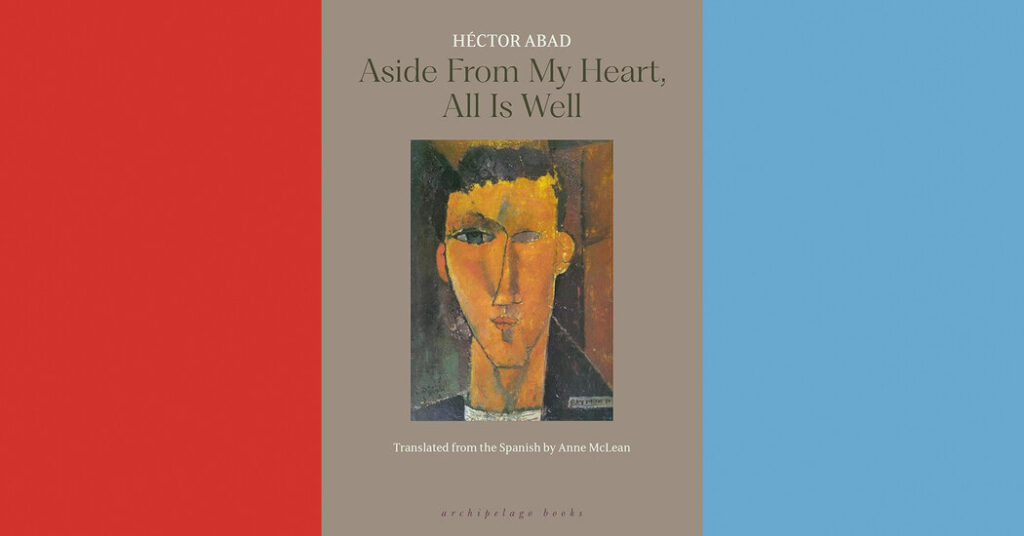
ASIDE FROM MY HEART, ALL IS WELL, by Héctor Abad; translated by Anne McLean
Perhaps the least convincing archetype of moral absolutism and piety in literature and film today is the Roman Catholic priest. A clergyman is now more likely to stand in for hypocrisy or raise dilemmas over conflicting ideals: What happens, for example, when a man of the cloth finds himself at odds with his own institution?
This question animates Héctor Abad’s novel “Aside From My Heart, All Is Well,” about what the author calls a “subject so unsuited to our times: a good priest.” Here are fallible men, hemmed in by the church, who find divinity in alms and prayer, yes, but also through romance and the arts.
The novel consists of journal entries by Aurelio Sánchez, an aging priest, in remembrance of the congenial Luis Córdoba, who is largely based on the Colombian priest and film critic Luis Alberto Álvarez. The story is mostly set in 1996 Medellín, as Father Córdoba, 50, awaits a heart transplant after a grim diagnosis. “Luis had a very big heart,” Father Sánchez says, “the prologue to cardiac failure.”
Abad indulges in what even he admits is a “worn-out metaphor,” especially while chronicling Father Córdoba’s budding romance with a housemaid after he leaves the priests’ residence. His diet is now bland, but saccharine quotes (“We are curing you here with love,” Darlis, the maid, says) abound like sentimental candy.
Abad, who wrote this novel after undergoing open-heart surgery in 2021, has spoken in interviews about imbuing Father Córdoba with his own love for opera. Even so, he has also created his own fictional stand-in, a divorced atheist and aspiring filmmaker who publishes Father Sánchez’s journals as a novel. The personal connection goes further: In the 1980s, Abad was expelled from university for publishing a column mocking Pope John Paul II, a story he recreates in the book.
A worldly enthusiasm courses through the novel. The priests drop giddy references to poems by Yeats, Lope de Vega and César Vallejo, and to videos of Mozart arias. They offer pastoral insights on subjects including the Second Vatican Council, sex abuse scandals, fatherhood (both the religious and the lay kind), an archbishop’s supposed complicity in cartel violence and the waning influence of Catholicism.
At turns, Father Sánchez proves to be a thoughtful interlocutor, with a bone to pick with the church. As a young, gay seminarian, he writes, he was alarmed at discovering the “flow of minors from the junior seminary to the senior at night,” which led him to transfer elsewhere and ultimately meet Father Córdoba. His actions sometimes undermine his sanctimonious comments. He questions the vow of chastity after he admits to sneaking off to a motel with a male student: “Absolute virginity,” he writes, is “much more against nature than my own desires.”
In its portrayal of a corrupt, morally bankrupt institution, “Aside From My Heart, All Is Well” recalls Roberto Bolaño’s haunting novel “By Night in Chile.” Like Bolaño’s Father Urrutia, a haughty literary critic who gets in bed with Augusto Pinochet’s dictatorship, Father Córdoba sees his purpose as to evangelize on behalf of the arts. His attitude, however, is open and accessible. He teaches Italian neorealism and starts film clubs, imparting his love for Maria Callas and Pier Paolo Pasolini. His heart is, admittedly, big.
The transplant, it turns out, may never come to pass. Still, as Abad demonstrates, you don’t need cardiac surgery to have a change of heart. “I have taken off my cassock in order to be a truer priest,” Camilo Torres, a Colombian clergyman turned Marxist guerrilla, once said. Father Córdoba would agree, by way of his own winsome motto: “The only mortal sin we could commit,” he proclaims, “the only one, is unhappiness.”
ASIDE FROM MY HEART, ALL IS WELL | By Héctor Abad | Translated by Anne McLean | Archipelago | 359 pp. | Paperback, $25
The post Catholic Guilt? Not for These Priests. appeared first on New York Times.