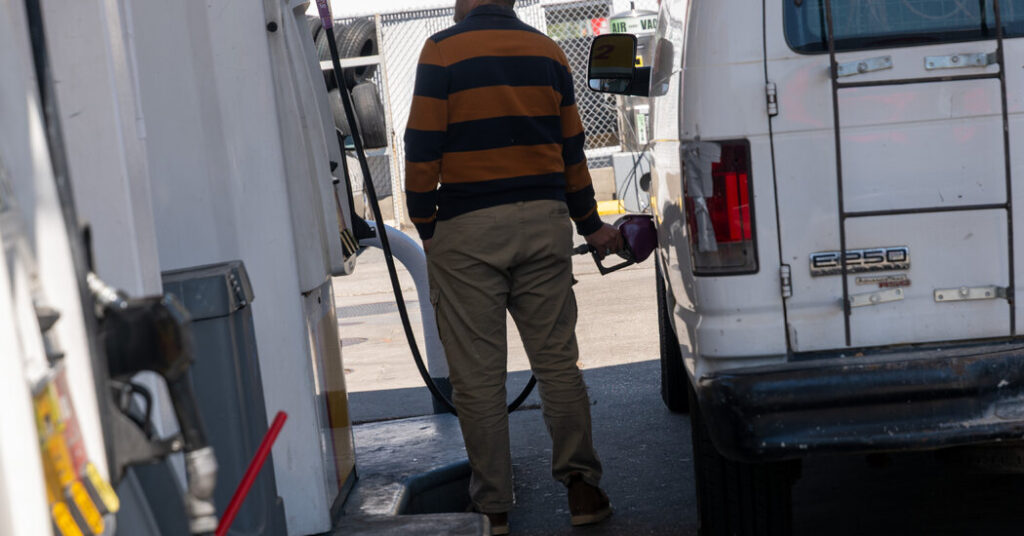
Gasoline prices in the United States rose on Tuesday to their highest level in four years as peace talks between the United States and Iran appeared at an impasse.
The average cost for a gallon of regular gasoline is $4.18, according to the AAA motor club. The price at the pump has not been that high since April 2022, shortly after Russia invaded Ukraine. Tuesday’s jump of 1.6 percent was the highest percentage increase in more than a month.
Oil prices continued to climb on Tuesday, with negotiators deadlocked over proposals to reopen the Strait of Hormuz to tanker traffic and restrict Iran’s nuclear program.
The price of crude oil has risen steadily over the past week, as talks have stalled during an uneasy cease-fire. Brent crude, the international benchmark, has posted gains in six of the past seven trading sessions and remains more than 40 percent higher than it was before the first U.S.-Israeli strikes on Iran in late February.
Stock markets are trading near record highs, however, as corporate earnings have been largely resilient. A batch of financial reports expected this week from the largest technology companies, which are spending hundreds of billions of dollars on artificial intelligence systems, will be closely watched.
Oil continues to rise.
-
The price of Brent crude, the global benchmark for oil, jumped 4 percent, to above $105 a barrel for July delivery, but slipped to $104 a barrel after the United Arab Emirates said it would leave the OPEC oil cartel next month. Brent’s price has risen about $10 per barrel over the past week. The price for oil deliverable in June rose above $110 per barrel for the first time this month.
-
West Texas Intermediate crude, the U.S. benchmark, rose 5 percent, to around $101 a barrel, for June delivery.
-
Investors and analysts are focused on the continued disruption to shipping in the Strait of Hormuz, the narrow waterway between Iran and Oman that is a vital trading route for oil and natural gas that normally carries as much as one-fifth of the world’s oil supply.
Stocks dip ahead of Fed meeting and tech earnings.
-
The S&P 500 fell 0.6 percent on Tuesday after nudging higher on Monday. Investors await a number of tech company earnings and the Federal Reserve’s decision on interest rates this week, which could move markets.
-
Stocks in Asia, where countries import vast quantities of oil and gas, were mixed. The Kospi index in Korea gained 0.4 percent, but Taiwan’s Sensex index slipped 0.4 percent. The Nikkei 225 in Japan slid 1 percent after the Bank of Japan held interest rates steady, as expected, but some board members argued for a rate increase to deal with inflation risks spurred by the war in Iran.
-
In Europe, the Stoxx 600, a broad index that tracks the region’s largest companies, fell 0.5 percent.
Gasoline prices tick higher.
-
U.S. gasoline prices rose on Tuesday, jumping to a national average of $4.18 a gallon, according to the AAA motor club. The increase has raised the cost for drivers 40 percent since the war began.
-
Gas prices don’t move in lock step with crude, usually trailing increases or drops.
-
Diesel prices have increased even more quickly and stood at $5.46 on Tuesday, up 45 percent since the start of the war.
What they are saying: ‘Exceptional’ conditions for big oil companies.
-
BP, the British oil giant, reported its latest earnings on Tuesday, comfortably surpassing analysts’ expectations by doubling its profit in the first quarter, to more than $3 billion. “The oil trading contribution was exceptional,” the company said in a filing.
-
Meg O’Neill, who recently took over as chief executive of BP, said in a statement that she joined the group “at a time when our industry is operating in an environment of conflict and complexity, playing a vital role in keeping energy flowing.”
The post U.S. Gas Prices Hit Highest Level Since Beginning of War in Iran appeared first on New York Times.