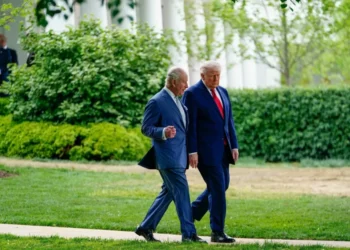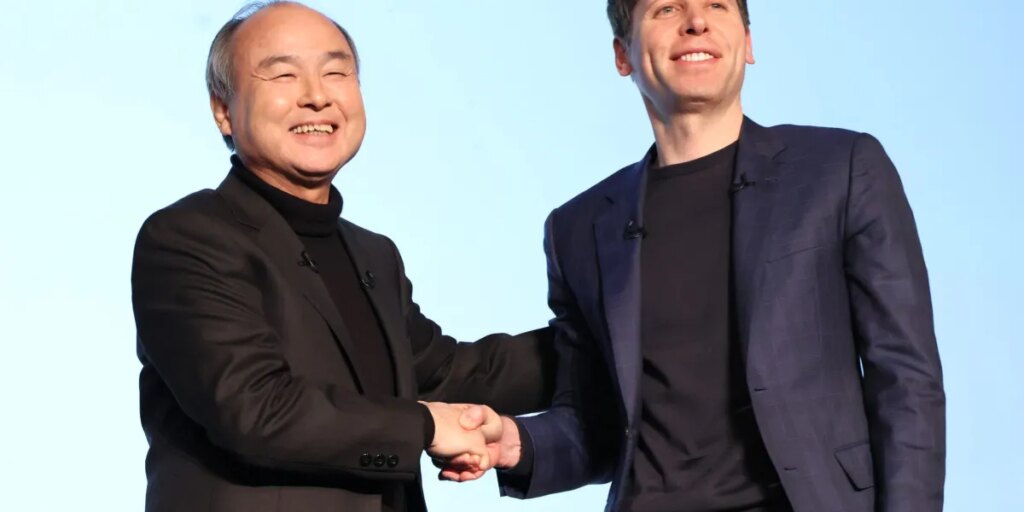
Sam Altman is having a pretty bad week, and it’s only Tuesday. On Monday, jurors were quickly seated in Oakland for his ‘hero,’ Elon Musk’s, $130 billion trial against him. Monday night, a fresh Wall Street Journal report knocked him down further, describing internal turmoil at OpenAI—slowing user growth, leading to missed revenue goals, leading to a CFO who has reportedly grown nervous about Altman’s appetite for compute.
Now, as Altman sits in the courtroom awaiting Musk’s opening statement, the Nasdaq is taking a hit on the report, falling more than 1% from record territory and pulling down the names tied closely to OpenAI’s commercial orbit. Oracle, which inked a $300 billion data-center partnership with OpenAI last year, fell roughly 5%. CoreWeave dropped 7%. SoftBank, OpenAI’s largest investor, sank nearly 10% in Tokyo overnight (SoftBank is a Japanese company).
Gene Munster isn’t buying it. “I think this is a true story—it is an example of over-analyzing,” the veteran tech analyst and managing partner at Deepwater Asset Management told Fortune. “It can miss the bigger picture. The bigger picture: it’s still growing, we’re still early in AI, and they’re still in a great place.”
The question behind the question
The headline concern is real. OpenAI has reportedly committed itself to roughly $600 billion in future compute spending—a number that only makes sense if revenue keeps roughly doubling each year. ChatGPT’s growth has begun to slow as Anthropic’s Claude and Google’s Gemini eat into its market share in different segments. The WSJ report quoted CFO Sarah Friar’s private concern that the company isn’t ready for public-market disclosure standards—stoking fears of an “AltaVista moment” for the original AI front-runner.
AltaVista is an old Fortune metaphor, for those who never used it before it shut down in the early 2010s, was the leading search engine of the mid-1990s, launching in December 1995 and handling roughly 300,000 searches within its first 24 hours. It was faster and more comprehensive than anything else at the time — essentially defining what modern search looked like before Google existed. (Bill Gates had to tell Warren Buffett that he should switch away from AltaVista, Fortune previously reported.) Could that be OpenAI’s fate, with Anthropic and its widely used Claude model emerging as the preferred player?
Munster reframes the concern: “That comment from Sarah Friar suggested there’s concern there. But it was in the context of them just saying, ‘We have to grow.’” He pointed out that OpenAI’s compute contracts are dependent upon their growth rate. He also flagged an underreported ambiguity in the WSJ piece itself—whether OpenAI missed its own internal projections or more aggressive stretch targets, and by how much.
“Their business is growing rapidly, likely doubling year over year,” he told Fortune in an interview. “They’re on track to be a multitrillion-dollar public company someday — not out of the gate, but over time.” The firm where he is currently managing partner, Deepwater Asset Management, holds a position in OpenAI through the private markets, and he’s “not concerned about it.”
The question Munster keeps coming back to is whether OpenAI has products that can sustain a doubling pace of revenue for the next few years. He thinks the answer is yes—and points to a piece of the business that hasn’t gotten as much attention as it probably deserves: Codex, OpenAI’s coding tool, built on GPT-5.5.
Anthropic’s Claude has been the darling of developers for months, with reports that companies like Meta are encouraging employees to “tokenmaxx”on Claude. The narrative in tech media has been that Claude is winning the coding race. Munster, whose firm uses both products through an affiliate called Intelligent Alpha, says that narrative is wrong.
“If you’re serious about developing, you’re using GPT-5, you’re using Codex,” he said. “You’re not using Anthropic.”
If he’s right, the implication is that some of OpenAI’s recent slack in revenue is just a lagging indicator from a pre-Codex time. OpenAI and Anthropic were both currently valued at roughly $850 billion based on recent private-market share sales, but Anthropic recently surged aheadto be valued above $1 trillion.
“It can be a zero-sum game, and they both can be wildly successful,” Munster said. “Right now, the focus is on these coding tools. But two years from now, the conversation around AI—what these models are, what value they’re providing—can be totally different. We’re still just scratching the surface.”
The post OpenAI’s bad week misses the point, says tech analyst Gene Munster: ‘I think this is a true story—it is an example of over-analyzing’ appeared first on Fortune.