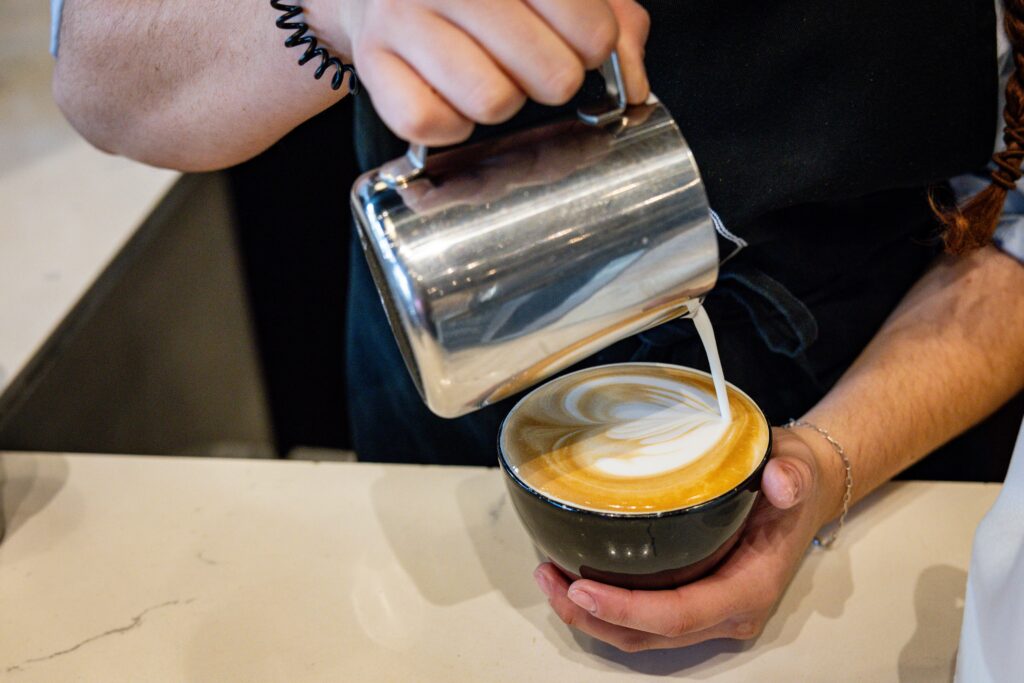
From a scientific point of view, a cup of coffee is a conundrum. More than a thousand molecules contribute to the flavor, influenced by the beans, the level of roasting, the grinding technique and, finally, brewing. The result can be an inconsistent cup that is unpredictable in taste and quality — too acidic, burnt-tasting or weak.
Chemists can use sophisticated tools to deconstruct how these individual components add up to the ineffable gestalt of coffee, but the approach hasn’t been practical as a quick quality check for a busy barista.
New research could help untangle the coffee quandary. Borrowing technology used in battery research, scientists demonstrated that measuring the current that runs through coffee can quickly quantify the strength and flavor of a cup of joe, according to a study published Tuesday in the journal Nature Communications.
Scientists at the University of Oregon took a device called a potentiostat that generates a varying voltage, stuck its electrodes into a cup of coffee and measured the current flowing through coffee samples. The samples were made with the same beans, roasted to different levels and prepared with an identical brewing process.
They found that the larger the charge passed through the coffee, the stronger the brew was — stronger coffee was more electrically conductive. The darker roasted coffee was less conductive at the same strength, in part because of the buildup of molecules like caffeine on the electrodes.
The finding is the latest in the world of coffee science, which has experts around the country studying the optimal ways to go from beans to brew.
Traditionally, the coffee industry measures the strength of coffee using the refractive index — a measure of “total dissolved solids,” or the amount of coffee dissolved in the brew. But flavor is an ensemble of attributes, including strength and how the beans have been roasted that can’t be fully captured by that measurement.
Christopher Hendon, a chemist at the University of Oregon who led the research, said he hopes this new electrochemical measurement could offer a way to monitor quality and consistency — something that is less important for a person brewing coffee at home, but a major challenge at scale.
“It’s the most simple experiment, but the analysis is really complicated. Inevitably why I’m excited … is it’s not clear you should ever be able to measure one feature corresponding to electricity and have that one feature map onto an ensemble flavor of something that contains thousands of different compounds,” Hendon said.
Figuring out how these components build to the notes of strawberry in one sip or the caramel overtones in another is far from trivial. The arbiter of taste — whether or not something tastes good — remains the human tongue.
Hendon said they validated their measure by analyzing four batches of coffee from a roaster called Colonna in Bath, U.K. They found their electrochemical measure could distinguish the discard batch that had been rated by a human tester as not up to standards. The roaster later told them the batch had been rejected because it wasn’t sufficiently roasted and was too acidic.
Heather Smyth, a flavor chemist and sensory scientist at the University of Queensland in Australia who was not involved in the study, said that she’s seen a lot of “electronic noses” that try to discern the fingerprint of coffee aroma and flavor.
“My feeling this technique adds something potentially new, but in itself is not a single solution,” Smyth said in an email.
The missing piece, she said, is the human sensory data, to understand how useful — or not — the electrochemical measure is.
“It’s a faster method to measure a fingerprint of a coffee compositional profile. It would add more information to the suite of analytical measures we have to measure coffee flavour quality. None of these methods alone are useful to fully describe and quantify coffee flavour. Only sensory evaluation can do this with human participants,” Smyth said.
The post How science can create a better cup of coffee appeared first on Washington Post.