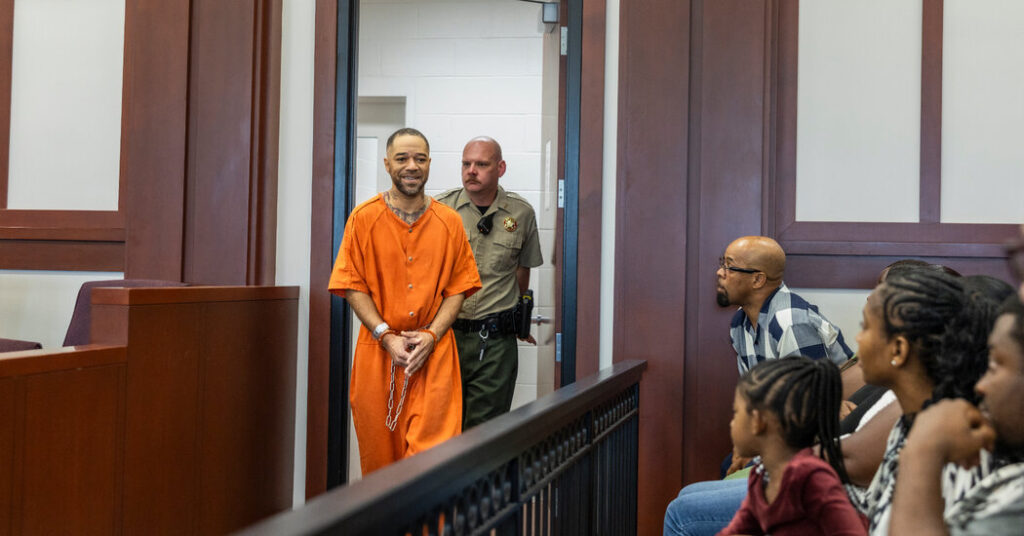
On Friday morning in Middle Georgia, Jessie Askew Jr. was escorted into court, chained at the wrists and ankles one last time.
Mr. Askew, 52, had been in a Georgia state prison since 1998, sentenced to life without parole for his part in an armed robbery in which no shots were fired and no one was hurt. He had been fighting ever since to get the courts to reconsider the punishment, arguing that it was excessive and unfairly imposed.
The chains clinked as Mr. Askew shuffled past his supporters, trying to obey a deputy’s unexplained order not to look into the crowd. The pews in Courtroom 1 overflowed with about 50 of Mr. Askew’s supporters — numerous relatives, a juror who convicted him and even victims of his crime who wanted him free.
Seated with them was the man who put Mr. Askew away to begin with — Kelly Burke, 67, the former district attorney for Houston County. A new prosecutor at the time, Mr. Burke was determined to be seen as tough on crime and pushed for life without parole, only to later realize that he had been tragically unfair. He said he considered it the biggest regret of his career.
Mr. Burke, who had been working since 2005 to get the sentence reduced, was prepared to testify again on Mr. Askew’s behalf.
Mr. Askew, a grandfather with flecks of gray in his beard, sat between his lawyers, hoping to finally overcome the worst mistake he ever made. This was his chance. The current district attorney had agreed to a reduced sentence. If Judge G.E. Adams signed off, Mr. Askew would walk free.
Judge Adams entered, greeting the hushed courtroom.
“For the record, we have the State of Georgia v. Jessie Askew Jr.,” he said. “I was presented a consent order, but before looking at signing it, I wanted to have a hearing to address a couple of things.”
Mr. Askew steadied his breath.
Mr. Askew was 23, broke and a new father in September 1997 when he and his cousin burst into Morrison’s Fresh Cooking, where Mr. Askew once worked. Wearing masks and carrying unloaded shotguns, they stole $5,000 but were quickly arrested because Mr. Askew’s former co-workers had recognized his cousin’s shirt, one Mr. Askew often wore to work.
Mr. Burke was 38 and the newly elected district attorney in Houston County, home of Robins Air Force Base. Though he had no experience as a prosecutor, he swept into office promising to toughen up a system that many believed had gone soft. Angered by the trauma Mr. Askew had caused to the victims, Mr. Burke decided to make an example of him.
He capitalized on a Georgia law, new at the time, that allowed prosecutors to secure life without parole for defendants convicted of their fourth felony if the crime was a serious offense, such as armed robbery. It didn’t make a difference to Mr. Burke that Mr. Askew’s previous felonies — forging a check, breaking into an unstaffed park concession stand and busting a car window — were nonviolent and relatively petty.
After a jury convicted Mr. Askew, Mr. Burke announced that he was seeking life without parole. Mr. Askew and his family were stunned. There had been a misunderstanding between Mr. Burke and Mr. Askew’s lawyer about what the prosecutor planned to do if Mr. Askew didn’t accept a plea deal. Mr. Burke insisted on life without parole even after the veteran trial judge privately urged him to reconsider, saying it was unfair. Mr. Askew’s co-defendant had received only a 10-year sentence.
Under the law, the judge had no choice but to impose the life sentence if the request met the criteria.
“Mr. Askew will never breathe another breath of free air,” Mr. Burke told a reporter that day.
In the next few years, Mr. Burke prosecuted multiple people for murder. Because their cases didn’t meet the guidelines of the new law, they got a chance at parole even though they had killed people. He now felt he had been unfair to Mr. Askew — a rare admission for a prosecutor — and had to do something about it. The appropriate sentence, he believed, was 15 years, not life.
“I’ve tried ever since to help any way I can, because I was just too hard on him,” Mr. Burke said in an interview.
Mr. Burke searched for errors in the trial record that could be used to overturn Mr. Askew’s conviction, hoping he and Mr. Askew’s lawyer could negotiate a less punitive plea deal. But he found no actionable mistakes and got no help from the parole board. In 2009, Mr. Burke sent word to Mr. Askew that he regretted pushing for the harsh sentence but couldn’t figure out how to fix it. Mr. Askew, who had become a mentor to younger prisoners during his decade in prison, was grateful for Mr. Burke’s efforts but remained incarcerated.
Mr. Burke retired from the district attorney’s office in 2010 and spoke with the man who replaced him, asking him to take up Mr. Askew’s cause. The new district attorney declined. So did the next one. In 2017, Mr. Burke was diagnosed with spinal cancer. It ravaged his body, leaving him thin, weak and unable to swallow. Excess saliva built up in his mouth, making it difficult to speak. He said he prayed that he would live to see his wrong righted.
Frustrated with his lawyers, Mr. Askew decided to represent himself. In 2021, he filed a habeas corpus petition challenging the legality of his incarceration, and included a sworn affidavit from Mr. Burke taking “full responsibility” for his “illegal” sentence. That led to an April 2023 hearing at which Mr. Askew had the surreal experience of questioning, under oath, the prosecutor who had forced a judge to condemn him for life.
Mr. Burke testified that he had pushed for the harsh sentence in part because he had been upset that Mr. Askew insisted on going to trial despite damning evidence.
“I’ve been in hospice twice,” Mr. Burke said. “And I’m convinced that the reason I’m back is to make sure this court is aware of my feelings about the sentence of Mr. Askew,” he added, pausing because of the excess saliva. “My biggest regret in my 40 years being an attorney is that Mr. Askew got treated the way he did because of my actions.”
Chris Carr, Georgia’s attorney general, opposed Mr. Askew’s petition, arguing that he should have presented Mr. Burke’s testimony sooner. Two days before Thanksgiving in 2024, Judge Howard C. Kaufold Jr. of Telfair County ruled in favor of the state. Mr. Askew would stay in prison.
Last year, an article about Mr. Askew in The New York Times prompted the Southern Center for Human Rights, a nonprofit based in Atlanta, to represent him pro bono.
Lawyers for the organization approached District Attorney Eric Z. Edwards with a proposal outlining the case for Mr. Askew to go free. (The law didn’t yet allow for this sort of agreement when Mr. Burke was district attorney.) Mr. Edwards agreed, telling The Macon Telegraph in an interview that he was swayed by Mr. Burke’s regrets, the lack of injuries in the crime and prison overcrowding.
Mr. Askew said he felt lightheaded but peaceful when he heard the news, as if a weight was leaving his body.
“When I called and told my parents, it was the sweetest thing and the best feeling in the world,” Mr. Askew said in an email.
On Friday, Mr. Askew sat quietly in an orange prison jumpsuit as the judge began the hearing.
Judge Adams wanted to know how the victims of the 1997 robbery felt about Mr. Askew’s possible release. Mr. Edwards, the current district attorney, said his office hadn’t heard back from most of them. One man who responded “barely even remembered” the details of the robbery and did not oppose Mr. Askew’s release, Mr. Edwards told the court. Two other victims were in court supporting Mr. Askew.
No one in the room was opposed.
Mr. Askew’s lawyer, Michael Admirand, presented letters from 12 Telfair State Prison workers, praising Mr. Askew, who worked as a medical orderly.
Mr. Admirand also pointed to Mr. Burke, noting his efforts on Mr. Askew’s behalf. Mr. Burke, whose cancer was in remission while the damage to his body remained, sat in a motorized chair in the back. Also present was Scott Holcomb, a state representative who had been collaborating with Mr. Burke to pass a so-called second look law that would create an easier legal path for reviewing disproportionate sentences. As it was, the current district attorney had to agree to a resentencing.
Mr. Admirand introduced Deitra Robinson, who was working at Morrison’s during the armed robbery. Mr. Askew and his co-defendant herded her and the other workers into a cooler at the time of the robbery.
“I was devastated and shocked when I learned that Jessie was sentenced to life without parole,” Ms. Robinson said. “I can only imagine the nightmare that this has been for Jessie’s family.”
Jessica Davis, Mr. Askew’s sister, was next. She was part of the staff working at Morrison’s the night of the robbery. Mr. Askew said he had known that she was going to be there but foolishly thought that because the guns weren’t loaded, the robbery wouldn’t cause lasting damage.
Ms. Davis said the crime had caused distance between her and her brother, and stress in the family, but their bond was now strong. “I believe this incident does not define him,” she said. “I have seen remorse, growth and a desire to do better.”
Mr. Askew, who learned in prison self-improvement courses about trauma’s effect on people, said in an interview that he deeply regretted hurting his little sister. Now, tears swelled in his eyes.
Mr. Edwards told the court that he typically would have fought a request to reduce a prisoner’s sentence in such a case. What stood out, the district attorney said, was Mr. Burke’s advocacy for Mr. Askew and insistence that he had treated him unfairly.
“His opinion carried a lot of weight with me,” Mr. Edwards said.
Judge Adams commended Mr. Askew for working hard in prison and for having a courtroom full of supporters. The room was hushed, waiting to hear his decision.
Mr. Askew stared ahead at the judge, bracing.
Judge Adams said he would resentence Mr. Askew to the requested 25 years.
Mr. Askew, who had served 28 years, nodded his head forward and back, forward and back. Tears flowed down his face. He would walk free as soon as he was processed out of the system.
In the gallery, people let out sighs. Mr. Askew’s parents, Molly and Jessie Askew Sr., beamed, and Molly started to cry.
A deputy took Mr. Askew by the arm and said it was time to go back to his holding cell. Passing his supporters, Mr. Askew, smiling through tears, lifted his chained hand to wave hello. The crowd cheered and applauded as he returned to the jail for the last time.
In the courthouse lobby, Mr. Burke lamented all the years Mr. Askew lost while he tried to find a way to help right the wrong. But he said he felt “awesome” that Mr. Askew could finally be with his family. He also said that he was thankful that the family forgave him and always treated him kindly, even when it would have been easy to lash out.
A few hours later, Mr. Askew emerged from the jail next to the courthouse, arm in arm with his sister. He lifted his other arm in triumph. He went straight for his mother, embracing her tightly.
“Love you,” he said softly into her ear, with his eyes closed. “Thank you. Thank you.”
Looking toward the parking lot, Mr. Askew saw his daughter, who was eight months old when he was arrested. He had given her a name that he prayed would bring hope to her life before everything went wrong in his: Justyce. Finally, the father hugged his daughter out in the sunlight.
At a nearby LongHorn Steakhouse, Mr. Askew sat among 16 relatives, who took up many tables. For his first meal as a free man, he ordered a rib-eye with grilled Mexican-inspired sweet-corn on the cob and a loaded baked potato.
Mr. Askew told The Times that he looked forward to helping his aging parents, loving on his family and sharing his story of faith, redemption and forgiveness. He planned to build the clothing and apparel line he had conceived in prison, Original Gentleman. He said he hoped to help Mr. Holcomb pass the Second Chance Act in Georgia. He said he knew a lot of deserving men the law could help.
A convoy of relatives headed toward Mr. Askew’s parents’ home, where he planned to live. They have a red brick ranch-style with fluffy spring ferns hanging on either side of the front door. Mr. Askew seemed at home at a house he’d only seen in the background of video calls from prison.
In the front yard, he took a couple of his little great-nephews in his arms.
“What’s up nephew, it’s your Uncle Pete,” Mr. Askew, who goes by Pete in the family, said to one boy. “You think you can outrun me?”
Yes, the boy nodded.
With his much longer legs, Mr. Askew won the race but didn’t gloat. His 7-year-old great-nephew, Daylan, lingered afterward. He asked his Uncle Pete why he had been in prison.
“I did something crazy,” Mr. Askew said softly, leaning down. But he said he would make sure that Daylan and the other kids would never end up in such a situation.
The post He Was Supposed to Die in Prison, but the Prosecutor Felt Guilty appeared first on New York Times.