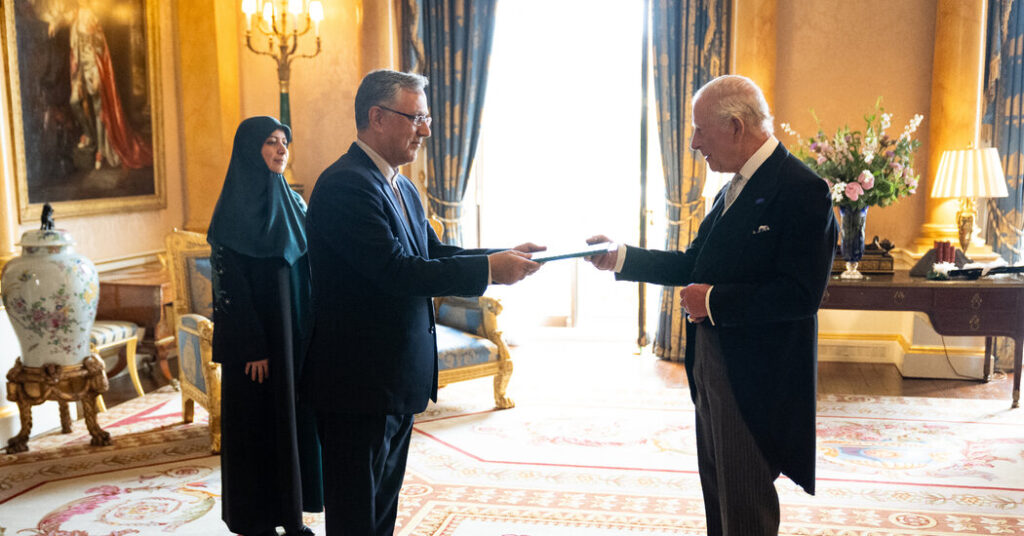
The British government said Tuesday that it had summoned the Iranian ambassador in response to what it called “unacceptable and inflammatory comments” posted by the Iranian Embassy on social media.
The summons, a formal diplomatic tool, comes as the relationship between Britain and Iran has grown particularly fraught amid the war in the Middle East. The British authorities have increasingly been warning of a rise in threats from hostile states, including Iran and Russia.
Earlier this week, Iran’s embassy in London posted a statement on its Telegram channel that invited Iranians living in Britain to register for what it described as “Sacrifice for the Homeland” campaign.
The embassy encouraged “all proud sons and daughters of Iran” to “demonstrate unity, loyalty, and national pride in a unified framework,” and ended: “Let us all stand together, ready to sacrifice our lives, for it is better than surrendering our country to the enemy.”
The embassy statement was unclear about what might be asked of Iranians who volunteered.
Britain’s foreign office said in a statement on Tuesday that Hamish Falconer, the minister for the Middle East, had made clear to the Iranian ambassador “that these actions and comments were completely unacceptable, and that the embassy must cease any form of communications that could be interpreted as encouraging violence in the U.K. or internationally.”
Asked for comment, the Iranian embassy in London issued a statement saying it “strongly rejects” the suggestion that it had called for any violence abroad.
“The allegation that the diplomatic mission of the Islamic Republic of Iran has issued a ‘call for life sacrifice’ is a misleading and inaccurate interpretation of a national campaign to manifest national solidarity and cohesion among Iranian people to protect Iran’s territorial integrity and borders,” the statement said.
The campaign, it said, is “solely a symbolic initiative aimed at emphasizing patriotism and the moral readiness to defend the homeland against any foreign aggression, and it does not, in any way, possess a violent or operational nature in abroad.”
The Iranian ambassador to Britain, Seyed Ali Mousavi, has been summoned by the Foreign Office before. It last happened in March after an Iranian national and a dual British-Iranian citizen were accused of conducting surveillance for Iran on people and places tied to London’s Jewish community.
That surveillance, along with a spate of arson attacks in Britain and across Europe that have been claimed by a shadowy online group, have set off concerns about the possibility of Iranian state involvement. The police have not confirmed that.
The incidents claimed by the group in Britain have been mostly centered in the north London area, which is home to just over half of Britain’s approximately 300,000-strong Jewish community. They follow a similar pattern seen in Germany, Belgium, France and the Netherlands.
Britain’s senior national coordinator of counterterrorism policing, Vicki Evans, last week told reporters that the police were looking into the possibility that the attacks were linked to Iran or its proxies.
“Counter Terrorism Policing and our partners remain alive to the threat of Iranian state aggression in the U.K.,” she said. “We are aware of public reporting that this group may have links to Iran. As you would expect, we will explore the question of motivation and direction as our investigations continue.”
She described the Iranian regime’s “routine uses of criminal proxies,” and said the police “are considering whether this tactic is being used here in London — recruiting violence as a service.”
Yeganeh Torbati contributed reporting from Istanbul, and Sanam Mahoozi from London.
Megan Specia reports on Britain, Ireland and the Ukraine war for The Times. She is based in London.
The post Britain Summons Iran’s Ambassador Over Message to Iranians in U.K. appeared first on New York Times.