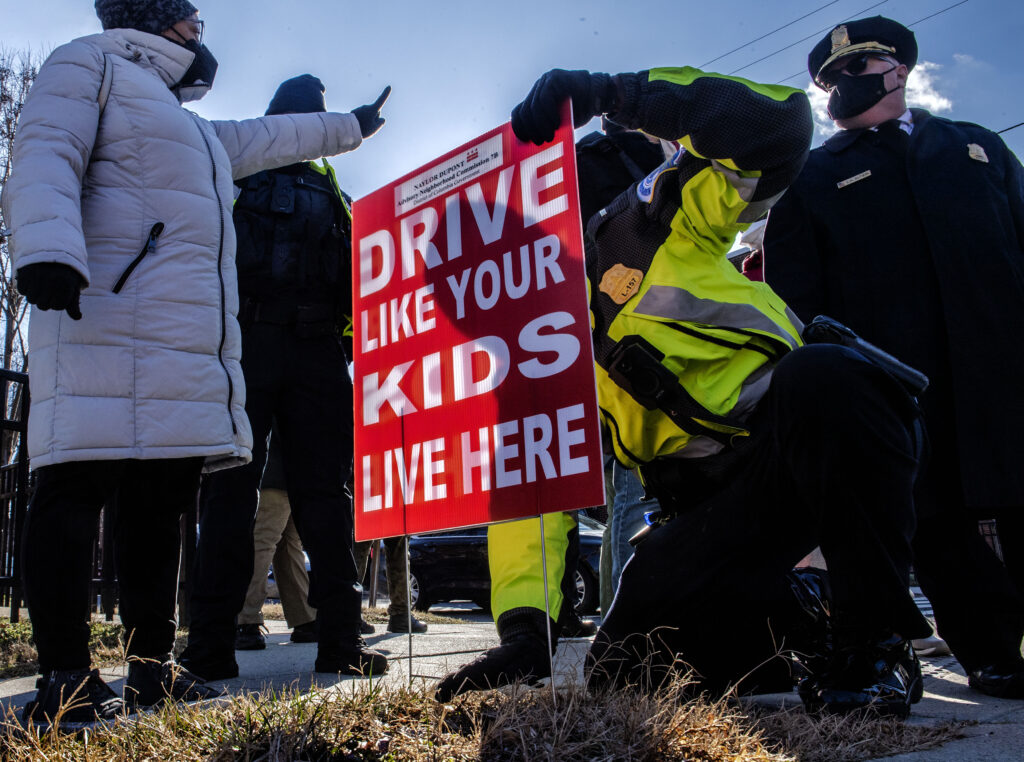
Pedestrians in D.C. who are near schools, especially children and teens, are more likely to be hit by a car or other vehicles than anywhere else in the city data analyzed by The Washington Post shows.
In the nearby suburbs of Maryland and Virginia, by contrast, young pedestrians were less likely to be struck near schools than elsewhere, The Post found.
Since 2022 in D.C., the likelihood of those crashes has been on a decline, but it remains higher than it was before the pandemic, underscoring concerns parents and advocates have raised for years about a need for more pedestrian safety measures in the nation’s capital, according to The Post analysis of D.C.’s crash data.
In areas within a tenth of a mile of a D.C. school, pedestrians are 24 percent more likely to be struck by a motor vehicle than those walking elsewhere in the city, the data shows. Children and teens are more than two times as likely to be hit near a school than in other parts of the city.
Low-income neighborhoods, in particular, have higher pedestrian accident rates near schools, the data shows, a trend that has prompted city officials to install traffic cameras in those areas in hopes of reducing speeds. The data was analyzed by only examining weekdays, when schools in the city are in session, and excluding summer breaks and holidays.
“It’s really a national kind of phenomenon in terms of higher crashes and fatalities happening in low-income communities of color, which is why we’ve been very focused on prioritizing our safety resources where they’re most needed,” said D.C. Transportation Department Director Sharon Kershbaum. “There’s more safety cameras because we have a big issue of traffic safety that we’re trying to address,” she said.
Data from INRIX, a transportation analytics company, indicates that speeds around most schools in the city have decreased since 2022, albeit only slightly and not during the morning rush hour. Between 7 and 8 a.m. on most weekdays, speeds remained flat or increased slightly near 45 out of 115 schools where traffic data was analyzed.
Alex Clark, a physical education teacher at Dunbar High School in Northwest Washington has been organizing “bike bus” rides for students since 2024 as a way to prevent pedestrian accidents.
“Dunbar is just a traffic nightmare,” Clark said of the school that is sandwiched between three major corridors near an entrance to Interstate 395.
“And then you also have more cars because of student drop-offs, you’ve got Ubers, you’ve got all of those things,” Clark said. Having a critical mass of students biking to school, instead of independently walking, helps keep them safe because they are easier for drivers to spot, he said.
The city passed legislation in 2022 that required DDOT to install new safety infrastructure around all public schools, including raised crosswalks and curb extensions, speed bumps and stop signs or traffic lights.
“That was when we actually had a lot more attention and resources,” Kershbaum said. A program that planned improvements at 8 schools a year now covers 25, including more expensive measures such as changing the direction of traffic. But implementation only began last year.
Also in 2022, residents in the Mount Pleasant neighborhood were able to get DDOT to close the portion of Newton Street in front of Bancroft Elementary School after several students walking nearby were nearly hit by cars.
Mark Simon, who lives in the Northwest Washington neighborhood, said city officials initially resisted that change out of concern that it would anger parents who drive their children to school and drop them off near the school entrance. “It was bureaucrats … who thought that it wouldn’t work,” he said.
After nine months of “pushing and pushing and pushing,” Simon said, an agreement was reached between the D.C. Transportation Department and the D.C. Public Schools system. Today, volunteers, mostly older residents, set up the barricades on Newton Street NW and keep out cars while the children walk before and after school.
Simon said he hoped the temporary road closure would become a model for other schools. But it didn’t. Principals elsewhere said they weren’t confident they could recruit enough consistent volunteers, and not every street is easily shut down during rush hour.
Kershbaum said DDOT doesn’t have the resources to shut streets down; because of a hiring freeze, the department had to pull traffic control officers away from rush hour management in other areas to help keep pedestrian children safe.
Council member Brianne K. Nadeau (D-Ward 1), who represents the area around Bancroft and helped get the road closure accomplished, said it was “incredibly difficult to do.”
“I love it,” she said of the twice-a-day arrangement. “It’s also hard to replicate equitably across the city.”
The issue of pedestrian safety has factored into the D.C. mayoral election. Both of the leading candidates in that race have advocated for ways to reduce such accidents, including through congestion pricing on D.C. roads aimed at reducing traffic in the city.
Council member Janeese Lewis George (D-Ward 4), sponsored the 2022 lawrequiring safety infrastructure near schools. In a statement she said that while dozens of schools have gotten improvements through the program, “much work remains.”
Lewis George is now vowing to designate some streets as “car-free” areas to allow for more pedestrian use, while expanding commuter bike lanes, if she’s elected mayor.
“Fulfilling our commitments to families requires sustained funding, expanded safety improvements, and continued oversight,” Lewis George said in her statement.
Former council member Kenyan R. McDuffie, who is also running for mayor, said he would push for safer street designs that are “people first,” including traffic-calming measures and better enforcement against reckless driving.
“We want safe streets across the District of Columbia,” McDuffie said during a recent interview with the “Dream City” podcast.
But, he said, he would eliminate “predatory” traffic cameras in some lower-income areas that lead to repetitive fines levied against local residents.
“The question is: Are the cameras about money and revenue, or are they about safety?” McDuffie said in the podcast. “Where the camera is about safety, it will remain, and where there are absences of cameras in places that are not safe, there will be new cameras. What there won’t be are cameras to generate revenue on the backs of hardworking people in the District of Columbia.”
Methodology:
The Washington Post collected 2017 to 2025 crash data from Maryland State Police, the Virginia Highway Safety Office and the D.C. Transportation Department. The data contained variables such as, age of those injured, if a pedestrian was involved and if speed or alcohol were involved. The data was cleaned and analyzed using R programming.
The Post analyzed crashes that occurred within a radius of one-tenth of a mile around each school. The Post then performed a relative-risk analysis that calculates the rate of crashes around schools and crashes outside of school zones.
The post Walking near a D.C. school raises the chance of being hit by a car, data shows appeared first on Washington Post.