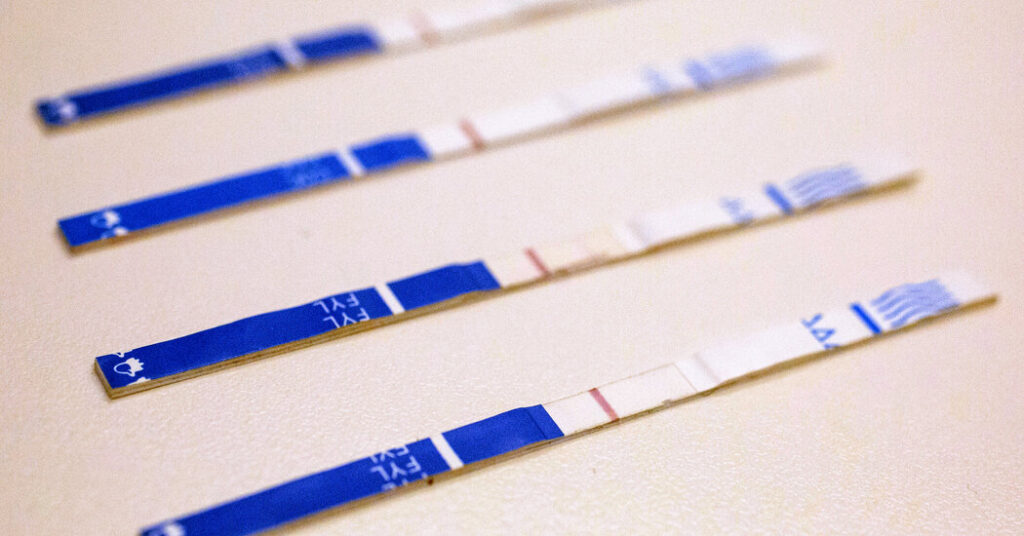
A simple strip of treated paper that can swiftly signal whether a street drug contains deadly fentanyl or other contaminants is a common overdose prevention tool, distributed widely on college campuses and at music festivals and community clinics. The federal government has championed test strips since 2021 and has paid to supply them to states, a position the Trump administration publicly embraced as recently as July.
But on Friday afternoon, the federal Substance Abuse and Mental Health Services Administration sent a letter to state health departments and grant recipients across the country, saying that the government would no longer pay for the strips because they are “intended for use by people using drugs.”
A copy of the letter was obtained by The New York Times.
The sudden policy reversal bewildered and alarmed administrators of programs that have routinely handed out test strips for years, hoping to stave off overdoses and encourage people who use drugs to exercise more caution. The strips can be used to test drugs ranging from crack cocaine to anti-anxiety pills.
“Having more information about drugs rather than less can really impact people’s behavior” including stopping them from taking something that might kill them, said Dr. Yngvild Olsen, the former director for the Center for Substance Abuse Treatment at SAMHSA, who now works as a health consultant.
“The drug supply now is unbelievably unpredictable,” she said. People might think they are using stimulants like cocaine and methamphetamine, she continued, but those drugs are increasingly cut with opioids and dangerous animal sedatives. “So they really need that information. ”
The policy shift highlights the growing tension over harm reduction, a drug policy approach introduced more than 25 years ago by grass-roots groups and later adopted by mainstream addiction medicine, and, finally, the Biden administration. The harm-reduction model maintains that interventions that make drug use safer have lifesaving merits, including the possibility that users might seek treatment.
But through executive orders and agency letters, the Trump administration has said that harm reduction measures encourage drug use, even as it had continued to support test strips, which cost about $1 each.
Asked about the letter informing states of the policy change, Emily G. Hilliard, a spokeswoman for the Department of Health and Human Services, which oversees SAMHSA, said: “This letter furthers the agency’s clear shift away from harm reduction and practices that facilitate illicit drug use and are incompatible with Federal laws.“
In the roughly 10 years since test strips were introduced, their use has grown considerably. At first people who used prescription opioids or heroin would rely on the strips to determine whether a notorious new drug — fentanyl — had been mixed into their supply. Now fentanyl and other synthetic opioids dominate the illicit street market. While many people eschew opioids, they may be seeking party drugs like ecstasy, or stimulants, like cocaine or methamphetamine. And they will use strips, to make sure that their drugs have not been cut with fentanyl.
“If you have no opioid tolerance, then fentanyl test strips really might be the tool for you: a tiny bit of fentanyl in an unprepared body could kill you immediately,” said Rachel Winograd, an associate professor of addiction science at the University of Missouri-St. Louis.
Test strips can also check for two very troubling animal sedatives coursing through the street supply: xylazine, which can prompt severe necrotizing wounds, and medetomidine, which causes hours of deep sedation and can lead to cardiac damage and prolonged hospital stays.
Nabarun Dasgupta, who runs the street drug analysis lab at the University of North Carolina at Chapel Hill, said he was worried about limiting testing for medetomidine, in particular, which is relatively new to the streets.
Often drug users don’t realize it is in their product. “So people trying to quit cold turkey are having heart attacks and being rushed to the hospital,” he said.
Studies that look at whether using the strips directly changes a drug user’s behavior show mixed results. In some, people reported that the strips had stopped them from using a drug that had fentanyl in it and had heightened their awareness of overdose safety practices. But another cautioned that a positive result for fentanyl encouraged risky behavior in some users.
“What’s interesting about test strips is that they can also help others, like providers, start a conversation about the risk of drug use, and options for people, including treatment,” Dr. Olsen said.
Last Friday afternoon, Dr. Winograd, who oversees a team that manages Missouri’s central warehouse for overdose prevention supplies, confirmed the usual $51,000 order for 80,000 test strips, which go to street outreach workers, drop-in and community centers and treatment programs, among others.
Scarcely an hour later, the SAMHSA letter landed in her inbox.
Jan Hoffman is a health reporter for The Times covering drug addiction and health law.
The post U.S. Government Will Stop Paying for Test Strips to Detect Deadly Drugs appeared first on New York Times.