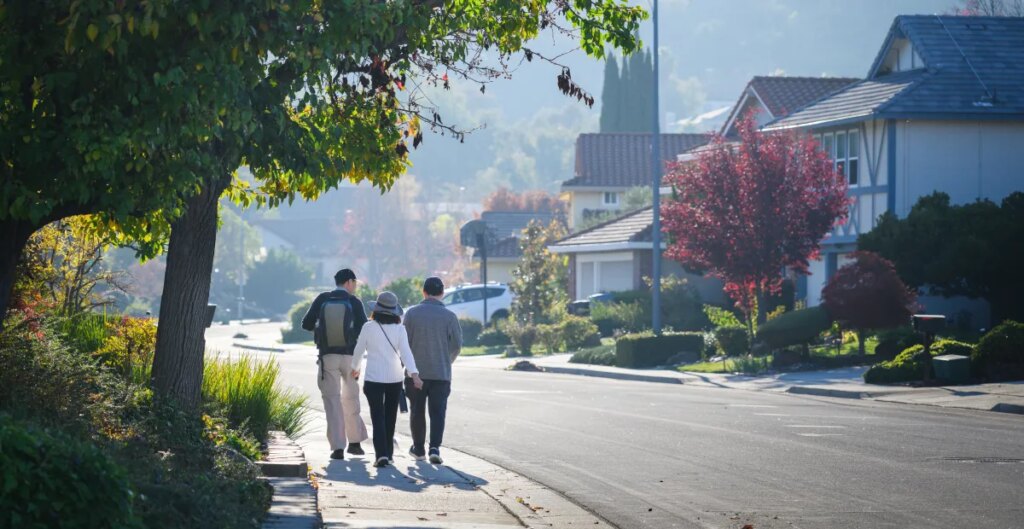
There are many ways you could measure the health of a city — its air quality index, its population growth, the number of jobs it added last year. My favorite is one not often high on the priority lists of city governments in the US: How safe is it to walk?
The US has the grievous distinction among peer countries as being one of the most dangerous places in the developed world for walking down the street. American pedestrians are killed by cars at three times the rate of Canadians, four times the rate of Brits and Australians, and more than 13 times the rate of Norwegians.
Last month, we finally got a bit of good news about pedestrian safety in America: About 11 percent fewer pedestrians were killed in the first half of 2025 — an estimated 3,024 people total — compared to the same period the previous year, according to a preliminary report published by the Governors Highway Safety Association (GHSA). That striking drop tracks a broader decline in total US car crash deaths last year.
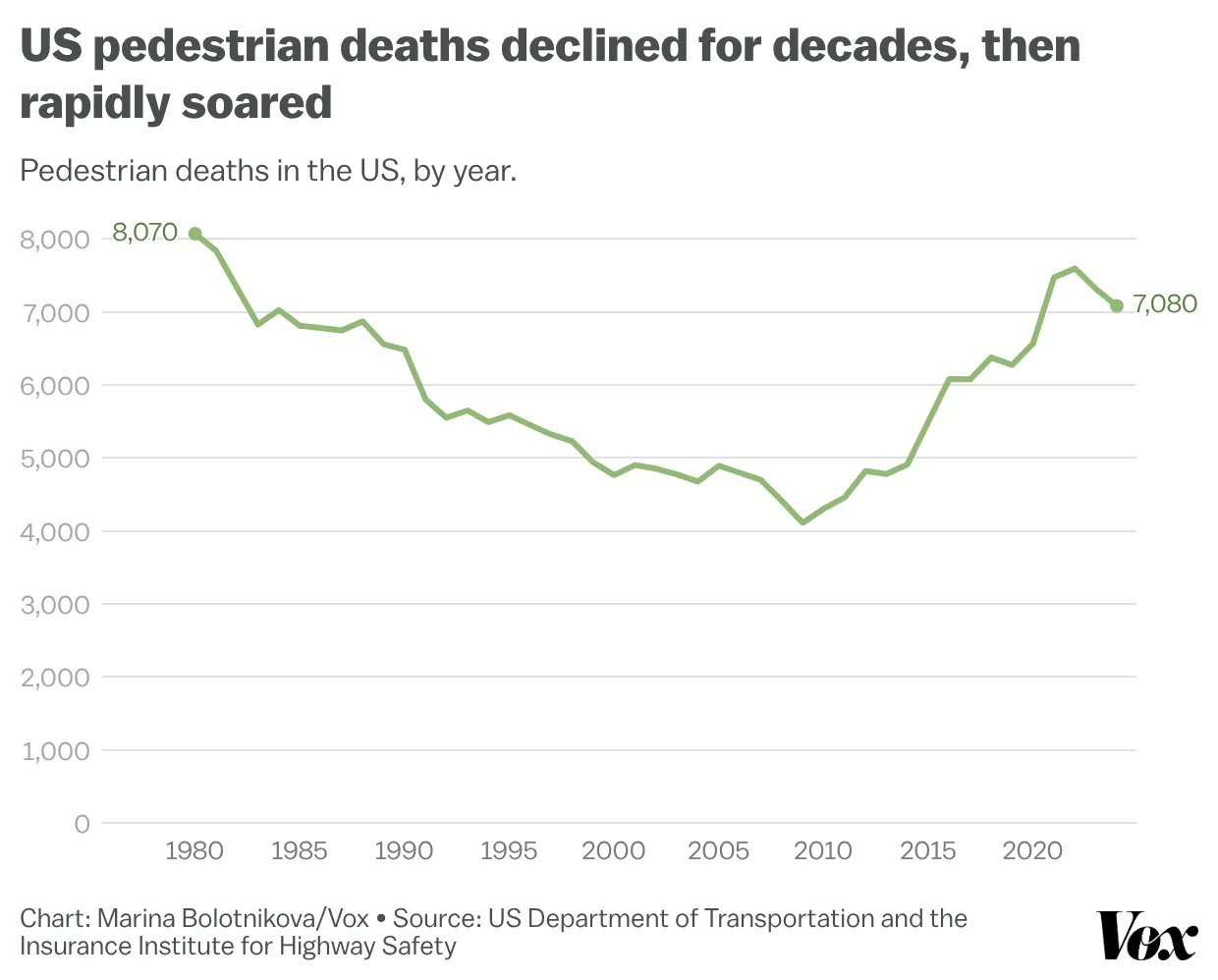
Any number of lives saved is worth celebrating, of course, but this is a case where a positive data point occludes a grimmer story. Road fatalities are likely only falling so steeply because just a few years ago, the US saw a rapid, pandemic-era rise in the number of people killed by cars. In 2021, 7,470 pedestrians were killed in crashes, up from 6,565 in 2020 and 6,272 in 2019. We’re now climbing down from that unusually deadly period, but pedestrian deaths in the first half of 2025, GHSA reports, are still higher than they were in similar periods pre-Covid.
The ubiquitous killing of pedestrians on American streets preoccupies me like almost nothing else, but “pedestrian” strikes me as a uniquely terrible term (unless I’m using it to insult someone). Adam Snider, director of communications for GHSA, who talks about pedestrian deaths among other road safety issues for a living, hates the word, too. “We are all pedestrians,” he recently wrote. “The moment you step out of your car, off the bus, or out your front door — you’re one too” (inclusive, of course, of people who get around in wheelchairs, children in strollers, and others). Our ability and need to walk is one of our deepest human inheritances, Rebecca Solnit wrote in her book Wanderlust: A History of Walking. It is, she wrote, “the intentional act closest to the unwilled rhythms of the body, to breathing and the beating of the heart.” And getting killed in that most vulnerable, most human state is “visceral, it’s sudden, it’s violent,” Snider told me. “It’s an awful way to die.”
For all those reasons, although all car crash deaths are preventable tragedies, the US transportation system’s endangerment of pedestrians strikes me as uniquely obscene. Pedestrian fatalities may not be at the top of the list of causes of death in the US, but they punch above their weight in significance because they are an indicator of deeper problems in American quality of life that set us apart from peer countries that are far less wealthy.
Our weird hostility to walking is an assault on human dignity. Americans would all be better off if our built environment made it safe, convenient, and dignified to walk as a major mode of transportation in both cities and suburbs. We would be healthier, our air and climate would be less polluted, and our cities would be more pleasant, socially connected places to live. And making the changes required to kill fewer pedestrians would make car occupants safer, too, and help put a real dent in America’s ridiculously high rate of death by cars.
Why did US pedestrian deaths get so high?
Over the long haul, the US, like other rich countries, has made a lot of progress on traffic safety, thanks to safer car engineering, the widespread adoption of seatbelts, and people simply driving around drunk less often. US traffic fatalities generally trended significantly downward over the last half-century, up until the pandemic. Which isn’t to say that our record is particularly good now — even at today’s fatality rates, at one of the safest times it’s ever been to ride in a car, Americans face a 1 percent lifetime risk of dying in a car crash.
And even as drivers and other people inside cars themselves have become safer, pedestrian safety began to diverge sharply from that of car occupants in the 2010s. In 2009, federal statistics recorded 4,109 pedestrians were killed by cars; by 2019, it shot up 53 percent to 6,272, a number that hadn’t been seen for nearly 30 years. (The true number of deaths is even higher than this because the National Highway Traffic Safety Administration doesn’t count people killed by cars in places like driveways and parking lots. The National Safety Council estimates the total number of pedestrian deaths are likely about 24 percent higher than NHTSA numbers show.) As a result, these deaths have made up an increasingly large share of total car fatalities over the last few decades, from 11 percent in the early 2000s to about 18 percent in 2025. None of this has happened in other wealthy countries, nearly all of which brought down their pedestrian fatality rates in the 2010s rather than raise them.
Why did it suddenly become so much more dangerous to be a pedestrian in America? There’s almost certainly no single reason, but most experts I’ve spoken to over the years have pointed to the growing popularity of SUVs and pickup trucks, which have soared in popularity and now make up an overwhelming share of car purchases in the US. These vehicles often make it harder for drivers to see pedestrians, and they’re more likely to seriously injure or kill people on foot because of their added weight and height.
“You can take the same speed crash and break some legs, or you can take the same crash speed and crush some ribs and destroy someone’s organs,” said Stephen Mattingly, a professor of civil engineering at the University of Texas at Arlington, describing the difference between being hit by a stout sedan and a tall SUV.
In a recent interview with Bloomberg, University of New Mexico engineering professor Nick Ferenchak, one of the country’s leading researchers on pedestrian and bicyclist safety, pointed to another, intriguing theory: Maybe there are just more pedestrians now. Not because Americans have suddenly discovered a love of long walks, but because an increasing number of people living outside pedestrian-friendly city centers can’t afford to get around any other way.
“There is a lot of evidence pointing to suburbanization of poverty being an important factor,” he said, with a growing share of low-income people who may not be able to afford cars living in suburbs where everyone is expected to get around by car. It is often especially dangerous to walk along the wide, high-speed roads ubiquitous in American suburbs, which are not designed to safely accommodate pedestrians and where drivers don’t expect to encounter people on foot.
But whether or not pedestrian volumes have increased enough to explain much of the sudden rise in deaths is hard to know. The US closely tracks the total number of miles driven by all cars in the country every year — a statistic known as vehicle miles traveled (VMT) — but we don’t have an equivalent “total miles walked” denominator for pedestrians.
Can the US ever change?
One reason cars kill so many people in the US is because we drive so much. Large steel boxes traveling at 50 miles per hour are inherently dangerous, and when we build a transportation system that prioritizes the rapid movement of cars and marginalizes other forms of getting around, we should not be surprised when the results are very deadly. But during the pandemic, something unexpected happened: total driving across the country dipped, but we saw a spike in crash deaths. Overall car fatalities increased by 7 percent in 2020 and another 11 percent in 2021, and pedestrian deaths similarly shot up.
The most widely accepted theory for why this happened is that in normal periods, routine traffic congestion slows cars down. But without road congestion during Covid, it suddenly became possible for drivers to go really fast and cause more fatal crashes — a shift that was enabled by the very design of roads in the US. That emptier roads so easily turned into deadlier ones displayed some of the fundamental flaws in the American approach to transportation: The same fatality spikes generally didn’t happen in peer countries, which had been prioritizing road safety in the decades prior, particularly the safety of people outside cars, and took steps to slow traffic on their roads because speed is the central variable that makes crashes deadly. They lowered speed limits and, to ensure the new speed limits were actually followed, embraced traffic calming measures like narrower roads to make speeding physically infeasible.
In the 2010s, many US cities took up Vision Zero, a campaign to eliminate traffic deaths that was originally conceived in Europe in the 1990s. It rejects the premise that deaths by car cannot be avoided, and emphasizes designing transportation systems where people don’t encounter conditions in which someone’s split-second mistake can easily turn fatal. But Vision Zero’s implementation has largely been regarded as a failure in America, in part because it is so hard to get the public to accept changes to road design that inconvenience cars. Traffic enforcement cameras also make a significant difference in deterring speeding in countries where they’re widely implemented, but in the US, they’re culturally anathema and in some places are even banned at the state level.
Mattingly, the civil engineering professor, at times sounds despairing when he talks about the prospect of making it safer to walk in the US: “The public generally don’t consider pedestrians valuable because they’re just getting in the way of them being able to drive fast to where they want to go,” he said. “And that is an incredibly bitter pill to try to swallow.”
It would be hard to deny that car fatalities generally, and pedestrian safety especially, lacks salience in the US. More than twice as many pedestrians may die here each year than the number killed in the 9/11 terrorist attacks, but these deaths occur scattershot and just infrequently enough that they can feel to many like an inevitable cost of modern transportation, rather than a policy choice. As long as that’s the case, it will be hard to change the car-dominated, 20th-century planning paradigm that prevails in the US, even as most urban planners now agree it was a mistake.
But the US need not become Amsterdam to save many people’s lives — remember that Canada and Australia, with post-war, car-dependent built environments similar to those found in the US, manage to kill many fewer pedestrians than the US does. On the margins, there are certainly technological fixes that could make a dent in the problem without fundamentally altering the American urban form or sacrificing the convenience of drivers. Automatic emergency braking that detects pedestrians, which is now being widely adopted in new cars in the US, can reduce deadly collisions considerably, though it’s still far from perfect. Judging from Waymo’s record, self-driving cars, too, are likely to be a lot safer for pedestrians than human-driven ones — although many experts, including Mattingly, worry that widespread adoption of driverless vehicles could further entrench the marginalization of pedestrians, if we don’t make the active choice to prioritize non-motorists.
In the long run, America ought to have bigger aspirations for the future of walking. That calls not just for technological shifts, though we surely need those, but for a philosophical one as well. Countries that have minimized pedestrian deaths have embraced walking as a wondrous, efficient transportation technology that for the last century has been wrongly sidelined by the automobile. Walking is, as Solnit wrote, “a state in which the mind, the body, and the world are aligned.” The transportation system of the future, if we want it, will allow it to flourish again.
The post The surprising reason why pedestrian deaths are down in the US appeared first on Vox.