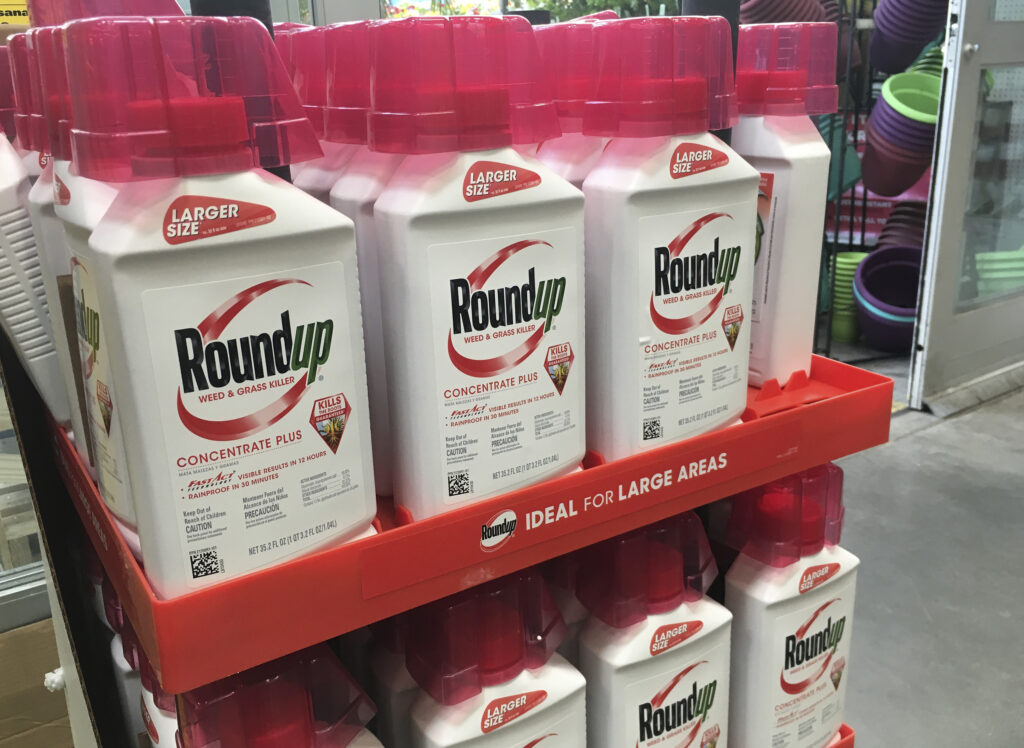
The Supreme Court on Monday wrestled with whether federal law preempts judges and juries from weighing claims from tens of thousands of cancer victims that the popular weed killer Roundup caused their disease and the chemical giant Monsanto failed to properly warn them about the health risks.
The case argued before the justices dealt with a prosaic legal question, but one with enormous consequences. The court will determine the fate of one of the largest waves of product liability litigation in the nation’s history. Billions of dollars are at stake, as well as the future of a chemical the nation’s largest farm group says is so important that ending its use would threaten America’s food supply but many environmentalists assert is toxic.
The justices seemed to lean toward restricting the lawsuits, but they asked tough questions of both sides and the outcome remains unclear.
At the heart of the case is glyphosate, the active ingredient in Roundup and other name brands that has been used as an herbicide since the 1970s. Roundup is one of the most widely used weed killers in the world.
The Environmental Protection Agency has found repeatedly over decades that glyphosate does not cause cancer in humans, but in 2015 a prominent cancer research group associated with the World Health Organization and United Nations determined glyphosate was “probably carcinogenic to humans.”
The finding led some countries to ban the herbicide and touched off a flood of lawsuits against Roundup’s maker, Monsanto. The company, which is now owned by the German conglomerate Bayer, denies Roundup causes cancer. More than 100,000 lawsuits have been filed in American courts, and Bayer has spent about $11 billion on settlements to date.
The case before the Supreme Court involves one of those lawsuits.
John Durnell sued Monsanto in Missouri state court in 2019, alleging exposure to Roundup had caused his non-Hodgkin lymphoma, a form of blood cancer. Durnell used Roundup to spray weeds in parks near his St. Louis home for two decades before his diagnosis.
Durnell’s suit claimed Monsanto had a duty to warn consumers that Roundup was a cancer risk.
“Monsanto has known for decades that its popular weed killer, Roundup, can cause cancer,” Durnell’s attorneys wrote in a Supreme Court filing. “But the company has refused to make its product safer or to inform consumers that they should exercise caution when using it. Instead, Monsanto has marketed Roundup as safe to spray in a t-shirt and shorts.”
Durnell points to findings that Monsanto relied on fraudulent studies to obtain Roundup’s approval. The leaders of the laboratory that performed the study were later convicted of fraud. The fraud became public in 1976, but Monsanto did not disclose it to customers subsequently.
A Missouri jury ruled for Durnell, awarding him $1.25 million in damages. An appeals court rejected Monsanto’s appeal, before the company eventually asked the Supreme Court to take up the case.
Such lawsuits have prompted Monsanto to remove Roundup from the consumer market, but it is still available to farmers. Monsanto says allowing additional suits to go forward could prompt additional action.
“The continuing overhang of these lawsuits threatens Monsanto’s ability to continue to supply glyphosate to farmers who need it to remain world leaders in food production,” Monsanto wrote in its petition to the Supreme Court.
That assessment was backed by the American Farm Bureau Federation in a friend-of-the-court brief, which said the demise of Roundup could force its members to rely on herbicides with even greater health risks.
“To remove glyphosate from the market would pose an immediate, devastating risk to America’s food supply,” the bureau wrote. “Farmers depend on this safe herbicide to support high-yield food and fiber production, season after season. Glyphosate is used on roughly 300 million acres of U.S. farmland.”
Some farm workers’ groups, cancer prevention organizations and environmentalists say Roundup poses substantial risks and should be labeled as causing cancer. Some rallied outside the Supreme Court Monday.
“Cancer is an epidemic, afflicting more than 1 in 3 Americans within their lifetimes,” the Center for Food Safety and other groups wrote in a friend-of-the-court brief. “The Court should not afford Monsanto immunity for its products’ risks … and deny Americans their right to know the risks of an inherently dangerous product.”
Paul Clement, an attorney for Monsanto, told the justices that the Federal Insecticide, Fungicide and Rodenticide Act (FIFRA) that regulates the sale and marketing of pesticides preempts the state-court judgment.
Under FIFRA, a company must submit studies and safety data that show an herbicide carries no “unreasonable risk” to human health or the environment to get approval from the EPA to sell the product. The EPA also signs off on a label, which is barred from featuring false and misleading statements. The manufacturer must seek EPA approval for any substantive changes to the label.
The law recognizes states retain their ability to regulate pesticide sale or use, provided a state’s rules don’t conflict with EPA or FIFRA regulations. But it bars states from requiring any additional labeling, not mandated under FIFRA. Clement argued in court the EPA has consistently found Roundup does not cause cancer, so it was not required to warn consumers of an alleged cancer risk and could not be held liable for not doing so.
“A Missouri jury has told us that a cancer label that is not required to be put on the label is required to be put on the label,” Clement said.
That argument seemed to gain traction with some of the justices, who questioned how companies could comply with different labeling requirements from the federal government and states. One of the goals of FIFRA was to establish a single labeling requirement.
“Do you think it’s uniformity if different states require different things?” Justice Brett M. Kavanaugh asked.
The Trump administration is backing Monsanto’s position. That represents a shift from the Biden administration, which supported Durnell. Deputy Solicitor General Sarah M. Harris told the justices that FIFRA requires federal law to take precedent over state restrictions on herbicides.
“State law must give way,” Harris said.
The post Supreme Court considers blocking lawsuits alleging weed killer causes cancer appeared first on Washington Post.