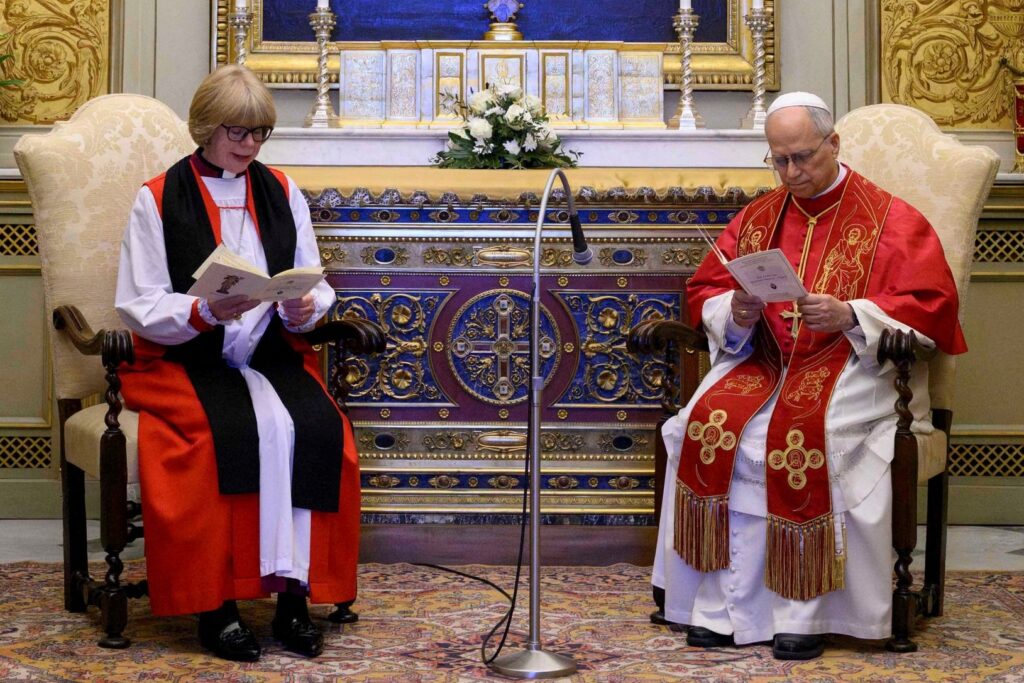
ROME — Archbishop of Canterbury Sarah Mullally, the first female spiritual leader of Anglicans around the globe, met and prayed Monday with Pope Leo XIV in a closed-door encounter at the Vatican that signaled both the promise and limits for women in Christian faiths.
The papal audience was the highlight of a four-day Roman pilgrimage by Mullally, a 64-year-old former nurse who broke the stained-glass ceiling in March with her enthronement as primate of the Church of England and touchstone for the global Anglican Communion. Following the private audience, her office said, she joined Leo in prayer inside the ornate, 17th-century Chapel of Urban VIII at the Apostolic Palace.
Mullally stood publicly in solidarity with the pope this month after he was upbraided by President Donald Trump in response to the pontiff’s withering criticism of the U.S.-Israeli war in Iran, and during the visit on Monday she reiterated her own message of peace.
“In the face of inhuman violence, deep division and rapid societal change, we must keep telling a more hopeful story,” she declared in her Vatican address.
Her journey to Rome is her first international trip as archbishop, and it comes some 60 years after a landmark thaw between the faiths saw Pope Paul VI become the first pontiff to hold an official meeting with an archbishop of Canterbury since the 16th century, when Henry VIII broke with Rome.
Hopes that Catholicism, with 1.4 billion adherents worldwide, and Anglicanism, with 85 million faithful globally — might reunify have failed to materialize in the decades since, in part because of sharp differences over the role of women.
In his address to the archbishop on Monday published by the Vatican, Leo said: “While much progress has been made on some historically divisive issues, new problems have arisen in recent decades, rendering the pathway to full communion more difficult to discern. … For my part, I add that it would also be a scandal if we did not continue to work towards overcoming our differences, no matter how intractable they may appear.”
Mullally’s appointment has divided the church she serves, which was already riven by the issue of female clergy. But while she embodies the hard-won progress of women in Anglicanism, on Monday she interfaced with a Catholic Church that repeatedly has rejected the ordination of women. Leo, in his first year as pope, has shown little appetite for changing an all-male clergy.
“I hope that this normalizes the image of a woman in a high ecumenical role and that it will sort of plant a seed,” said Kate McElwee, executive director of the Women’s Ordination Conference, a group pressing for the ordination of woman in the Catholic church. “Maybe it will be a reminder to the Catholic Church that this is an unsettled question … maybe for Leo personally it will inspire him to find more courage and to act boldly.”
Catholic churches in various parts of the world are suffering a chronic shortage of priests and deacons, a shortfall that advocates say the church could easily address by ordaining women. Yet in recent years, the prospect of women as priests has not been seriously discussed. The notion of ordained female deacons performing baptisms, witnessing marriages, presiding at funerals and preaching the homily at Mass has received a more thorough airing, but it repeatedly has hit a brick wall.
Before his death, Pope Francis showed openness to continued discussion on the topic while also clearly ruling out any change during his papacy. Most recently, a Vatican committee in December again recommended against the idea, saying “historical research and theological investigation … rules out the possibility of moving in the direction of admitting women to the diaconate.”
Leo, like Francis, has promoted women to senior positions at the Vatican and frequently celebrated the role of women in the church. But asked about female ordination last summer for a book by the Catholic journalist Elise Ann Allen, he said: “I at the moment don’t have an intention of changing the teaching of the Church on the topic.”
Still, some said the meeting with Mullally was an important symbol. “I think the optics of it are significant, and I think the Vatican knows that,” said Anna Rowlands, a British theologian who is a member of the Vatican’s Dicastery for Promoting Integral Human Development. But, Rowlands added, “I certainly don’t believe that Leo is sitting on fundamental support for the ordination of women. I don’t believe that will be part of the plan for his pontificate.”
Some traditionalist Catholic bloggers were scandalized by what they saw as the “special treatment” afforded to Mullally by the Vatican during her trip — a reaction that suggests the extent of opposition to female clergy. Her program included a weekend visit to St. Peter’s Basilica — the spiritual heart of the Catholic Church — in which she was photographed offering a benediction in a sacred space behind the Tomb of St. Peter while a senior Vatican cleric bowed his head.
Describing Mullally as a “secular woman” who “now pretends to be” the “religious leader of the schismatic Anglican Community,” Lorenzo Vitali, a writer for the traditionalist Italian-language Mass in Latin blog, decried the scene near the tomb as “a false and sacrilegious blessing.”
The Anglican Communion itself remains divided over women clergy — especially bishops — and Mullally’s appointment has stirred the pot in ways that could offer lessons for Catholics.
After decades of mounting pressure, the major gathering of the Church of England in 1992 voted to allow female priests, triggering a backlash that persists to this day. Even as the faith blazed a trail for gender equality in religious vocations — approving female bishops in 2014 — dioceses that object to female clergy have been given dispensation to worship only under men.
Following Mullally’s selection last year, conservative Anglicans, including many in Africa, stopped short of threats to name a “competing spiritual leader.” But they did move forward with a new leadership council headed by a male Rwandan archbishop.
On Monday, Mullally offered three gifts to the pope — an antique edition of a book by St. John Henry Newman, a Catholic convert from Anglicanism who was canonized in 2019, a jar of honey from her official London residence and a traditional Peruvian Nativity scene — a nod to the Chicago-born pope’s adopted homeland, Peru.
Thus far, Mullally is seen to be guiding her church with a focus that in many ways is comparable to Leo’s. They have both pivoted around themes of peace and unity. “I think those are themes that they will find a close bond over,” Rowlings said.
The post Pope Leo meets Sarah Mullally, first woman to be archbishop of Canterbury appeared first on Washington Post.