In the chaotic swirl of events after President John F. Kennedy’s assassination, doctors feared that Vice President Lyndon B. Johnson had suffered a heart attack upon arrival at Parkland Memorial Hospital in Dallas. The signs were ominous: Johnson’s face was ashen, and he was clutching his chest. “There was the real possibility that the No. 3 in the line of succession would become president,” the historian Michael Beschloss told me. Johnson was reportedly examined and a heart attack ruled out—but not before then–House Speaker John McCormack was told that he might be the next president. The declaration prompted a severe bout of vertigo in the 71-year-old.
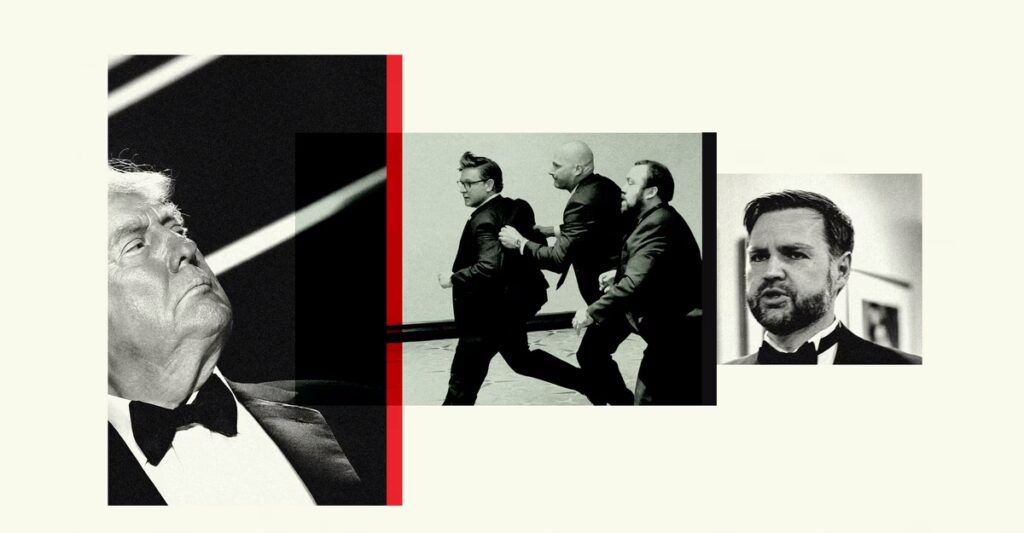
Few moments in history have so starkly exposed the vulnerabilities of the presidential line of succession—or the lack of clarity about how it is protected. Last night provided another illustration of them. If events at the White House Correspondents’ Association Dinner had gone differently, a gunman who breached security at the Washington Hilton could have reached a ballroom containing an unusually dense cluster of American power. The president and the vice president were seated a few feet apart. Congressional leadership and many Cabinet secretaries were also on hand. In other words, much of the presidential line of succession was in the same spot—and subject to the same vulnerabilities.
Senator Chuck Grassley, 92 and third in line as president pro tempore of the Senate, was home in Iowa—his absence briefly making him one of the most important people in the country. The Correspondents’ Dinner is built for symbolism: the press, the presidency, and Washington’s political elite gathered in a single room, putting their differences aside in celebration of the First Amendment. But the failed attack highlighted the typically unspoken peril of such a gathering, with so many figures in the line of succession crammed into a ballroom packed so tightly with tables, chairs, and people that it was hard to move around—much less duck for cover.
Jonathan Wackrow, a former Secret Service agent who served on the presidential detail, told me that the system for protecting the president—and those who might replace him in the event of incapacity—is far more fragmented than it appears. Responsibility for protecting senior officials is divided across multiple agencies: the Secret Service, the Capitol Police, and departmental security teams, each operating with different mandates and chains of command. That system functions best when those requiring protection are dispersed. When they converge, it runs the risk of lapses.
“These acute shock moments make it reasonable to reintroduce a conversation,” Wackrow told me. “Should we have all of these political leaders—especially those who are in the line of succession—crammed together in one location?”
[Read: A dark new litmus test for power in Washington]
A 2003 report by the Continuity of Government Commission warned that in the event of a catastrophic strike on Washington, a large portion of the presidential line of succession could be killed at once. It also noted a deeper constitutional ambiguity: The inclusion of congressional leaders in the line of succession raises both separation-of-powers concerns and the possibility of abrupt partisan shifts in control of the executive branch. The presidential historian Tim Naftali told me that gathering the president, vice president, and speaker in the same space when the United States is at war with Iran—a country previously linked to plots against Trump and other U.S. officials—was ill-advised. “This is not the right time to have all hands on deck,” he said.
That vulnerability is magnified in settings like Saturday’s dinner—which unlike inaugurations or the State of the Union address was not designated a National Special Security Event, the Secret Service told me. That designation, granted by the Department of Homeland Security, triggers a full federal-security architecture, Wackrow explained: integrated command structures, airspace restrictions, counter–chemical and biological monitoring, and coordinated intelligence fusion across agencies. Without it, planning is thinner, less centralized, and more dependent on venue-specific security, he said. (DHS and the White House did not immediately respond to my request for comment.)
Wackrow pointed to what he calls “consequence management”—the often overlooked challenge of what happens after prevention fails. A crowded ballroom that can hold more than 2,000 people is, by design, difficult to evacuate quickly. Exits can funnel into choke points. Movement could become dangerous amid panic. Even a contained incident can cascade into chaos simply because the geometry of the space works against rapid response.
The modern system of succession was designed to anticipate worst-case scenarios—but only in fragments. The Presidential Succession Act of 1947 reordered the line of succession to place elected officials—the speaker of the House and the president pro tempore of the Senate—ahead of Cabinet officers. (The secretary of state and secretary of the Treasury are next to follow.) The Twenty-Fifth Amendment, ratified in 1967, filled another gap, creating a formal process for presidential incapacitation and vice-presidential replacement. But both were reactive fixes, assembled after earlier crises exposed what the system had failed to imagine.
During the Cold War, officials confronted one version of the problem more directly. The concept of a “designated survivor”—a Cabinet member excluded from major events like the State of the Union—emerged from fears of nuclear war. In the late ’50s, the U.S. government quietly built a massive fallout shelter beneath the Greenbrier Resort in West Virginia. Code-named “Project Greek Island,” it was designed to shelter the entire Congress if Washington were wiped out in an attack, complete with dormitories, committee rooms, and temporary House and Senate chambers carved into the mountains.
For decades, it sat in plain sight, beneath the luxury hotel—hidden in a space built for the sole objective of government continuity in the event of catastrophe. The bunker was taken out of service soon after its existence was revealed by The Washington Post in 1992; it’s now a Cold War relic of how seriously Washington once planned for the continuity of constitutional government. What those plans did not fully solve was a more ambiguous modern risk: mass vulnerability, without warning, in civilian settings.
That gap persists, though there have been attempts to close it. The 1968 assassination of Robert F. Kennedy in the kitchen of the Ambassador Hotel in Los Angeles led to Secret Service protection for presidential candidates. In 1975, President Gerald Ford survived two attempts on his life in California. Six years later, the shooting of President Ronald Reagan outside the Washington Hilton—the same hotel that hosted last night’s dinner—led to the elimination of its exposed VIP entrance in favor of a stone-enclosed driveway. “We have learned from history,” Naftali told me.
But that accumulated wisdom is undermined, he suggested, by a basic lapse. Gathering so many leaders in the same place, at the same time—particularly during wartime—“is not a good idea,” he said. Beschloss put it bluntly: Elected officials are reluctant to highlight their own vulnerability. “They are afraid it will make them look afraid or too distant from other Americans,” he said. But, he added, “we can’t allow national tragedies to become more likely”—a tension that becomes sharper as political violence becomes more routine.
After the January 6 attack on the Capitol, the 2021 inauguration of President Biden took place behind fortified perimeters, lined with thousands of National Guard troops. Beschloss argued that if ever there were a time to hold an inauguration indoors, that was it. But Biden sought to demonstrate the importance of a peaceful transfer of power, even if it was conducted under conditions that resembled a security operation more than a civic celebration.
[Read: Biden’s inauguration is the most militarized since 1861]
The lesson, continuity experts argue, is not that public events should disappear. It is that the system still struggles to reconcile two competing imperatives: visibility and survivability.
Some officials have begun to say so explicitly. Representative Michael McCaul questioned earlier today whether it makes sense for the president and vice president to appear together at events like the Correspondents’ Dinner, noting that a single explosion could have killed multiple officials in the line of succession. Senator John Fetterman, who attended the dinner, argued on social media that the venue was not designed to safely accommodate so many senior officials, suggesting the need for more secure, purpose-built spaces—like the White House ballroom the president is currently fighting to build. (The Correspondents’ Dinner is organized by the White House Correspondents’ Association, not the White House).
But in the short term, it’s not clear how much will actually change. Acting Attorney General Todd Blanche insisted on ABC News that “the system worked,” emphasizing that law enforcement prevented catastrophe and that democratic leaders must continue to appear in public spaces.
He said on CBS’s Face the Nation: “We will not stop doing things like we did last night in this administration.”
The post Maybe the Most Senior Members of Government Shouldn’t Be in the Same Room appeared first on The Atlantic.