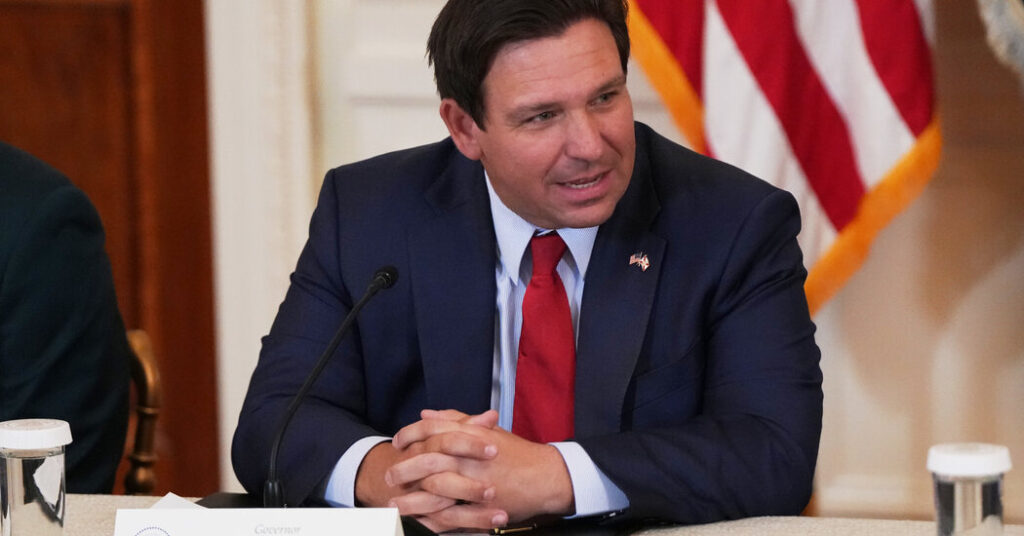
Gov. Ron DeSantis of Florida proposed a redraw of the state’s congressional districts on Monday that could give Republicans as many as four new seats, an aggressive gambit that could also set the party up for some losses in the November midterms.
The map appears to eliminate two Democratic-held districts in South Florida, a third in the Tampa area and a fourth in the Orlando area, leaving Democrats with perhaps only four of the state’s 28 congressional seats. There are currently seven Florida Democrats in Congress; an eighth, former Representative Sheila Cherfilus-McCormick, resigned last week after being charged with embezzlement.
Florida, which does not hold primary elections until August, is the last state aiming to redraw congressional maps ahead of the midterms. A Supreme Court decision expected soon on a key provision of the Voting Rights Act could provide opportunities for other states to do so, but with many holding primaries in the next month or two, time is running out.
Mr. DeSantis’s map, initially made public without detailed county borders or other critical information, was first reported by Fox News, which received the map before the State Legislature did Monday morning. Lawmakers are scheduled to meet in a special redistricting session starting Tuesday, which means they have less than 24 hours to examine the proposal before they convene.
The short turnaround is likely to upset some state lawmakers, few of whom have expressed much interest in redistricting, as well as many members of the Florida congressional delegation, who will have to introduce themselves to new voters between now and the midterms. State lawmakers are not expected to propose any maps of their own, but rather to vote on Mr. DeSantis’s redraw as early as Wednesday. It is almost certain to pass, given the Republican supermajorities in the State House and Senate.
Should the map pass, it could give Republicans nationwide an edge of roughly two to four seats heading into the midterms. That would hardly be the multiseat advantage that President Trump and national Republicans envisioned when they kicked off the national redistricting battle in Texas last summer.
But should the fight for the U.S. House come down to a few districts, any seat that flips from Democrat to Republican could prove critical. Republicans currently control the chamber by just a handful of seats.
Any redistricting effort in Florida faces a significant legal hurdle. In 2010, voters in Florida passed the Fair Districts amendments, which effectively ban partisan gerrymandering in the state. Mr. DeSantis told Fox News that his proposed map — colored red and blue to indicate the expected political leanings of new districts — “more fairly represents the makeup of Florida today.”
In a letter to legislative leaders on Monday, David Axelman, the governor’s general counsel, reiterated Mr. DeSantis’s position that Florida should have received at least one additional congressional seat after the 2020 census. Mr. Axelman also said that the state’s existing map had been “distorted by considerations of race.” In the Voting Rights Act case before the Supreme Court, the court’s conservative majority has signaled that it might prohibit using race as a factor in drawing election districts.
Representative Hakeem Jeffries of New York, the Democratic minority leader, said last week that if Florida Republicans redrew the state’s congressional map, it would “only create more prime pickup opportunities for Democrats.”
“We will aggressively target for defeat Mario Diaz-Balart, Maria Elvira Salazar, Carlos Giménez, Kat Cammack, Anna Paulina Luna, Laurel Lee, Cory Mills and Brian Mast,” he said, referring to Republican House members throughout Florida. “We are prepared to take them all on, and we are prepared to win.”
In a new statement on Monday, Mr. Jeffries said, “See you in court.”
Though the new maps can simply be passed by the Legislature and will not go before voters, recent polling in Florida showed a majority of likely voters in the state were opposed to drawing new maps before the midterms. A poll from Emerson College this month found that Florida voters, by a slim margin, said it was a “bad idea” to redraw maps in the middle of the decade.
Some Republicans in the state have expressed reluctance to draw new maps this year. Such worries grew after special elections this year in which Democrats flipped a State House district that includes Mr. Trump’s Mar-a-Lago estate in Palm Beach, and a State Senate district near Tampa.
“I think the Legislature needs to be very cognizant of the fact that if they get too aggressive,” Representative Greg Steube, a Republican from Southwest Florida, told Politico in late March, “you could put incumbent members at risk.”
Mr. DeSantis’s map appears to eliminate the lone Democratic district near Tampa, currently held by Representative Kathy Castor. It also packs Democratic voters in Orlando into a single district, appearing to eliminate the seat currently held by Representative Darren Soto. The Orlando district that would remain intact under the proposal is held by Representative Maxwell Alejandro Frost.
The proposal also appears to eliminate the South Florida districts held by Representatives Jared Moskowitz and Debbie Wasserman Schultz.
Patricia Mazzei is the lead reporter for The Times in Miami, covering Florida and Puerto Rico.
The post DeSantis Proposes Florida House Map That Could Add Four Republican Seats appeared first on New York Times.