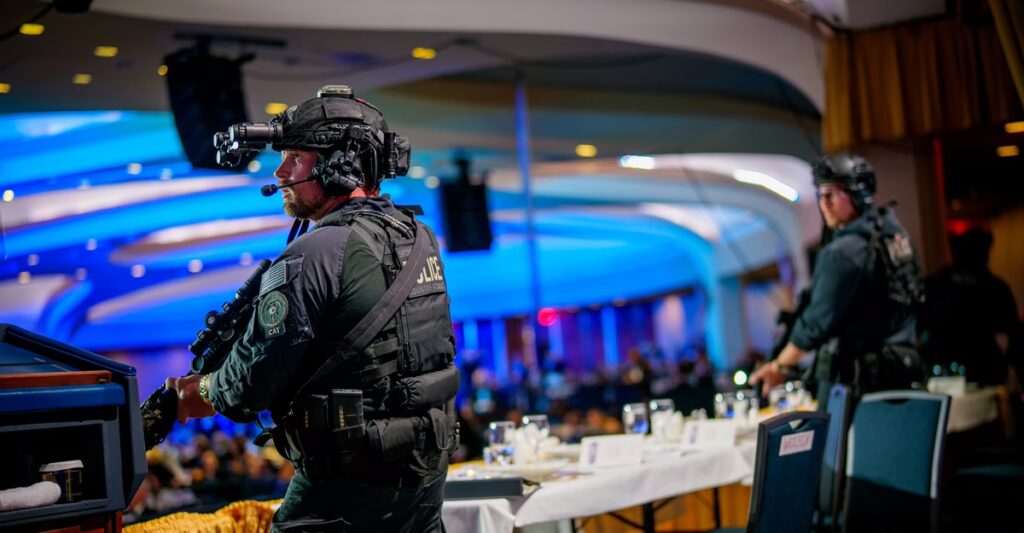
Except for what appears—thank God—to be only a minor injury to a Secret Service officer who was shot near a security checkpoint, no one was hurt at the White House Correspondents’ Association dinner Saturday night. News reports are reassembling the mosaic of the attacker’s movements; he apparently took a train and transported some weapons with him, checked into the hotel, and then made his run at the event.
These are the basic contours of all that we know, and it will take time for more credible information to emerge. In the meantime, the vacuum of facts has been filled by a certain amount of hysteria and the usual conspiracy theories, as well as understandable demands to make changes so that such a thing can never happen again.
The people who were at the event are understandably shaken. Other Americans need not panic, but unfortunately, here is the list of things we can do, right now, to prevent similar attacks in the future: nothing.
Well, almost nothing. One solution is to stop having public events, or to hold them exclusively in ultra-secure locations, or to lock down the area around such occasions as if they were castles surrounded by a moat, with modern archers on all the parapets and the local peasantry told to shelter in place until the nobles are done with their revels.
To live in an open society is to live with a very small, but nonzero, amount of risk. We cannot know if the accused attacker, Cole Tomas Allen, exploited some gap in security, but that seems at this point unlikely. I attended the dinner last year, and unless you’ve been inside the labyrinthine Washington Hilton, it’s hard to grasp just how much space exists between the lobby and the ballroom where the dinner is held. As many observers have noted, the system in place seems to have worked as intended: Allen never got close to the president.
More important, the journalist Garrett Graff writes in a column on Substack, such security arrangements are not meant to stop everything, but one thing: “You always have to have an outer security perimeter,” Graff notes, but the goal of the Secret Service “isn’t to prevent any incident at a high-profile event—it’s to prevent an incident that could harm the president.” For those of us who donʻt have our own Secret Service detail, this hierarchy may seem disturbing, but as my colleagues Ashley Parker and Michael Scherer point out, this is by design. The shooter himself seems to have thought that hotel security was lax, but that’s because he knew what he was up to. In a note he reportedly sent to his family, he wrote:
Like, the one thing that I immediately noticed walking into the hotel is the sense of arrogance. I walk in with multiple weapons and not a single person there considers the possibility that I could be a threat. The security at the event is all outside, focused on protestors and current arrivals, because apparently no one thought about what happens if someone checks in the day before.
The arrogance here, however, is the gunman’s. He is shocked that no one was focused on him, reportedly a quiet, unassuming young man. No one could possibly know he had weapons. (Should hotels really be expected to screen bags like airports do?) Allen finds it laughable that his fellow Americans do not constantly scan their surroundings for murderers and terrorists, but reasonable people do not do this because they assume, rightly, that the other patrons in a hotel are virtually never murderers and terrorists.
After every frightening event, zero-defect thinking tends to overtake reason. Already, some are talking about tightening security on trains, so that they become as protected as airplanes. This is a ludicrous idea, as anyone who relies on regular train transportation will tell you, but it’s as if the discourse actively looks for something to harden, because, after all, we must do something. This is the same thinking that had Americans kicking off their shoes and handing over their belts in airports for decades, when in reality (one incompetent, would-be shoe-bomber 26 years ago notwithstanding) the most important change in aviation security was the cheap and simple fortification of cockpit doors—the one measure that might have prevented 9/11.
Within hours of the gunman’s arrest, Donald Trump and his supporters went beyond trains and planes and used the thwarted attack to push for the construction of the gigantic ballroom that Trump wants to build on the ruins of the White House’s former East Wing. But every event to which the president is invited cannot be held on government property, even if there were an Impregnable Trump Ballroom-Fortress. Or they could, but such a change would represent a dramatic retreat from public life for the American president—the kind of move that typically takes place in autocracies such as China and Russia, where citizens see their leaders only in tightly controlled circumstances or as their limousines go speeding by them.
And in any case, will Trump also stop having rallies and open-air meetings that attract much larger crowds than a dinner at a hotel? This is the same president who went back to the exact spot in Pennsylvania where another shooter came within millimeters of killing him, just to make a point—and he wasn’t wrong to do so, if the point was to underscore that Americans should not give in to fear. Unless he’s willing to spend his presidency in a bubble (and he should not be), he should not rush to hide in a special ballroom.
Reacting to every event as if it is a failure of security moves America that much closer to a state of permanent lockdown, in which citizens must constantly prove they are not maniacs or terrorists, and where the president dare not leave a new Green Zone in the middle of the District of Columbia.
None of this is to deny the necessity of measures to protect the president and his family, even if they involve dramatic actions such as shutting down airspace or canceling major events in light of a credible threat to his safety. Every American should wish for the safety of the officials who represent us. But at some point, Americans must decide whether we live in an open democracy or a garrison state. Our presidents and other top officials should not become prisoners in their own country.
Americans don’t like to accept the reality that living in an open society carries risks that cannot be remedied. I say this as someone who, over the years, has received a fair number of death threats and twice has been the victim of violent crime, including an incident that left me with permanent physical damage. But perhaps we should heed the words of a wise literary character, Robert B. Parker’s Boston private eye Spenser. When he is asked in Looking for Rachel Wallace, a 1980 novel, to protect the life of an outspoken gay, feminist author—a danger that seemed outrageous at the time but is less shocking now—Spenser flatly refuses to give an unreasonable guarantee. “I can make her harder to hurt,” he tells the author’s agent. “I can up the cost to the hurter. But if she wishes to live anything like a normal life, I can’t make her completely safe.”
Americans, if we give in to our fears, can ramp up the intrusions on our lives and undermine the culture of our democracy in a vain attempt to close every last loophole and gap. Or we can accept important limitations on our freedom in the name of public safety while still living our lives, understanding that, say, texting while driving is more likely to kill us than an angry loner or a foreign terrorist is.
The shooter at the White House Correspondents’ Association dinner thought he was among idiots who didn’t see him coming, when in fact he was among his fellow citizens. Americans must not adopt that kind of cynicism, which will lead only to ill-advised attempts to turn all of our public spaces into one gigantic airport-security line. We should reject anyone who calls for violence against the perceived “other,” whether in public life or in our own neighborhoods, but we can express that demand while still refusing to remake the buildings that represent American democratic institutions into armed safe rooms.
The reality of life in an open society is that there is very little we can do to stop any one person among us who is determined to kill others. We were fortunate last night that the attack in Washington was foiled. But new measures to create some chimerical absolute safety will not make us more secure, and instead will erode a democracy that is already slowly poisoning itself to death with paranoia.
The post We Cannot Harden the World Against Every Attacker appeared first on The Atlantic.