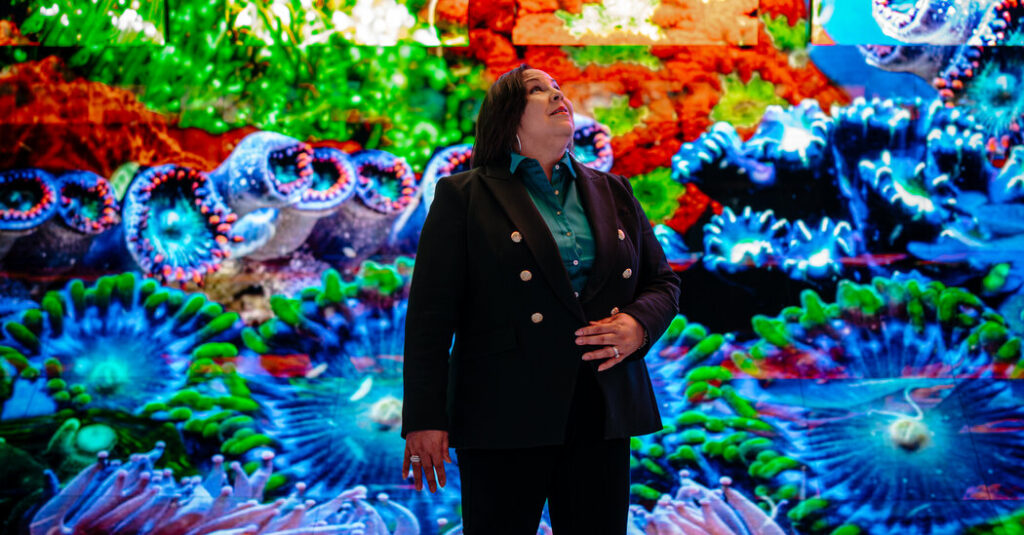
The largest science museum in the Western Hemisphere is doing a lot of experiments these days.
To attract more visitors, the Griffin Museum of Science and Industry in Chicago has rotated its exhibits more frequently, adjusted its schedule of free-admission days and acquired splashy new pieces, like a SpaceX Dragon spacecraft, which it secured in 2022, its first major acquisition in 30 years.
The museum is colossal: a Beaux-Arts style palace built for the 1893 World’s Fair sprawls over more than a million square feet and houses exhibits that include an interactive coal mine that inspired Walt Disney to create Disneyland, a simulated 40-foot tornado and the only German submarine in the United States. In the rotunda, digital screens flash the question: “What Is Science?”
Chevy Humphrey, the chief executive, is trying to answer that question in a broad and urgent way. In May, the museum will open a new permanent exhibit exploring “how energy shapes our daily lives,” just as the war in Iran is prompting big questions about our relationship with oil, gas and other sources of power.
That is a traditional initiative for a science museum. Just a few paces away, another exhibit is set to open on something less expected: Anne Frank. Dr. Humphrey sees it as an opportunity for the museum’s youngest patrons to grapple with larger, frightening forces around them, as Frank did in her “Dear Kitty” journal during the Holocaust.
“Kids are just trying to make sense of the world and still have a childhood,” Ms. Humphrey said, noting “all the things happening with the war, with the school shootings,” and other alarming events.
Dr. Humphrey took the top job at the museum in early 2021, as attendance plummeted during the depths of the Covid-19 pandemic. She is the first woman and person of color to run the institution and has focused on forging ties with the surrounding Hyde Park neighborhood. She’s also overseeing the museum at a time when discussing science has become particularly fraught; everything from vaccines to climate change has become politicized.
Dr. Humphrey, 61, seems to embody the giddiness of the elementary school students who bounce through the museum’s halls and describes her job as running a business “where we’re actually changing things to create excitement.” Last year, 1.5 million people visited the museum and foot traffic was up 12.4 percent compared with 2019. Revenue, which comes from ticket sales, membership, donations and city government support, has increased nearly 10 percent from 2020 to 2024.
The official name of the museum changed in 2024 to acknowledge Kenneth C. Griffin, the chief executive of the hedge fund Citadel, who donated $125 million, one of the largest gifts the museum has received. In an emailed statement, Mr. Griffin said that Ms. Humphrey has led the institution with “clarity and purpose.”
This interview has been edited and condensed.
How do you think about how to talk about science in this polarized, politicized moment?
Science helps you to understand the world around you.
A scientific process is about testing, experimenting, observing, finding the solution, and then start iterating, and it starts all over again.
We have to show you what the scientific process was. We try to show our audiences why and how this was developed. How this affects you and impacts your life.
You are from Texas and previously worked in Arizona. What was it like coming to work on the South Side of Chicago?
Sometimes when you come in as a new person coming from another community you have a different lens and a different perspective. You see things that others may not see.
The blessing of not knowing means I can ask more questions. I’m using the same scientific process that we try to help kids and families learn to build a better museum for our community.
You seem focused on museums being community gathering spots. How do you think of the utility of a museum?
We’re safe spaces to have conversations, where people trust that we’re not telling them what to do. We’re helping them to think and providing them with the tools to critically think and problem solve on their own. No one’s ever failed at a museum. This isn’t a school.
Tell me about this Anne Frank exhibit, which is coming from Amsterdam and will feature artifacts from Ms. Frank’s life. Why would a science museum feature it?
Most of the people that are coming to our museum — on our free field trips and specifically in our community — will probably never get to go to the Anne Frank House in Amsterdam.
If you think about it, our children are trying to make sense of the world around them because there’s lots of stuff going on today. Anne’s story is similar. She’s writing to Dear Kitty, wondering what’s happening in the world around her and why all these horrible things are happening.
The executive director of the Anne Frank House was skeptical about bringing it here at first. Then he stepped in our lobby. We have a lot of Annes running around our museum, trying to make sense of the world around them. They’re going to receive their own diary, so they can write and reflect.
How do you excite the donor base?
The business side is no money, no mission. You have to run it like a business but at the end of the day you have to show donors how you’re going to leverage their dollars to have a higher impact.
I remember a call I did with someone from private equity. They’re really tough.
He sat there and he questioned me about the business for an hour and 10 minutes. I was able to answer every question. He said, “OK, now let’s talk about how I will invest.”
You have to make tough decisions. You have to assess. You to have to analyze. You have to say no, just like a regular business does.
How else do you work with donors?
When I first got here, we hadn’t collected a big artifact in over 30 years. So in my third month, I was on the phone with two board members. They said, “What can we do for you?”
I had a mentor that said, when somebody asks you what you want, you need to be prepared with an answer. So I said, “you were one of the first investors in SpaceX. I’d like to get a Dragon spacecraft.”
Two weeks later, we got a SpaceX Dragon spacecraft.
You’re from Houston. Tell me about your upbringing.
I grew up in Third Ward in Houston. My parents bused me to school outside my neighborhood, and I felt guilty because all my friends in my neighborhood weren’t getting all the education I was from those rich schools. So I’d hold school in my garage: “I’m going to teach you what I learned at all these rich schools.” I’d give them a toy after they learned. I’d go back to my parents, get some more money, buy some more toys.
What did your parents do?
My father was a policeman and U.S. Marshal and my mother was a music teacher. My father was a first-generation college graduate.
He wanted to go to medical school, but gave that up to send his baby sister and his niece to college. He always taught me, “We’re put on this earth to help people.”
My father allowed me to be the C.E.O. and C.F.O. of our household. I actually had to pay the bills. I had to write the checks out. I had to keep the books. I always knew I wanted to be a manager or C.E.O. of something. I wanted to be in charge.
What’s the best advice you received from your mom?
At Arizona [Science Center], I was the first Black American to ever run a science museum in the United States. I was proud and excited. I went home and told my mom.
My mom was like, “Take the trash out. What you going to do tomorrow?” She always told me that it’s not where you are, it’s what you do.
Time for the lightning round. What exhibit inside the museum do you find yourself in the most?
I gravitate toward the tornado in Science Storms because it keeps me on my toes.
What’s the toughest science class you ever took?
It was microbiology. It was a lot of memory. I went to my mother for help, and she taught me how to create songs out of each communicable disease, so that I could pass the test.
Greatest invention of all time: the wheel or the internet?
I would say the wheel.
Would you rather walk on the moon or be the first person on Mars?
First person on Mars.
When you need to think, do you like a quiet office or walking the museum floor?
Walking the museum floor, hands down. I’ll get to thinking, and some young kid will stop me and ask me a question because I always wear my name tag. They ask me questions and that’s when I learn more.
What’s the last thing you learned from your youngest employee?
They taught me on my cellphone how to do an emoji that really looked like me.
A big part of your job is fund-raising. What’s your best piece of advice for it?
“No” is always a maybe.
What’s the last question you asked A.I.?
How do I make my 3-year-old grandson happy and what toys should I take him?
What did it say?
Spider-Man.
Jordyn Holman is a Times business reporter covering management and writing the Corner Office column.
The post The Chief of Chicago’s Science Museum Is Doing Some Experiments appeared first on New York Times.