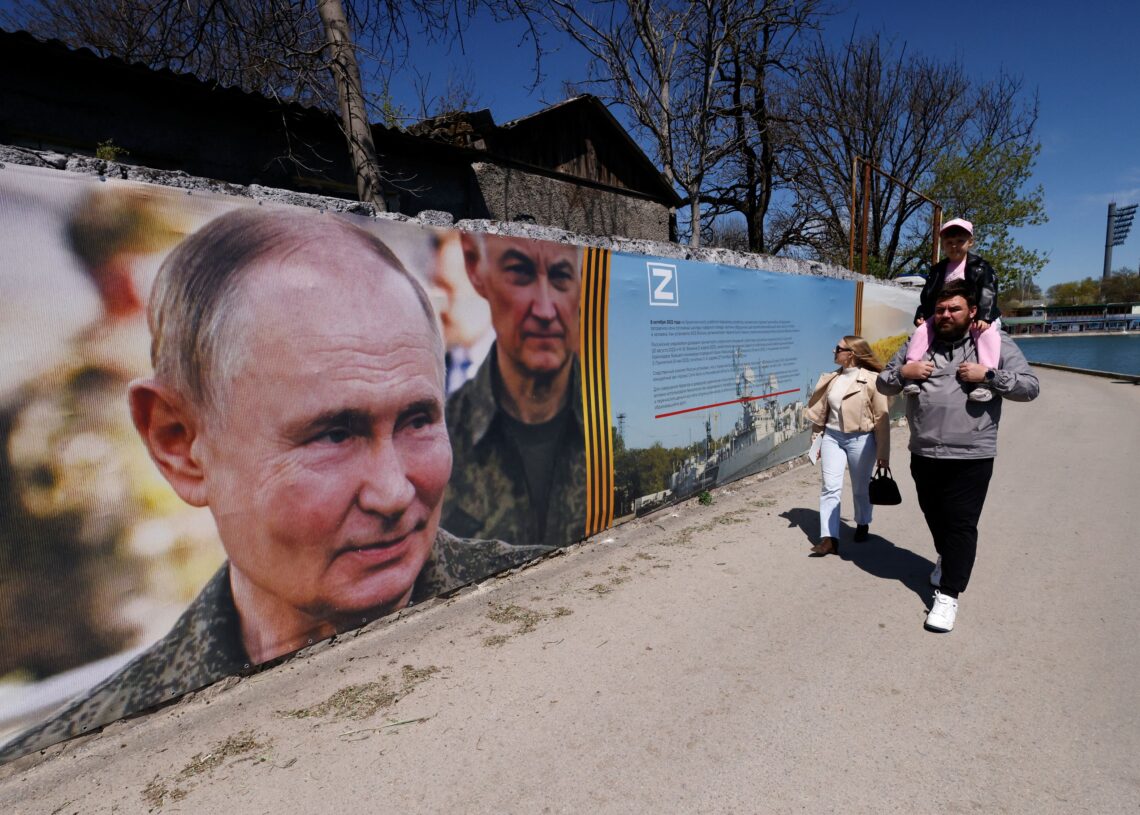
President Vladimir Putin is facing rising discontent across Russian society as the war against Ukraine drags on, the economy flounders and public dissatisfaction mounts over government restrictions on internet access.
Russia’s biggest state-owned pollster, the Russian Public Opinion Research Center, on Friday recorded that Putin’s approval rating fell to 65.6 percent, its lowest level since before the beginning of the war and a drop of 12.2 percentage points since the start of the year.
Gauging genuine public opinion is difficult under an authoritarian regime that exiles, imprisons or even kills political opponents and where criticism of the war is illegal, but compared with Putin’s historical ratings — as high as 88 percent — the falling poll numbers signal growing weariness with the war now in its fifth year, and with negotiations to end it largely stalled as the Trump administration focuses on Iran.
Economic sanctions are biting ever deeper into Russia’s economy, hitting pocketbooks, and the government’s push to limit access to the internet, citing security concerns, is rankling a society that long enjoyed a high level of digitalization.
“The overall mood is that’s enough already; you’ve been fighting for long enough,” said one Russian official, speaking on condition of anonymity for fear of retribution. “It seems to everyone that it’s been going on for longer than World War II, the Great Patriotic War — and at the same time we can’t even take one region,” the official said, referring to Russia’s failed effort since the full-scale invasion in 2022 to take full control of the Donetsk region in eastern Ukraine.
In recent weeks, Putin’s government has faced unusually open and strident criticism from members of Russia’s financial elite over its handling of the economy, which contracted by 1.8 percent in the first two months of the year as tougher sanctions and high interest rates intended to combat inflation continue to choke investment and led nonpayments of commercial bills to reach a record high of $109 billion in January, according to Rosstat, Russia’s Federal Statistics Service. The number of companies owing taxes to the government, meanwhile, has climbed to 439,900, according to Aktion Accounting, a Russian firm.
One by one, businessmen and economists attending an economic forum in Moscow earlier this month upbraided the government over the shrinking economy.
“The people at the top have completely lost touch with the reality on the ground, in the economy,” said Vladimir Bogalev, the head of a Russian tractor manufacturer, according to online video footage from the forum. Those in a position of power are actively “discrediting” themselves, Bogalev said.
Robert Nigmatulin, an economist at the Russian Academy of Sciences, told the forum that Russia was lagging China and that inflation had far outstripped economic growth. “We’ve lost everything and still we are the poorest. Even in the poorest regions of China incomes are higher than in our poorest regions,” Nigmatulin said. “GDP growth since 2015 — that’s 11 years — is about 1.5 percent per year. Do you know how much consumer prices have increased by? Seventy-seven percent.”
He added: “Can we invest in a country with leadership like this? You can’t run an economy this way.”
Meanwhile, a video posted by a Monaco-based social media influencer Victoria Bonya railing against the online restrictions — and denouncing the government’s handling of other problems facing ordinary Russians — went viral, forcing the Kremlin to respond by insisting that it was working on all the issues she raised.
Gennady Zyuganov, the longtime leader of Russia’s Communist Party, took things further during a speech in parliament this past week, warning that “economic collapse is inevitable” if issues go unaddressed. “By autumn we will face what happened in 1917,” he said, referencing the Bolshevik Revolution.
Sanctions and Putin’s heavy military spending drove inflation sky-high, forcing the central bank to raise interest rates above 20 percent to cool down the economy. Though the central bank has since pulled rates back — they now stand at 14.5 percent — economists increasingly have warned of “overcooling” and recession.
Russia’s economic development minister, Maxim Reshetnikov, said this past week that Russia’s reserves “are largely exhausted,” while Putin this month publicly acknowledged that the economy was in trouble and called on the central bank and his government to explain the slowdown in growth.
The Russian economy, heavily dependent on oil revenue, has won some respite from a surge in oil prices caused by the U.S.-Israeli war against Iran, but economists said only a much longer, sustained period of high prices would let Russia balance its budget.
“Right now, the Russian economy is in a strange twilight zone between the positive effects that can be expected from the closure of the Strait of Hormuz and the high commodity prices, and at the same time Russia’s own economic dynamic, which was worsening significantly in the last months,” said Janis Kluge, an economist with Germany’s Institute for International and Security Affairs.
In addition, increasing attacks by Ukrainian drones on Russian ports and refineries forced Russia to slash oil production in April by 300,000 to 400,000 barrels per day, Reuters reported, potentially undermining some of the windfall Moscow anticipated from higher prices and President Donald Trump’s temporary waiver of sanctions on Russian oil.
“Problems are growing and we have spoken for a long time about how this time would come,” said a Russian academic with close ties to senior Russian diplomats.
As citizens are forced to cut back on basic expenses and internet restrictions disrupt daily life, divisions are emerging across all sectors of society, analysts said.
“Dissatisfaction is very strong,” said Tatiana Stanovaya, a senior fellow at the Carnegie Russia Eurasia Center, a think tank based in Berlin. “There is the dragged out war and the financial complications, while the youth is not happy it is being cut off from its usual environment in social media. Wherever you look there are problems … and where this will lead to we cannot say.”
“People are beginning to speak out more bravely now,” Stanovaya said, adding, however, that the authorities are likely to respond with further repression and there is no sign the regime is at risk of losing control.
Mikhail Khodorkovsky, once Russia’s richest man and now a leading opposition figure based in London, said an initial patriotic boost from the war has dissipated. “The war has been going on for too long and there are no clear changes,” Khodorkovsky said. “The fact that they won or lost three villages is not helping very much.”
For some in Russia, Trump’s seemingly arbitrary decision to go to war against Iran offered justification for Putin’s own war of choice against Ukraine and could prompt the Kremlin to dig in its heels in pursuit of its military objectives, especially seizing Donetsk.
“Everyone believes that the war in the Persian Gulf gives Russia and Putin the chance to fight for longer against Ukraine and to take more territory,” one Moscow businessman said, also speaking on condition of anonymity for fear of retribution. “No one understands how long the war is going to last and on the other hand people increasingly fear that the state is going to take more and more away from them.”
Against that backdrop, despair is growing, especially over the internet restrictions, which are reviving potent memories of Soviet repression. “People like us are very worried, because we were born in a country you couldn’t leave,” said Tatyana, 53, a manager in a logistics company, who spoke on the condition that she be identified only by her first name. “We already lived behind the Iron Curtain once, and then we were sure it would never happen again. But in reality, it has. Now we have a digital Iron Curtain.”
Others spoke of the desolate economic landscape. “From a business perspective, I can see things are a complete mess — sales have dropped, people have less and less money, there are far fewer people in shopping malls, prices have doubled, and for fruit and vegetables they’ve tripled,” said Irina, 46, a sales manager who spoke on the condition that she be identified only by her first name. “Utility bills have gone up, taxes have been raised too.”
Igor, 19, a student, described growing despondence. “Overall, both I and the people I know feel a complete sense of hopelessness that nothing can be done about,” said Igor, who also spoke on the condition he be identified only by his first name. “Everyone wants to leave, but most don’t have that option. No one wants to tie their future to this country. Living here is difficult, expensive, and bleak.”
The post Mood in Russia turns bleak as war in Ukraine drags on and economy suffers appeared first on Washington Post.