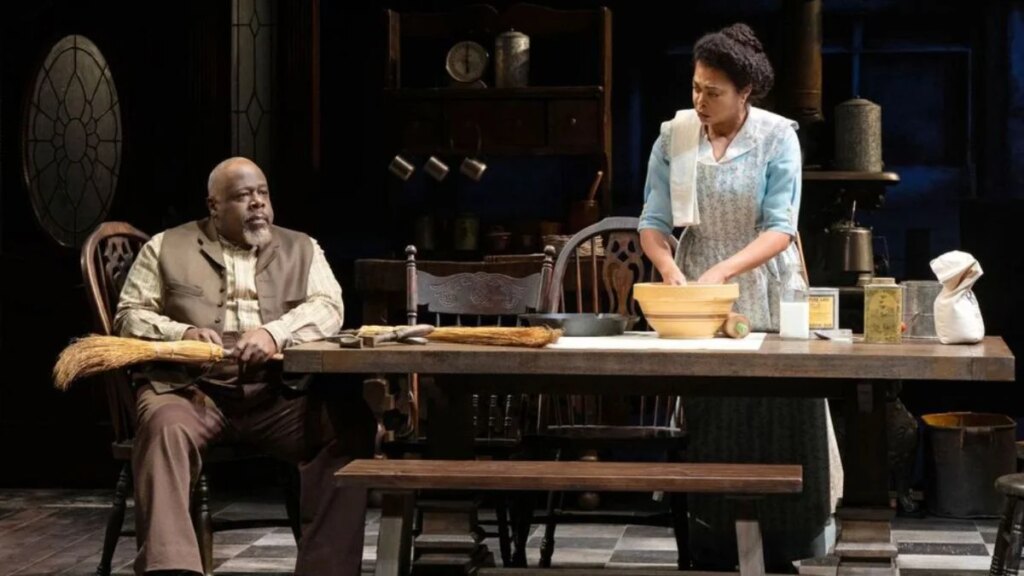
August Wilson won the Pulitzer Prize twice for “Fences” and “The Piano Lesson.” He also deserved to win for “Ma Rainey’s Black Bottom” and “Joe Turner’s Come and Gone,” which receives a stirring revival at the Ethel Barrymore Theatre, where it opened Saturday.
Debbie Allen directs, with her last Broadway credit being a “Cat on a Hot Tin Roof” production from 2008 that was strictly routine — except for its casting. There’s nothing routine about her sophomore directorial turn on Broadway, however. This “Joe Turner” comes alive instantly with arresting performances that only tighten their grip as the drama intensifies.
The play is second in Wilson’s Century Cycle of 10 works, with “Joe Turner” set in 1911 Pittsburgh. Many of its characters are former slaves or victims of Joe Turner. As the brother of Tennessee’s governor, Turner, a.k.a. Joe Turney, made his living kidnapping Black men, whom he then forced to work on his chain gang.
In Wilson’s play, Turner held Herald Loomis (Joshua Boone) captive for seven years, and about half way through the first act, this “ex-convict” makes his entrance, holding the hand of his young daughter, Zonia (Savannah Commodore). “Joe Turner” is one of those boardinghouse plays that is mostly talk; there’s not much plot and a helluva lot happens.
As entrances go, Joshua Boone delivers one of this theater season’s most riveting, one that owes much to Clint Eastwood and Ennio Morricone. Boone was charismatic in “The Outsiders,” his last Broadway outing. In “Joe Turner,” he nearly explodes without saying a word. Nearly. The real fireworks happen at the end of act one and don’t subside until the final curtain comes down more than an hour later.
Loomis is in search of his long-lost wife (played by Abigail Onwunali, who is very powerful in one brief scene). He has remained faithful to her for seven years, but he is tempted to stray when he meets a young woman, Mattie (Nimene Sierra Wureh), also bereft from having recently lost her love. The two share an intimate moment that is as tense as Loomis’ spectacular entrance. But here, there’s no “Man with No Name” hat or spaghetti Western sound effects. Two actors stand alone on stage, and Boone encapsulates without saying a word the terror and pain inflicted on him, and so many others, by Joe Turner. Boone’s regretful turning away from Wureh in act two of “Joe Turner’s Come and Gone” is this theater season’s most indelible, heartbreaking moment.
That said, Loomis is a featured role. Grounding this production are Taraji P. Henson and Cedric the Entertainer, playing the owners of the boarding house. They’re the marquee names here, and to their credit, they don’t give star turns. This has been a Broadway season (it ends tomorrow, Sunday) replete with showy performances that appear to be jockeying for Tony Award nominations (announced May 7). Neither Henson nor Cedric go there, although they are certainly deserving of that recognition with their very understated performances.
As with Henson and Cedric, Ruben Santiago-Hudson is never off the stage for long. In the major role of Bynum, Santiago-Hudson portrays the play’s most exotic character, a voodoo “conjuror,” and tellingly, he’s the one most aware of, and secure with, his own identity. He calls it his “song.”
Santiago-Hudson last appeared on Broadway in 2021 in his solo play, “Lackawanna Blues,” in which he portrayed over 20 characters. In most one-person shows, where an actor switches roles every other minute, the transitions come off as a gimmick. Not with Santiago-Hudson. His portrayals of children and female characters were especially effective. It is real pleasure now to see him deliver just one character for two and a half hours, especially one as rich in spirit and texture as Bynum.
This “Joe Turner” production is one of the season’s best. Loomis’ entrance and other memorable moments owe much to David Gallo’s set, Paul Tazewell’s costume, Stacey Derosier’s lighting and Steve Bargonetti’s original music.
The post ‘Joe Turner’s Come and Gone’ Broadway Review: Debbie Allen’s Direction Injects Real Fire Into August Wilson’s Masterpiece appeared first on TheWrap.