Back in Florida, Shremaine Stewart found her job prospects a bit unsettling: She was better off working at a grocery store deli than as a teacher for a child care center.
“I was getting paid more to make sandwiches versus to educate kids,” Stewart said. “That to me was very baffling.”
She moved to D.C. about two years ago, lured by a city fund that offers extra pay to early child care educators with credentials.
“I saw how much D.C. was pouring into their teachers,” she said. Here, making twice as much as in Florida, she finally bought a car. Upgraded to a two-bedroom apartment in the city for her and her son. Went back to school to pursue her bachelor’s degree.
It was exactly the life that Stewart, a Jamaican immigrant and daughter of a preschool teacher, had envisioned — and that she now fears could be uprooted.
The wages of thousands of workers like Stewart are in limbo as the city’s Early Childhood Educator Pay Equity Fund is on the chopping block in Mayor Muriel E. Bowser’s proposed budget. The administration says D.C.’s struggling economy is forcing difficult trade-offs to balance the budget.
In that climate, child care has become one of the largest policy debates this spring, with Bowser’s proposal drawing immediate pushback from child care providers, teachers and lawmakers. Many D.C. Council members say they will push to restore the funds as budget talks continue in the coming months, and the issue is simultaneously playing out on the campaign trail, as the top mayoral candidates have each made child care and affordability cornerstone issues.
D.C. Council Chairman Phil Mendelson (D) recently said restoring the pay equity fund, as well as boosting a child care subsidy for lower-income families, was a priority. But he said it was too soon to say how they would fund it — or whether the city would be able to predictably fund the program for the next several years.
“We need to make a choice whether we want to solve for one year or whether we want to actually try to get ahead of the problem that we’re having this year so we don’t have it again next year,” he said during a council meeting Tuesday.
The questions carry unique weight in a city with some of the nation’s highest child care costs, and among the most significant public investments in child care.
D.C. offers families a rare service: It provides the vast majority of the city’s 3 and 4 year olds with free prekindergarten, and pours money into subsidies that help low-income families afford child care. Beginning in 2022, the city also began funding pay increases for early childhood educators.
The pay equity fund, described by the Urban Institute as the first of its kind in the country, boosts the pay of about 3,300 teachers by amounts between $7,000 and $25,000 annually, depending on their level of education. Before its implementation, teachers at day care centers made an average of $36,000 a year, according to a Mathematica study commissioned by DC Action, which advocates for child-friendly policies in the District.
The extra funds for teacher pay — which help three-quarters of the city’s licensed child care centers — were transformative, said Tara Villanueva, center director for the Kidspace Child and Family Development Center at House of Ruth in Southeast Washington.
Villanueva said workers at the center, which serves D.C. families that have experienced homelessness or abuse, were finally recognized and compensated as professionals. Without government help, the center could not afford the higher wages, she said.
“These are teachers — these aren’t babysitters,” Villanueva said. “There are people who went on vacation for the first time on a plane … I was just so happy for the field.”
Villanueva and other supporters say the pay equity fund incentivized many teachers to advance their educations and classroom skills. And once they did, they stayed in the field instead of leaving for more lucrative jobs elsewhere — leading to less staff turnover and higher quality teachers, she added. The Urban Institute, which has been studying the D.C. fund, also found the program was associated with higher-quality child care and better teacher retention.
Still, paying for the fund is a nearly annual budget fight for city leaders.
Two years ago, Bowser similarly proposed eliminating its funding to plug a budgethole, but the council reversed the cut. Bowser did not propose a cut last year — an olive branch to the council despite the challenging budget.
But this year, facing a $1.1 billion budget gap, Bowser argued cutting the pay equity fund was necessary as she sought to preserve money for other pricey services, including Medicaid.
“What I hear most from families is they want more opportunity for child care, more places, more spots, more quality spots, and they want it to be less expensive,” Bowser said when presenting her budget earlier this month. The pay equity fund did not achieve that goal, she said, describing it as “more of an income support fund for child care workers.”
The mayor did set aside $12 million to maintain health care for child care workers. She also put $94 million toward subsidies that help low-income people afford child care, but not enough to avoid a wait list for families.
Theola DeBose, a spokesperson for D.C.’s Office of the State Superintendent of Education, said city data show that creating the pay equity fund “did not lead to a surge of new child care facilities opening.”
“The Early Childhood Educator Pay Equity Fund, which nearly doubled in cost over just two years, is unsustainable,” she said in a statement. DeBose said the fund “provides a pay boost for employees at private child care providers, some of which charge high private tuitions, and some of which do not accept D.C. families paying with child care subsidies.”
So far this fiscal year, DeBose said $7.6 million, or 28 percent of spending on the pay equity fund, went to providers that do not participate in the child care subsidy program. Mendelson said the issue was “something we’re going to look at.”
Council member Christina Henderson (I-At Large) took issue with the mayor’s framing that the pay equity fund was not functioning to make child care more affordable for families. That missed the point of why it was created in the first place, Henderson said.
“The whole point of the pay equity fund was for us to stabilize our child care centers and our markets so that when folks went back to work the child care slots would be there,” Henderson said. “It was to say that we believe as a city that child care workers, early childhood educators, should not have to scrape by to take care of their families just so they can take care of ours.”
She said she heard from child care workers who sometimes worked 13-hour days, yet did not make enough to enroll their kids in extracurricular soccer programs or go to the doctor.
“So I hate this sort of framing of like, ‘Well, we can’t have pay equity fund because of affordability,’” she said. “What about the affordability of these workers to be able to live?”
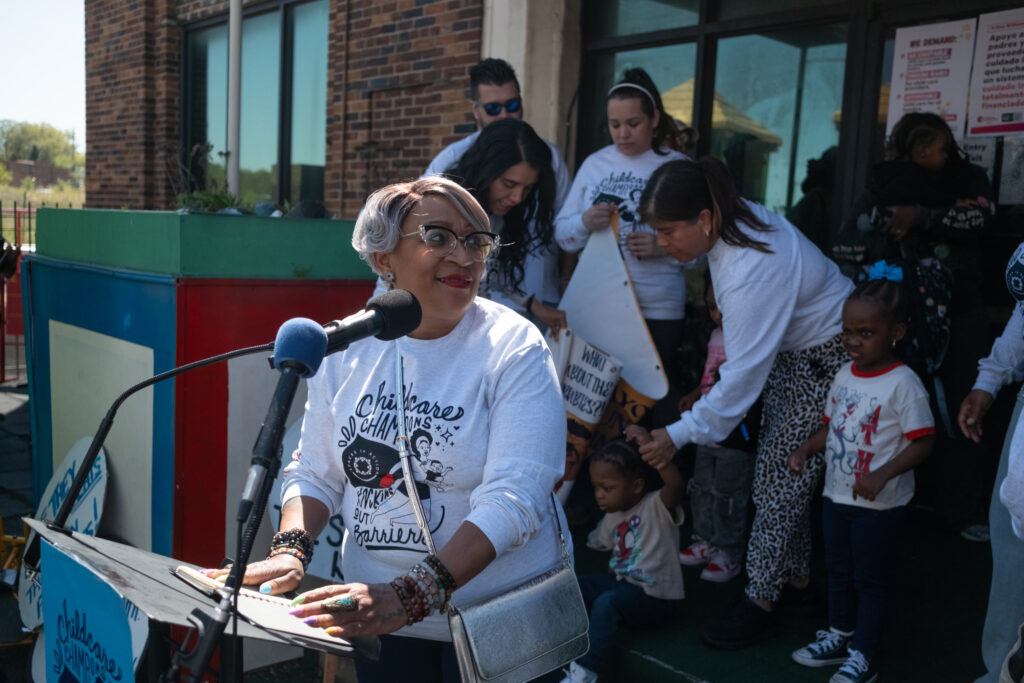
Under 3 DC, a coalition that successfully pushed lawmakers to prioritize the pay equity fund in the past, is fighting once again for full funding for the program. At a panel Wednesday, the coalition presented research on the positive economic returns of the pay equity fund as parents, researchers and center operators in the room laid out potentially dire effects of the proposed cuts.
Travis Hardmon, CEO of the GAP Community Child Development Center in Northwest Washington, said the potential cut could lead many centers to close. “That’s how scary this is,” he said. “And then you couple that with the other cuts in subsidies, potential cuts in reimbursement rates, and you add all that together, I don’t know how people survive it.”
Child care has also emerged as a central issue in the race for mayor.
In interviews, the top mayoral candidates — former council member Kenyan R. McDuffie and council member Janeese Lewis George (D-Ward 4) — both pledged to prioritize funding the child care subsidy and pay equity fund if elected.
“The next mayor absolutely has to protect what D.C. has built when it comes to those programs. And go even further,” McDuffie said, adding the annual “instability” with the pay equity fund must end.
McDuffie unveiled a plan he called “Every Child, Every Step” on Thursday outlining proposals to support children from birth through high school. His plan proposes lowering the cost of child care by increasing supply through efforts such as providing tax benefits to employers offering child care and changing zoning rules to ease restrictions around in-home care or within office buildings.
“We know it would be great for folks to drop off their child in the office building where they work,” he said.
Early in her campaign, Lewis George pledged universal access to affordable child care, vowing to expand the existing child care subsidy until no D.C. family pays more than 7 percent of its income on care. She’s promised to fully fund the pay equity fund, which she played a key role in getting off the ground in 2021 by co-leading a proposal to raise taxes on the richto help pay for it. She has broached an expanded business activity tax as one potential funding stream to expand the child care subsidy. (McDuffie said he would not consider raising or expanding taxes to fund his child care platform.)
Lewis George faces a political test as she campaigns on child care policies while also having an opportunity to advocate for her vision during the council’s budget debate. In an interview, she did not offer specifics on how she would propose fully funding the child care subsidy and pay equity fund, but said her team was looking for budget savings.
“The child care workforce has to work in order for the rest of the workforce to work,” she said. “So it is both an economic growth policy and a good policy across the board for our children as we look at future outcomes from investing in birth to 3 and beyond.”
If the cuts go through, Stewart, who works at Educare in Ward 7, said she doesn’t see any reason to remain in D.C.
Her family and friends are back in Florida. Her bills here — the car, the higher rent, the school — would no longer make sense without the extra pay from the equity fund.
“That would mean starting over again, going back to my life in Florida, which is something that I don’t want to do,” she said. “I finally feel like I have a purpose.”
If she returned to Florida, she said, she may as well go back to the grocery store.
The post D.C. child care workers got life-changing raises. Now they may be cut. appeared first on Washington Post.