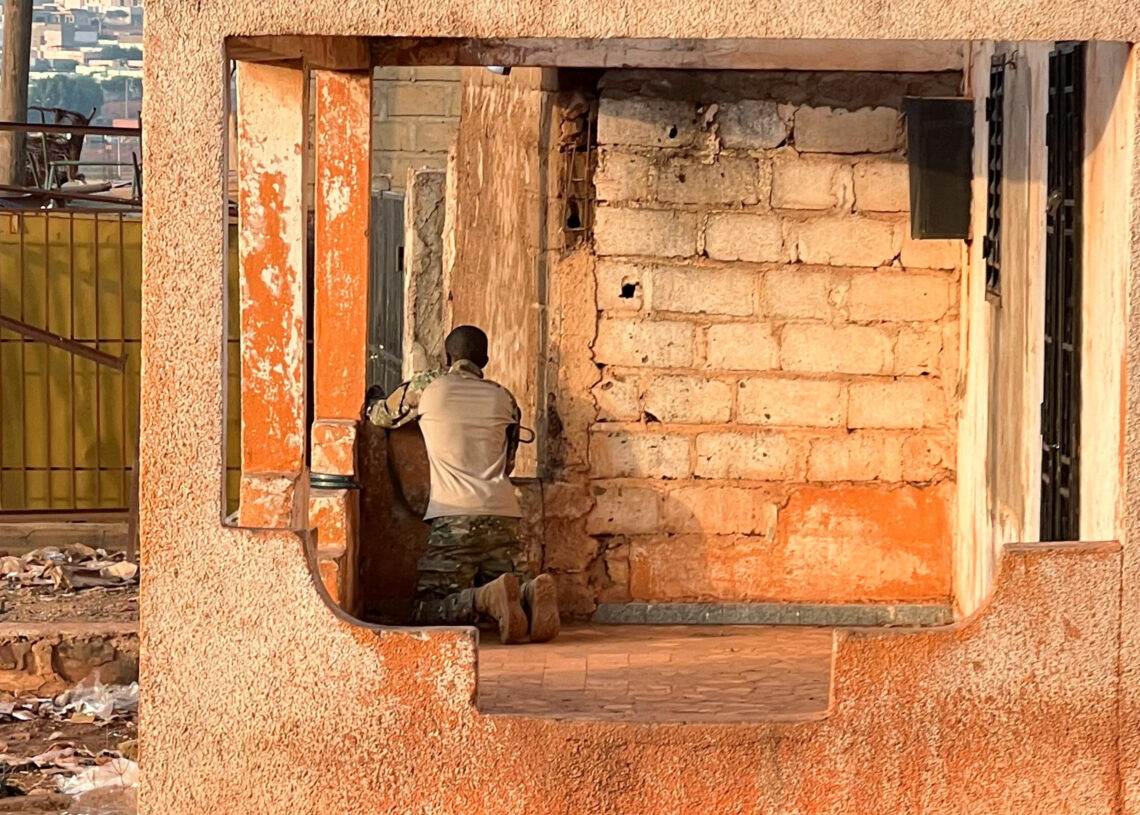
Islamist militants with a powerful al-Qaeda affiliate and separatists launched attacks across the West African nation of Mali on Saturday, in what analysts say constitute the biggest strikes since militants overran much of the country in 2012.
Heavy gunfire and explosions were reported from around Mali, including in its capital, Bamako; in Kati, where Mali’s main military base is located; at the former U.N. base in Gao; at the main airstrip in central Mali; and in Kidal, in the far north of Mali. Unprecedented scenes showed militants on motorbikes and in trucks openly operating inside Bamako and Kidal, a longtime stronghold for Tuareg separatists that Russian mercenaries helped Mali’s military take back in 2023.
Jama’at Nusrat al-Islam wal-Muslimin (JNIM), the most well-armed militant group in West Africa, claimed the attacks in a statement, saying it had hit the residences of Malian President Assimi Goïta and Defense Minister Sadio Camara. The group said it took “complete control” of the city of Mopti and, with the separatists, captured Kidal.
JNIM promised in the statement “a real transformation” of the country. And it directly addressed the Russians, urging them to stay out of the conflict so that they could build “an effective future relationship.”
“The coordinated, high-level attacks through the country, along with their visibility and ability to operate so freely, is unprecedented,” said Andrew Lebovich, a research fellow with the Clingendael Institute who focuses on Mali. “It’s hard to see how anything is the same after this.”
Mali has been led since 2021 by a military junta that took power in a coup that year. But it has been besieged for years by JNIM, which has helped turn the region into the epicenter of global terrorism.
Mali’s military leaders turned to Russian mercenaries for help, but the violence only worsened. Some of the worst attacks on civilians have come not at the hands of militants but by Russian mercenaries and Mali’s military.
In response, the Trump administration has ramped up intelligence sharing with Mali’s government, The Washington Post previously reported, in an effort to repel the advance of extremists. But the extremists have continued to grow in strength, including imposing a fuel blockade that crippled the capital last year.
On Saturday, the U.S. Embassy in Bamako issued a security alert urging U.S. citizens to shelter in place and avoid travel to Kati and Bamako. In a statement, the African Affairs department of the State Department condemned the attacks and said it stood with the Malian people and government.
“The United States remains committed to supporting efforts to advance peace, stability, and security across Mali and the region,” said the post on X.
A spokesman for Mali’s military said “unidentified armed terrorist groups targeted certain locations and barracks” in Bamako, later adding that the situation was under control.
But videos from across Mali underscored the severity of the attacks, including scenes of militants overrunning the governor’s office in Kidal; bombs that appeared to destroy Camara’s housein Kati; and Bamako residents watching as militants in trucks entered Bamako without any opposition.
The arsenal of weapons used by the militants included a range of small arms, such a AK-47s and RPG-7s, in addition to some drones, said Wassim Nasr, a Sahel specialist and senior research fellow at the Soufan Center.
Nasr said that it has long been clear how ineffective the Russian mercenaries were as counterterrorism partners, both when associated with the Wagner Group and now with Africa Corps. Saturday’s attacks only drove those struggles home, Nasr said.
As of Saturday afternoon, he said, JNIM and the Azawad Liberation Front (FLA), a Tuareg-dominated rebel alliance that is pushing for its own state in northern Mali, were using mortars and machine guns to attack the former U.N. camp where Africa Corps is currently entrenched.
JNIM has not yet claimed the attacks but is widely believed to be responsible, along with the FLA in the north. A spokesman for the FLA, Mohamed Elmaouloud Ramadane, said in a Facebook post that its forces “control the entire city” of Kidal and are present inside the city of Gao.
Nasr said “the fighting in Kidal and Gao put into practice the agreement reached a year ago between FLA & JNIM” — which have sometimes been allies but at other times clashed — that involves the sharing of assets.
An official in Bamako, who spoke on the condition of anonymity because of the sensitivity of the situation, said the sound of gunfire and explosions started around 5 a.m. and continued until about 11 a.m.
There had been rumors of the possibility of such an attack for years, the official said, adding that its full scope remains unknown.
The post Al-Qaeda-linked militants launch coordinated attacks across Mali appeared first on Washington Post.