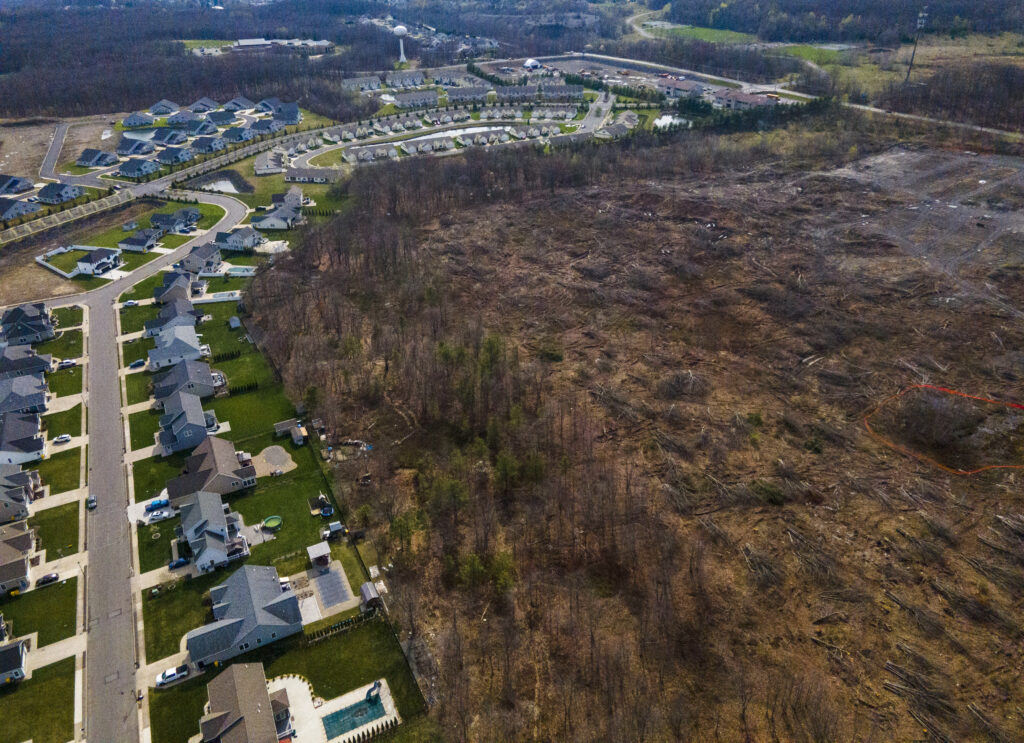
ARCHBALD, Pa. — Tim Bachak would look out to his backyard most evenings to see wildlife emerging from the forest of birch, maple and oak trees hugging his property.
He regularly spotted black bears, deer and coyotes. Owls would hoot and turkeys would scurry. Bachak, a 43-year-old public school teacher, saw the activity as a sign this former coal town had recharged from its polluting past.
Then last month, Bachak woke up to the sound of chainsaws. Workers were cutting down the forest, about 180 acres of trees, to make way for a massive data center.
“Those animals now have no place to go,” Bachak said on a recent afternoon as he looked out at a vast landscape of tree stumps. “It’s disgusting. … Why are they putting these things near us, near our schools and near our parks?”
Throughout Archbald, a northeastern Pennsylvania town of 7,000 people tucked in a valley near the Pocono Mountains, residents are asking similar questions as the community emerges as one of the latest frontiers in the nation’s increasingly chaotic battles over data centers.
Developers plan to build six of the sprawling campuses in Archbald to power the demand for artificial intelligence, eventually covering about 14 percent of the town’s land. Those campuses would include 51 data warehouses — each about the size of a Walmart Supercenter — including seven buildings encompassing more than a million square feet near Bachak’s home.
For years, developers’ plans to make the community, which sits beneath a major interstate power line, a hub for data storage went largely unnoticed. But as word began circulating last year about borough council zoning changes to allow for the development, residents rebelled and have launched one of the most contentious grassroots campaigns in local history. They are organizing on social media, overwhelming community meetings and calling for the ouster of some key local officials.
Over the past month, most of the seven-person Archbald Borough Council, along with several planning board members, have resigned. At least two of the council members said they left their positions out of fear for their safety after shots were fired at the home of an Indiana politician, who found a ‘No data centers’ note on his doorstep.
As the acrimony over data centers intensifies, developers appear to be pressing ahead with their plans in Archbald, even as they refuse to tell the community what technology firms will occupy the buildings. The showdown could have nationwide implications over whether local activists can stop massive data center projects.
“This debate has destroyed this community,” Archbald Mayor Shirley Barrett (D) said. “We want answers, but we have no clue what is going on because this is all happening so quickly.”
In recent months, clashes over data centers have become some of the testiest local and state political debates. President Donald Trump and many state leaders have welcomeddata center construction, arguing they fuel economic development and are needed to fortify the nation’s technological advancements.
But a growing number of communities, from small towns to big cities, are pushing back against the often-secretive plans. They cite a range of concerns — from the size and noise to fears they could overwhelm local energy grids and water supplies.
Public opinion has rapidly shifted against data centers. In several communities, lawmakers are responding with local moratoriums on large data centers. This month, legislators in Maine passed the nation’s first statewide ban on large data centers — a move the governor has since vetoed.
Here in Pennsylvania, opposition is forcing some political leaders, including Gov. Josh Shapiro (D), to rethink how the projects should be managed. Shapiro, who had implemented policies that would fast-track data center construction to spur economic growth, is now supporting tighter reviews on how they affect local communities.
“We need to be selective about the projects that get built here,” Shapiro said during his budget address this spring.
‘A big, slow surprise’
Residents in Archbald, located in Lackawanna County, are baffled over how their community became ground zero in the push to build more data centers. The town is so small that some of its most recognizable buildings are funeral homes.
But representatives for the developers say the area is attractive because it sits near the nuclear-powered, 500-kilovolt Susquehanna-Roseland power line that slices through the county. Archbald also has abundant freshwater and land since most of its coal mines shut down by the early 20th century.
In 2023, Archbald’s government took the first steps toward allowing data centers when they approved new zoning requirements that contained language permitting data centers, including an “internet server building.” The ordinance passed with little community opposition.
But in early 2025, Kayleigh Cornell and several other residents began hearing that the Project Gravity data center had begun applying for permits needed to begin construction on seven two-story buildings near her family home. Cornell quickly learned that two other data center projects were also proposed under the 2023 zoning changes.
“That is when things got real for me,” said Cornell, who also heads up the Archbald Neighborhood Association. “So, I just started looking around to what the impacts would be. … It was kind of a big, slow surprise.”
Cornell began organizing community meetings last summer at a local library to research and discuss the data center projects. By the fall, hundreds of residents had gotten involved.
Despite the building opposition, the Archbald Borough Council moved to amend the town’s zoning code in November, which clarified some parts of the 2023 law but also opened up more areas of the town for development.
“It defined what a data center was,” said Dave Moran, who was borough council president when the new zoning ordinance was approved. “It laid out what restrictions [developers] had to work with and defined where they could be built.”
Within weeks of the approved changes, three more developers applied to construct data centers in the town. Meanwhile, community opposition continues to swell from those who said leaders aren’t doing enough to communicate possible risks.
“I want to know the effects of electricity usage, water usage, noise pollution, light pollution,” said Michael Pilch, 54, a resident who joined the campaign.
A Facebook group opposing the data centers now has nearly 10,000 members, outstripping the population of the town. Hundreds have put bright yellow “NO DATA CENTERS” signs in their front lawns. And residents have turned council and planning board meetings, typically sleepy affairs, into raucous community events.
Opponents were further energized in March after DeSmog, an environmental news website, reported that developers had been in contact with borough officials before the zoning changes were made. The companies successfully pushed, DeSmog reported, to decrease the distance between data centers and residential properties.
Archbald residents crammed into the next borough council meeting on March 18 and launched a petition calling to oust the council members who supported the rezoning as well as the borough’s manager, solicitor and zoning officer.
“THE PUBLIC TRUST HAS BEEN VIOLATED,” the petition reads. “Borough governance must be conducted in the interest of the public, not shaped in private by the interests of developers seeking approvals.”
‘Hidden scars’
Developers’ plans would drastically alter Archbald’s landscape, residents here said.
One project, Wildcat Ridge, has applied to build 14 two-story data centers on 400 acres of forest land near the base of a mountain. The developer, Cornell Realty Management, mailed residents a magazine-style pamphlet describing the complex as “ultramodern,” adding that it would help generate $7 million in annual tax revenue for the borough and another $23 million for the school system.
“The Wildcat Ridge Data Center Campus will be designed with integrated architectural and landscaping elements,” the pamphlet said.
The fliers, part of an extensive public relations campaign designed to win over residents, said the campus would be at least 1,500 feet from anyone’s home, would be no louder than a “normal conversation at home,” and create 1,280 permanent jobs.
The buildings also would use an average of 50,000 gallons of water a day, not the 3.3 million gallons that opponents have suggested, developers noted.
The tensions came to a head at a meeting in mid-April for the borough council to consider the Wildcat Ridge zoning application. About 500 residents packed the meeting where Edmund J. Campbell Jr., a lawyer for the developer, was met with jeers, whistles and taunts.
One by one, residents approached the stage and threw the glossy pamphlets about the Wildcat Ridge project into the garbage.
“They think we are stupid and think we are pushovers,” said Judy Quinlan, 81, who added Archbald residents were “ready to stand in front of bulldozers” to halt the construction.
Several prominent local officials — including the Lackawanna County controller, a county commissioner and a former judge — spoke out during the hearing to oppose the Wildcat Ridge development.
“Pack your bags and get out of this place,” Thomas Munley, who retired as the county’s chief judge in 2022, yelled at Campbell and several consultants for the developer. “Don’t come back.”
Campbell declined to comment. Cornell Realty Management officials did not return requests for comment.
If all the data centers are built, they would occupy about 2.5 miles of land and be clustered near Archbald Pothole State Park, a 150-acre forest that includes a 38-foot hole that dates to the Ice Age. One of the data center campuses would be built over a trailer park, forcing out dozens of tenants.
Joseph Pullman, who said his three-bedroom house is about 900 feet from the proposed Wildcat Ridge campus, wonders if he’ll be able to stay in his home if the project moves ahead. The 70-year-old retired mechanic, who is raising his 9-year-old granddaughter, recently paid off the house he has lived in for 38 years.
Site plans show it might soon sit near 574 diesel generators designed to be a backup power source for the data centers.
“I didn’t work 38 years to sit here and listen to a data center, 24/7, 365 days a year,” said Pullman, who added as his voice broke with emotion that he worries it’s too late to fend off the development.
“We know we are going up against some really wealthy people,” Pullman said. “This all seems too baked in already for anyone to really do anything about it.”
Others in the town said their fight is far from over. Pilch, a lifelong Archbald resident, said he’s increasingly heartened by several “small wins” in the community’s battle over data centers.
Last month, the Archbald Borough Council unanimously denied a permit to an applicant that proposed an 18-building campus. Opponents had argued during hearings on the project that plans were not properly communicated to the public.
An attorney for the applicant, Provident Realty Advisors, did not respond to a request for comment. Provident has appealed the decision.
It was during the meeting when the permit was denied that an Archbald council member, who had initially supported the zoning amendments, abruptly resigned. Two weeks later, when the council met to fill the vacant seat, three more council members who had voted for the zoning that allowed data centers also resigned — including Moran, the former president.
As the resignations were announced, audience members cheered and exchanged hugs.
In his resignation letter, Moran said he had great concern for his health and his family after gunshots were fired at the home of the Indianapolis politician who’d supported data centers in his state.
“I want to caution my fellow council members, the planning commission members and zoning board members to be careful of the many unstable people,” Moran wrote. “Please remember your family should come first.”
Moran also appeared to take aim at his Archbald critics, writing, “Social media is proving to be the downfall of good government.”
Another council member who resigned, Marie Andreoli, said in an interview she had grown overwhelmed by data center opponents’ “meanness” on social media, adding criticism has become “personal instead of business.”
Three of the four council members who resigned have now been replaced by data center opponents, with one seat still vacant.
It could be months or years before any data centers are built in Archbald. Once plans are approved by the local planning board, state and local permits are needed before construction can start.
Project Gravity was accepted last fall into a “fast track” permitting process launched by Shapiro to stimulate economic development. But the application is now on hold, pending additional documentation from the developers, state officials said.
The developer’s decision to clear the trees from the proposed development site angered community members who accused the company of taking advantage of an environmental regulation loophole.
In Pennsylvania, developers must obtain permits for “earth activities” and stormwater discharge. Project Gravity had applied for those permits but none were issued, said Patti Monahan, a spokeswoman for the Pennsylvania Department of the Environment.
But permits are not required to simply cut trees on private property so long as the earth is not disturbed. Project Gravity hurriedly took that action last month, said Jerry Stiles, a district manager for the Lackawanna County Conservation District.
“If you literally walk around with a chainsaw, cutting them and felling them and leaving them where they fell, that is not earth disturbance,” Stiles said.
Larry West, a local activist and new borough council member, said the tree cutting revived the “wounds” and “hidden scars” in a community where it took decades for the coal dust to be cleared. The town’s trees, West noted, cover abandoned mines.
“Now, it’s happening again but this time it’s data centers,” he added.
Bachak also believes his property will never be the same, even if the Project Gravity site is never completed. He recently installed blinds on his enclosed patio in an attempt to dull the pain he felt whenever he looked out at what used to be the forest lining his backyard.
“No one wants this,” Bachak said, “except the people making money off it.”
The post A town of 7,000 planned so many data centers, it’s like adding 51 Walmarts appeared first on Washington Post.