When I attended the Los Angeles premiere of “Michael” last Monday — with Magic Johnson, Usher, Martin Lawrence, Raven-Symoné and Miles Teller, among other stars, on hand — I felt transported to a time when Michael Jackson mania ruled the earth. The capacity crowd at the Dolby Theater, the longtime home of the Academy Awards, included fans dressed up in outfits inspired by all phases of Jackson’s career: the vibrant colors of the Jackson 5, the glittery military jackets and, of course, sparkling white gloves everywhere. Inside the theater, there was exhilaration as the movie began, the audience cheering for every dance step and high-pitched whoop in the film. It felt like more than a celebration. It felt liberating.
As I got ready to attend that premiere, I felt especially nostalgic. I even grabbed a sequined jacket and white socks from my wardrobe. For one night, I could celebrate the Michael Jackson who’d meant so much to me.
It was also a scene I could not have imagined happening two decades earlier. Jackson’s career had bottomed out after his 2005 trial for child molestation and other charges. He was found not guilty, but the sensationalized specter of the accusations stuck.
My experience that night at the premiere solidified for me that maybe it was OK to be an out and proud Jackson fan again.
I’ve been one my whole life. He vaulted to the top of the charts as the cherubic lead of the Jackson 5 before I was born. His music defined my early years, from the robotic funk of “Dancing Machine” to the synth disco sounds of “Shake Your Body (Down to the Ground).” At the end of 1982, when I was a preteen, he released “Thriller,” and I, along with much of the rest of the world, fell hard into M.J. mania. He conquered the charts and opened up MTV to videos by other Black artists. He followed that up with “Bad,” and together those albums changed the culture.
Then the weirdness started. What was going on with his skin color? His nose? His chin? Why does he have a monkey for a friend? Why does he live on an estate called Neverland, surrounded by amusement park rides? Even before the allegations of pedophilia — those would come later — Jackson became a punchline, the target of endless jokes. By extension, so did his fans.
As one of those fans, I often found that I had to explain myself and my sanity: How could a proud Black woman, a professional journalist no less, rep for him so hard? Still?
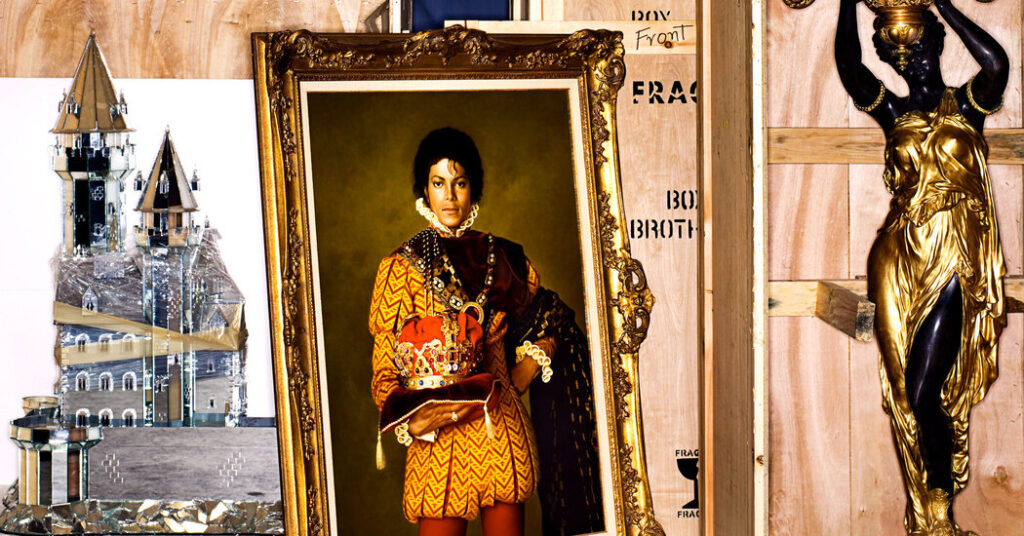
In my garage in Los Angeles, I have two huge bins of Jackson memorabilia that I can’t let go of. There’s that poster from his peak-“Thriller” era, with him in the yellow sweater vest. There’s a set of playing cards that bear his face, old copies of “Black Beat” and “Right On!” magazines that dissected every facet of his life, even a Jackson jigsaw puzzle.
But I also kept the New York Post issue with the infamous “Peter Pan or Pervert?” headline after the first child molestation allegations were lodged, in 1993. I have the issue of The National Enquirer that speculated on a romance between him and his former wife Lisa Marie Presley after their divorce, and I have the program, wrapped in plastic, from his Staples Center memorial service after his death at 50 in 2009. I have it all, still, in part because I’m a pack rat (I also inexplicably own a Bill Clinton doll with a saxophone) but also because those events track the timeline of my life, too — not just the beginnings of my fandom but also a meticulous catalog of the different M.J. eras: the white-hot stardom, the fall from grace, the comebacks, the scandals and the tumbles.
What I could never envision was an M.J. renaissance, yet we’re in the middle of one. On Broadway, “MJ: The Musical” has been packing the house for years, after being nominated for 10 Tonys and winning four. This weekend, the new biopic, starring his nephew Jaafar Jackson, is expected to be a smash hit at the box office, despite generally critical reviews. A new generation of music fans seems to be partly responsible for fueling this resurgence, discovering an artist who remains the blueprint for much of modern music. But there are also many oldheads like me taking Jackson T-shirts out of storage and streaming classic playlists.
In today’s fractured media world, it’s sometimes hard to recall just how popular Jackson was during his heyday, when he united every demographic — young and old, Black and white, urban and rural. Back then, you’d be questioned if you weren’t a Jackson fan. He was still the most popular entertainer of his time when “Bad” was released in 1987, but the conversation around him began to change. His friendships with children as he neared 30 became harder to justify. Friends would look at me and ask: Yo, is this still your dude? For real?
The answer was yes. My years of obsessively keeping up with all things Jackson were good for more than just trivia. I’d become an expert Jackson defender.
When people suggested his changing hue and his plastic surgery represented anti-Blackness, I’d point to all the ways in which he broke racial barriers, provide examples of how he uplifted Black culture and, later, challenge those who doubted he really had vitiligo. I’d explain about the abusive behavior of his father, Joseph Jackson, and the verbal taunts about his nose and how growing up in America with a beauty standard that valued white features over Black ones had warped many a mind-set besides Jackson’s. It was challenging to defend him even then, before the allegations of sexual misconduct, but when it came to mental gymnastics involving him, I had Simone Biles-level moves. The barbs of late-night comedians and magazine takedowns couldn’t throw me off balance.
My footing got less sure as things turned darker. When the first child molestation allegation surfaced in 1993, it was vigorously denied by Jackson, but it led to a multimillion-dollar settlement that forever stained him. A criminal trial in 2005 ended with an acquittal, but his back story of a lost childhood, a childlike demeanor and a fascination with all things Peter Pan was no longer so charming or nearly enough to explain away the stories of unsupervised sleepovers with children or the accusations that continually surfaced, including more just this week.
Still, the fan in me grasped onto the testimonials from well-known celebrity defenders like Macaulay Culkin, and the music journalist in me sought assurances from industry insiders who bolstered the defense theories. I also trusted my gut, believing, as with the notion of the one-armed killer in “The Fugitive,” that the implausible could also, sometimes, turn out to be true. But unlike the most fanatical followers who regarded every iteration of Jackson’s ever-changing face as beautiful and who viewed bizarre antics, such as dangling his baby off a balcony, as explicable or forgivable, I eventually grew weary of defending him, even while still loving him.
I remained a fan — just one who wanted Jackson to go back to the man I once adored, who I still believed existed somehow, even if he was unrecognizable in his current form. I wanted to focus on the man who donated millions of dollars to charities; who is said to have given Little Richard back his masters; a trailblazer whose influence allowed others to soar, from Beyoncé to Justin Bieber; the man who was a vulnerable, too-sensitive-for-the world character whose story became the basis for all the memorabilia in my bins.
I thought that moment would never come after Jackson died in 2009, just as he was preparing for yet another comeback. The dates were sold out, and even with all of the scandal and baggage, it was poised to be the event of the year.
Now, years later, the renaissance is in full swing, even as, on Friday, four people who previously denied misconduct by Jackson came forward to publicly accuse him of sexual abuse, as part of a lawsuit against his estate — allegations that his estate has denied. None of this, of course, makes it into “Michael,” which, partly because of legal complications related to an abuse settlement, ends its story in 1988, when Jackson was still the king of pop and everybody loved him.
When I arrived at the movie theater for the premiere, I found that, inside the envelope containing my tickets, there was a keepsake card of the movie poster, to mark the occasion.
I plan to add that keepsake card to my collection, another relic for the memorabilia bin.
Nekesa Mumbi Moody is a former music editor for The Associated Press and a former co-editor in chief of The Hollywood Reporter.
The Times is committed to publishing a diversity of letters to the editor. We’d like to hear what you think about this or any of our articles. Here are some tips. And here’s our email: [email protected].
Follow the New York Times Opinion section on Facebook, Instagram, TikTok, Bluesky, WhatsApp and Threads.
The post Why I Still Love Michael Jackson appeared first on New York Times.