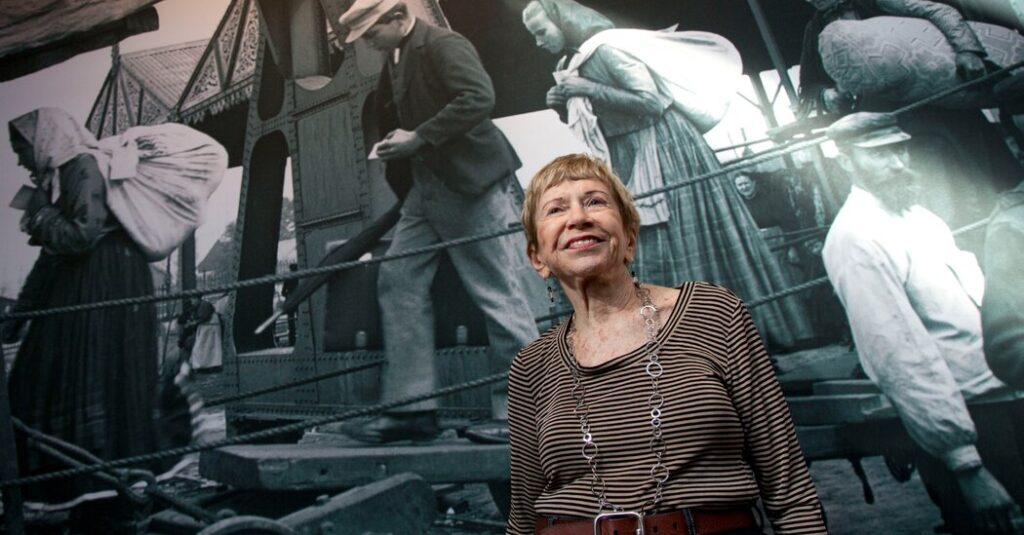
Sonia Pressmen Fuentes, an early women’s rights lawyer who told the feminist author Betty Friedan that women needed an advocacy group to fight for them the way the N.A.A.C.P. fought for Black Americans, planting the seed for the National Organization for Women, died on Dec. 20 in Sarasota, Fla. She was 97.
Her death, which was not widely reported at the time, was confirmed by a friend, Nancy Gold.
In 1965, Ms. Fuentes became the first female attorney in the general counsel’s office at the Equal Employment Opportunity Commission, a new agency that had been created to enforce Title VII of the Civil Rights Act of 1964, which prohibited discrimination in hiring and in the workplace.
Title VII, as originally written, only protected people from hiring discrimination based on race, religion and national origin. Protections based on sex were added at the last minute, but, as Ms. Fuentes discovered, many at the E.E.O.C. had little interest in fighting sex discrimination.
It was the predawn of the modern women’s movement, when male and female roles were still narrowly prescribed. Job openings were listed as “Help Wanted — Men” and “Help Wanted — Women.” Public schools required teachers to quit if they got pregnant. Airlines grounded flight attendants who married or reached their early 30s.
Invited to speak to employers and unions about the new anti-discrimination law, Ms. Fuentes found that “any reference to women’s rights was greeted with laughter,” she recalled in a 1999 memoir, “Eat First — You Don’t Know What They’ll Give You.”
In an oral history she recorded for the University of Southern California in 2021, she said the E.E.O.C. at first did almost nothing to fight discrimination based on gender.
“Whenever they would be discussing issues of law,” she told the interviewer, “I would always say, ‘Well, what about sex discrimination?’ My boss took to calling me a sex maniac because I raised that issue.”
Ms. Friedan, the author of the 1963 landmark book “The Feminine Mystique,” about the frustrations of middle-class women stuck in roles as housewives and mothers, visited the commission to research a planned second book. Ms. Fuentes, deeply frustrated, brought her aside.
“I took her in my office with tears rolling down my cheeks,” she recalled in the oral history, “and I said what this country needs is an organization to fight for women like the N.A.A.C.P. fights for its constituents.”
In June 1966, Ms. Friedan and 27 others chipped in $5 each to create what became the National Organization for Women, eventually the largest feminist group in the country. NOW was a catalyst for significant change in the American workplace and home as feminism’s second wave advanced in the 1960s and 1970s.
Another group of 21, including Ms. Fuentes, joined as additional founding members in October 1966. The organization filed lawsuits, picketed the E.E.O.C. and pressured it to enforce Title VII.
The E.E.O.C. “began to take seriously its mandate to eliminate sex discrimination in employment,” Ms. Fuentes wrote in her memoir.
She herself drafted the commission’s ruling that airlines’ policies toward female cabin attendants violated the law.
She was also a founder of two anti-discrimination groups, Federally Employed Women and the Women’s Equity Action League, which both started in 1968.
Sonia Pressman was born on May 30, 1928, in Berlin, the younger of two children of Zysia and Hinda Leah (Dombek) Pressman. Her parents had been born in a shtetl in Poland and moved to Germany, where her father owned a men’s clothing store and factory, at which her mother helped out.
In April 1933, “Jude” was painted on the window of the store to target it in a boycott of Jewish businesses organized by the Nazis. Sonia’s older brother, Hermann, said it was time to leave Germany and moved to Antwerp, Belgium.
The store and factory were sold at a steep discount, and the rest of the family also fled to Belgium. In 1934, they were granted visas to the United States and sailed for New York on the Red Star Line.
Sonia entered kindergarten in the Bronx, but soon the family moved upstate to the Catskill Mountains, where her enterprising father, who had no formal education, built 25 bungalows for summer vacationers in Monticello, N.Y.
Sonia graduated from high school there, then studied languages, psychology and business at Cornell, graduating in 1950. After a series of frustrating secretarial jobs, she entered the University of Miami Law School in 1954.
“Friends and acquaintances, like my parents, were taken aback to learn that I was thinking of becoming an attorney,” she wrote in her memoir. “Young women in the ’50s did not become attorneys. Everyone asked why I had chosen such an inappropriate occupation.”
On earning her law degree in 1957, she was hired by the U.S. Department of Justice, transferring two years later to the National Labor Relations Board, where she remained for six years.
In 1960, when she sought a job with a private law firm in Washington, she was told that her salary request — $10,000 — was unacceptable because she would be making more than some of the male attorneys. What’s more, the firm would have to go to the expense of building a women’s restroom and enforce a rule against profanity.
An interviewer at a different firm pointed to his pregnant secretary and said, “How do I know that won’t happen to you?”
Joining the E.E.O.C., which Ms. Fuentes later said she did only because she wanted a change of scene, opened her eyes to women’s issues.
In 1970, she married Roberto Fuentes. They divorced in the late 1970s. She is survived by a daughter, Zia Fuentes.
After nearly eight years at the E.E.O.C., Ms. Fuentes took a series of jobs in the private sector, first at GTE, then the nation’s second-largest phone company. As the first woman in the legal department, she was a pioneer as corporate America began its often rocky journey toward including women in the executive ranks. On Ms. Fuentes’s first day at headquarters in Stamford, Conn., a security guard pointed her to the separate elevator for secretaries.
She later worked at TRW, the giant auto parts and defense contractor, as director of compliance management, where her responsibilities included equal employment and affirmative action.
Ms. Fuentes resigned after less than three years, unhappy in the private sector. She returned to a government job with the U.S. Department of Housing and Urban Development, from which she retired in 1983.
“I was uncomfortable in the corporate world,” Ms. Fuentes wrote. “It was not the place for an outspoken, independent, liberal, Jewish woman who wanted to change the way things were done.”
Trip Gabriel is a Times reporter on the Obituaries desk.
The post Sonia Pressman Fuentes, Early Women’s Rights Lawyer, Dies at 97 appeared first on New York Times.