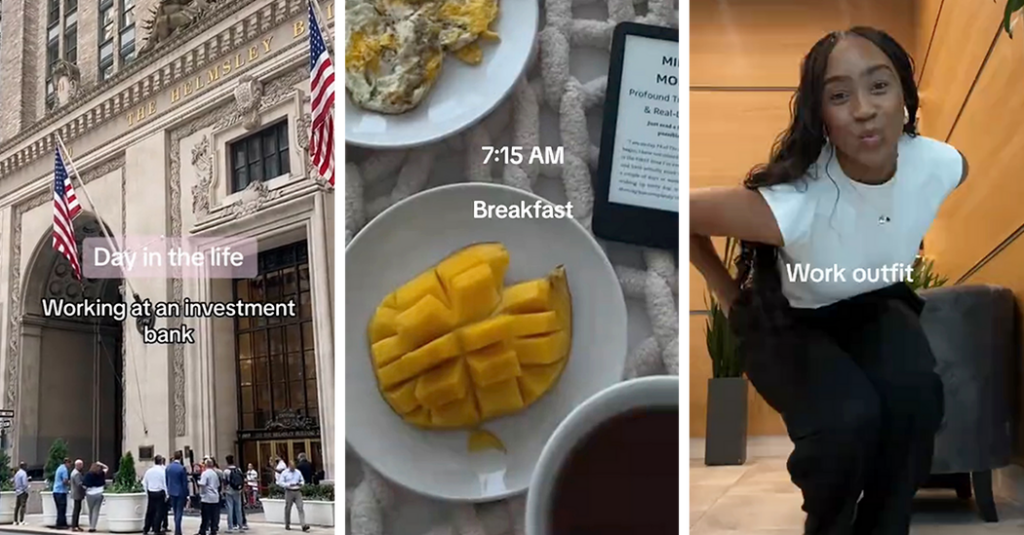
It’s 5:30 a.m. Allison Sheehan switches on the light in the bathroom of her New York City apartment and stretches in front of the mirror. “Welcome back to another morning in the life of an ‘investment baker,’ which means someone who works at an investment bank but also makes cakes,” she says at the beginning of the video, which she uploaded to TikTok in early 2025.
Tying an apron over her pajamas, Ms. Sheehan, now 26, proceeds to pipe lilac buttercream ruffles on a heart-shaped funfetti cake she had baked the night before.
At 6:50, she heads to the gym, filming herself doing crunches before heading home to shower, put on makeup and pick out an outfit. By 8:20, Ms. Sheehan heads to her wealth management job, at Goldman Sachs (she didn’t reveal the name of the bank in her videos while employed there).
In 2023, Ms. Sheehan, who has since made cakes for brands including Goop and LoveShackFancy as well as the model Gigi Hadid, was posting on social media as “The Investment Baker,” a persona she created for her custom-cake business, Alleycat.
On her Investment Baker Instagram and TikTok pages, Ms. Sheehan posted familiar influencer content like “What I eat in a week” and day-in-the-life videos, along with breakdowns of her corporate wardrobe. At the time, her DMs were inundated both with cake orders and with young women seeking advice on how to break into finance.
The finance industry remains one of the most sought-after sectors for college graduates. In 2025, Goldman Sachs saw 360,000 students competing for just 2,600 internships — up 15 percent from the previous year. It has also historically insisted that employees maintain a low profile on the internet. Ms. Sheehan was careful never to disclose the bank at which she worked in her videos, and she never filmed herself in the office, per her employer’s rules. In fact, she never discussed finance much at all. Still, the tension between the “two worlds of baking and being a financier was the whole allure,” Ms. Sheehan said.
Yet Ms. Sheehan was informed that her baking content was seen as a “reputational risk” for the firm. She was instructed to delete every post on her TikTok and Instagram and to change her handle so that it made no reference to the word “investment.” When Ms. Sheehan drew comparisons to the firm’s chief executive, David Solomon, who moonlights as a D.J., she was told she could not compare herself to him. She pushed back, saying that the firm’s policy should apply to everyone. “It doesn’t work like that,” she said she was told.
Like Ms. Sheehan, Sahilee Waitman, 28, used the fact of her employment at an investment bank as a hook for her TikTok videos. Ms. Waitman moved to New York City from Amsterdam to work in compliance at an investment bank in 2023. She soon started posting day-in-the-life content, detailing everything from her workouts to what she ate for lunch, with the goal of building financial autonomy outside her corporate role. Both women were clear that while they worked at investment banks, they were not investment bankers, often a point of contention or confusion in the comments section.
The New York Times reached out to many of the investment bank employees on TikTok, but they declined to comment for this article, fearing the risk to their reputation. The New York Times also reached out to 14 different banks, among them Goldman Sachs, but none responded to requests for comment regarding the matter of social media use among employees.
Despite these fears, investment banking content is going viral across social media. Nearly 60,400 videos tagged #investmentbanking have appeared on TikTok in recent years. Time-stamped 100-hour work weeks and late-night keyboard A.S.M.R. regularly draw hundreds of thousands of views on TikTok. Part of the appeal is that influencers offer a more realistic depiction of the world of work than can be gleaned from shows like “Industry” on HBO or from actual recruitment events.
Ms. Sheehan was determined to show that even bankers could have a life outside work. In October 2024, a year after posting her first video, a meeting with her manager appeared unexpectedly on Ms. Sheehan’s calendar. At first, she thought it might be good news. But the excitement was short-lived when she was greeted by three compliance officers. “We see you have an online persona called ‘The Investment Baker,’” she recalled them saying.
At present, there is no widely agreed-upon policy regarding employees’ personal social media use. The Financial Industry Regulatory Authority, the largest independent regulator for brokerage firms in the United States, and the Securities and Exchange Commission, a government agency that regulates the entire U.S. securities industry, have rules and guidance dictating that employees cannot share any information that is deemed confidential or in any way sensitive. But how firms apply their own internal policy is at their discretion.
Hannah Awonuga, the former head of colleague engagement at Barclays U.K. and a cultural transformation and inclusion consultant, sees both parties as at risk. Employees might find themselves on the wrong side of human resources. For employers, “once you allow staff to post freely,” she said, “you run the risk that they might express an opinion on a Saturday that goes against your values.”
For decades, “workism” — the belief that work is central to one’s identity — has infiltrated the American ethos, particularly for many city dwellers, whose hobbies and leisure activities can fall by the wayside. Increasingly, younger workers are pushing back, demanding a healthier work-life balance and actively working to decouple their identity from their careers.
The world of high finance is one of the last sectors to catch up. “Once you work in these industries,” Ms. Waitman said, “you’re essentially taught to choose one lane.” You are either a “serious professional,” she said, or a “creative.” “I just don’t believe those things are mutually exclusive,” she added.
Ms. Waitman, who is Black, hoped that by posting on TikTok, she would be promoting diversity in the industry. She received the occasional negative comment, insisting she must be a “secretary,” but a majority of her messages were positive, she said, and came from other women seeking her advice about pursuing careers in finance.
At the time, Ms. Waitman did not receive pushback from her employer on her videos, though she made sure to declare any outside business activity to compliance and her director. “I think firms are just now catching on to this,” Ms. Waitman said. “Once they find out, you have compliance on your neck.”
A recent glossy fashion spread in Interview Magazine entitled “Meet the Finest Boys in Finance” highlighted what can happen when young finance professionals attract the wrong kind of publicity. The designer-heavy photo shoot was mocked and meme-ified online for violating Wall Street’s sacrosanct rule against flashiness.
Across social media, some women were quick to point out the double standard at play. “But women get fired from Goldman for being influencers …” read one comment left on a TikTok video about the spread.
In fact, many of the people posting influencer-like content are young women, which is at odds with the traditionally male-dominated world of high finance.
A spokesperson for Goldman Sachs told Bloomberg that the interviews in Interview Magazine were not approved by the firm.
After the compliance meeting, Ms. Sheehan did as she was instructed and archived all her social media posts. Three months later, though, she put them back up. “I didn’t see my posts as a violation of the bylaws,” she said. Immediately, another meeting with compliance landed on her calendar. This time, her cake business was taking off, and Ms. Sheehan decided to hand in her resignation. (Goldman Sachs did not respond to requests for comment.)
As banks are forced to iron out their policies in an ever more online world, workers sharing the minutiae of their days is likely to become an increasing headache for compliance. “If you have five followers, there’s no need to make anyone aware,” Ms. Awonuga said. But, she added, “as more Gen Z’s come into the workplace and grow in their roles, I just don’t know how feasible it becomes to say you’re not allowed a social media presence.”
Ms. Sheehan, meanwhile, has no regrets. “I cannot believe,” she said, “that they were concerned about me making pink cakes when people are insider trading.”
The post Make Way for the Investment Bank Influencers appeared first on New York Times.