Without telling his State Department bosses where he was going, Lionel Rosenblatt bought a Pan Am ticket and traveled halfway around the world, taking one of the last commercial flights to Saigon before the city fell to the North Vietnamese on April 30, 1975.
Mr. Rosenblatt was 31, a mid-level Foreign Service officer working for the deputy secretary of state. He and a colleague, L. Craig Johnstone, had both spent years in South Vietnam, helping to support a U.S.-backed government that now seemed on the verge of collapse.
Huddling in a Washington conference room, discussing the latest news out of Saigon, they had agonized over the fate of their friends and colleagues, South Vietnamese citizens who worked with Americans and now faced the prospect of death, torture or imprisonment under the incoming communist regime.
Many of those men and women seemed to have no way out. So Mr. Rosenblatt and Johnstone took matters into their own hands, organizing a multiday rescue mission on behalf of their friends and allies.
Using a Saigon apartment as a safe house, and holding clandestine meetings at a pho restaurant and on the terrace of the Hotel Continental, the two helped about 200 Vietnamese reach Tan Son Nhut Air Base and board U.S. flights to freedom, manufacturing travel documents and paying bribes when necessary.
“It was nonstop,” Johnstone told The Washington Post this week. “I think I got one night of sleep there. And that was in a bowling alley on the air base. We were a physical wreck by the time we finally got out,” days before North Vietnamese troops seized the presidential palace and raised a Viet Cong flag.
Mr. Rosenblatt and Johnstone evaded police who worried that unauthorized evacuation efforts might lead to chaos. They also managed to avoid staff at the U.S. Embassy, who had been instructed to track down the AWOL diplomats.
Back in Washington, where they were summoned before the secretary of state, they worried they might lose their jobs.
“A stern Henry Kissinger warned them never to do such a thing again, using words like ‘irresponsible’ or ‘over-dramatic,’” The Post reported in 1979. “And then the Kissinger smile appeared. He embraced the two saying that he hoped he might have had the courage to do the same if he had been in their positions.”
Neither man was disciplined. Each received an award from the American Foreign Service Association. And while Johnstone went on to become a U.S. ambassador (he was later a deputy high commissioner for refugees at the United Nations), Mr. Rosenblatt moved into refugee work full-time, discovering a calling as he pushed the U.S. government to accept more refugees at home and to protect more displaced peoples abroad.
As president of Refugees International, he helped shape the response to some of the biggest humanitarian crises of the late 20th century, including war in the Balkans, genocide in Rwanda, famine in Somalia, and fighting in Chechnya and Sudan.
“He had a unique talent,” Johnstone said. “He could go to Bosnia or Darfur and wend his own way. He didn’t need to have a lot of support. He would attract press attention and call attention to refugee crises that nobody else knew existed.”
Jeremy Konyndyk, the current president of Refugees International, said, “He didn’t want anyone who was in a position of power being excused from the reality of what was happening on their watch.”
Mr. Rosenblatt was 82 when he died April 11 at his home in Washington. The cause was leukemia, said his wife, Ann Rosenblatt.
In diplomatic circles, Mr. Rosenblatt and Johnstone’s self-financed trip to Saigon became the stuff of legend. The episode helped inspire a 1990 TV movie, “Last Flight Out,” which featured a composite character (“Larry Rose”) based on the two men, and burnished the image of a diplomat and aid worker whom colleagues found highly personable yet occasionally exasperating.
“Conventionality was never his strong suit,” said Parker W. Borg, a former U.S. ambassador.
In the early 1970s, Mr. Rosenblatt took a two-year hiatus from the Foreign Service to work as a reporter for the Bangor Daily News in Maine. In 1986, he and his wife began spending their weekends in rural Virginia, where they ran a short-lived llama farm near Woodstock. Mr. Rosenblatt thought that llamas could offer a financial lifeline to Southeast Asian refugees, and started the farm as a pilot project. “It wasn’t too prosperous,” his wife said.
“Lionel is very disorganized, but somehow it doesn’t matter,” Louis Wiesner, a former U.S. diplomat and refugee advocate, observed to The Post in 1979. “In the end he is extraordinarily effective.”
The oldest of four children, Lionel Alexander Rosenblatt was born in New Rochelle, New York, on Dec. 10, 1943. He grew up in Bellport, on Long Island, where his father was a nuclear physicist at the nearby Brookhaven National Laboratory. His work took the family to Haifa, Israel, for two years, and encouraged a wanderlust in Mr. Rosenblatt that contributed to his decision to join the Foreign Service in 1966.
By then, Mr. Rosenblatt had graduated from Harvard College and spent a year at Stanford Law. His first posting was to Sri Lanka, then known as Ceylon, where he met Ann Grosvenor, a State Department secretary he married in 1971.
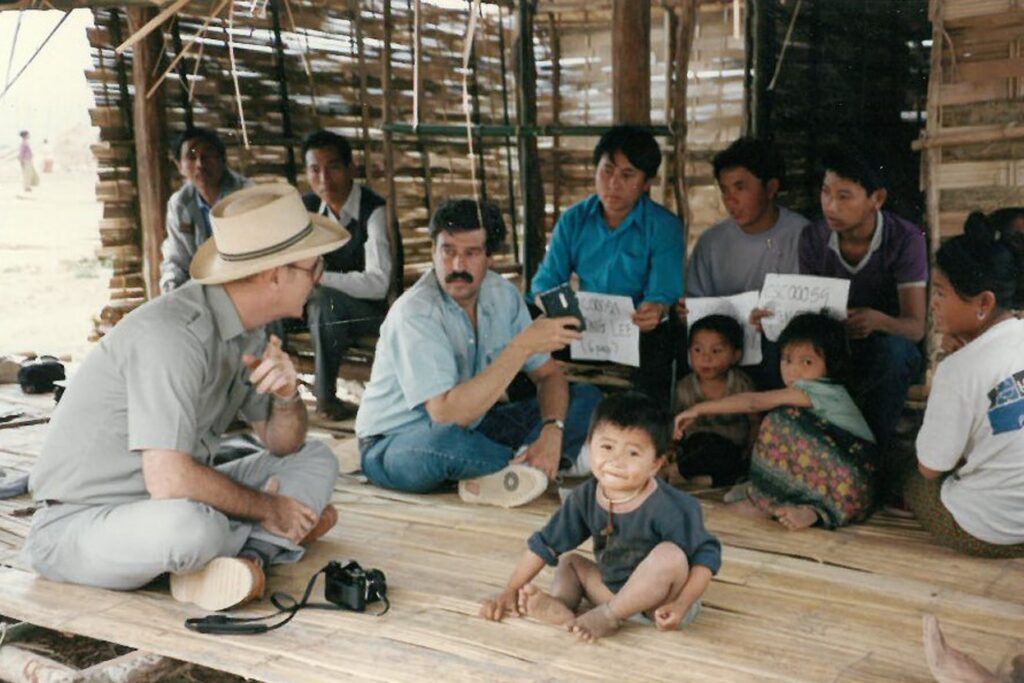
She became a nurse with the International Rescue Committee in Thailand, treating refugees with gunshot wounds, malaria, dysentery and other maladies. Mr. Rosenblatt, meanwhile, worked as the State Department’s refugee coordinator in Bangkok, helping hundreds of thousands of people — from Laos, Cambodia and beyond — make their way to the United States.
Mr. Rosenblatt was especially close to groups that had aided U.S. troops and diplomats, and became known as a devoted champion of the Hmong, a minority in Laos that helped the U.S. during the so-called “Secret War” against the communist Pathet Lao.
When he learned that Hmong were not being prioritized for resettlement, Mr. Rosenblatt and his staff began obscuring the group’s ethnic identity on refugee documents, helping thousands of Hmong families reach the U.S.
“It was always a mystery to me why they were good enough to fight for us but not good enough to consider for resettlement,” he told a television interviewer.
Mr. Rosenblatt retired from the State Department in 1988 and, two years later, became the president of Washington-based Refugees International. He “really took the organization to the next level,” Konyndyk said, imbuing it with “that ethos of challenging power that he showed in the Saigon case.”
While in Bosnia in 1992, Mr. Rosenblatt bumped into veteran U.S. diplomat Richard Holbrooke, who was out of the State Department at the time and trying to understand what was happening in the besieged capital of Sarajevo.
Mr. Rosenblatt had a seat on a U.N. convoy that was headed to the city, past an array of Serbian military checkpoints. To get Holbrooke in, he pieced together a fake U.N. identification badge using a cigarette lighter, some plastic and a mug shot of a man who only vaguely resembled the longtime diplomat.
“It was very Lionel — high-risk, unorthodox, bending the rule book,” Konyndyk said. “It’s not the most professional looking thing, so when he gives it to Holbrooke he says, ‘When you show it to the guards, hold this corner, because this corner’s not fully together.’ But it works. Holbrooke gets in. He’s able to see Sarajevo besieged, firsthand. And he comes back absolutely impassioned about the need for U.S. leadership to end the war, and with the dust on his boots to give him credibility to carry that message.”
Holbrooke went on to serve in the Clinton administration, helping orchestrate the 1995 Dayton peace accords that ended the Bosnian War. “There’s a good chance that if Lionel doesn’t jury-rig that ID badge while they’re having dinner in Bosnia, that plays out very differently,” Konyndyk said. “It’s a wonderful example of how his passion and his willingness to push the envelope could yield real impact for refugees and for displaced people.”
Looking back on Sarajevo in his memoir, “To End a War,” Holbrooke described Mr. Rosenblatt as “the most dynamic person I knew in the refugee field.”
He went on to pay homage to Mr. Rosenblatt’s unusual tactics, writing that under his direction, Refugees International “made a name for itself by pressuring — or, not to put too fine a point on it, harassing — governments around the world into doing more for their unwanted refugee populations.”
Working in the humanitarian sector, “you develop a sense as to what you can do and what you can’t do,” Johnstone said. “I mean, would you fly off today to Somalia or Sudan? The answer to that is, Lionel would.”
In addition to his wife, Mr. Rosenblatt is survived by two brothers and a sister. He stepped down from Refugees International in 2001 and, two decades later, was reminded of his Saigon experience during the bloody and chaotic U.S. withdrawal from Afghanistan.
Asked what he would say to Afghans who had helped the United States and were trying to flee the Taliban, he told the New Yorker: “It’s disgraceful, but I think I’d say you can’t count on the United States. Come up with a plan on your own.”
The post Lionel Rosenblatt is dead at 82. He defied his bosses to help hundreds flee Vietnam. appeared first on Washington Post.