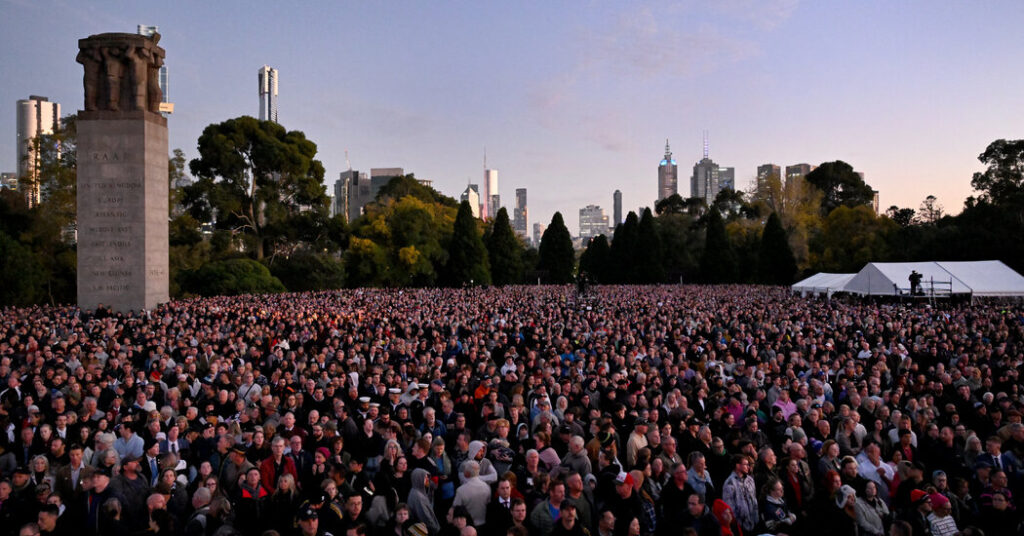
The annual dawn services marking Anzac Day in Australia are normally a solemn affair, with a hushed silence enveloping those gathered in the darkness to honor the country’s war dead.
But on Saturday, in three of Australia’s biggest cities, the services were disrupted by loud booing, raucous enough to register clearly on national broadcasts carrying the ceremonies live. Indigenous speakers were the targets.
The disruptions in Sydney, Melbourne and Perth occurred during the “Welcome to Country,” an Aboriginal custom that has become common at public events in Australia, meant to acknowledge the original inhabitants of the land. The booing was widely condemned by political, military and civic leaders, and it betrayed simmering tensions over the country’s identity.
Shortly after Mark Brown, an elder with the Bunurong people of the area encompassing Melbourne, began speaking at a war memorial in the city, loud boos erupted from the crowd.
“I’m here to welcome everybody to my father’s country,” Mr. Brown said through the interruptions. “But before we do that, as always, we take a moment, we pay our acknowledgments, and we pay our respects.”
Jacinta Allan, the premier of the state of Victoria, which includes Melbourne, called the disruption “pure disrespect” in a statement, saying it had come from “a hateful few.”
“A moment meant for silence and reflection was deliberately broken. To shatter it with boos is not protest,” she wrote. “And it is certainly not patriotism.”
The police in New South Wales, which includes Sydney, said they had arrested a 24-year-old man on “nuisance” charges during the service for booing, and that they had removed others from the event.
Premier Chris Minns said the booing in Sydney had come from “a small number of people,” and that it had been drowned out by applause for the speaker, Ray Minniecon, an Indigenous pastor who is also a military veteran.
Anzac Day is a cherished national holiday that celebrates the landing of Australian and New Zealand troops on the Gallipoli Peninsula during World War I. (Anzac stands for Australian and New Zealand Army Corps.) Thousands of Indigenous Australians are estimated to have served in the country’s military during the two world wars.
The furor over the ceremonies was the latest flashpoint in tensions over how to acknowledge the history of European colonization of Australia, and over what it means to be Australian today.
At least some of those who booed appeared to sympathize with a group called March for Australia, which has held anti-immigration rallies in recent years that drew thousands of people. A government minister described the movement last year as “far-right activism grounded in racism and ethnocentrism.”
Right-wing groups have protested “Welcome to Country” acknowledgments as alienating non-Indigenous Australians by telling them that they don’t belong. March for Australia said in a Facebook post on Friday that many of its members “feel the need to boo” at Anzac Day services.
The acknowledgments of Aboriginal landowners, the group said, is “a weapon to make the people who built and defended Australia feel like perpetual outsiders, and it needlessly pits Aussies against Indigenous Australians.”
Australia has grappled in recent years with the legacy of its colonial past, with fierce disagreements over whether to enshrine political representation for Aboriginal Australians and how to mark the anniversary of the arrival of the British in Australia.
Victoria Kim is the Australia correspondent for The New York Times, based in Sydney, covering Australia, New Zealand and the broader Pacific region.
The post Indigenous Speakers Are Booed During Commemorations of Australia’s War Dead appeared first on New York Times.