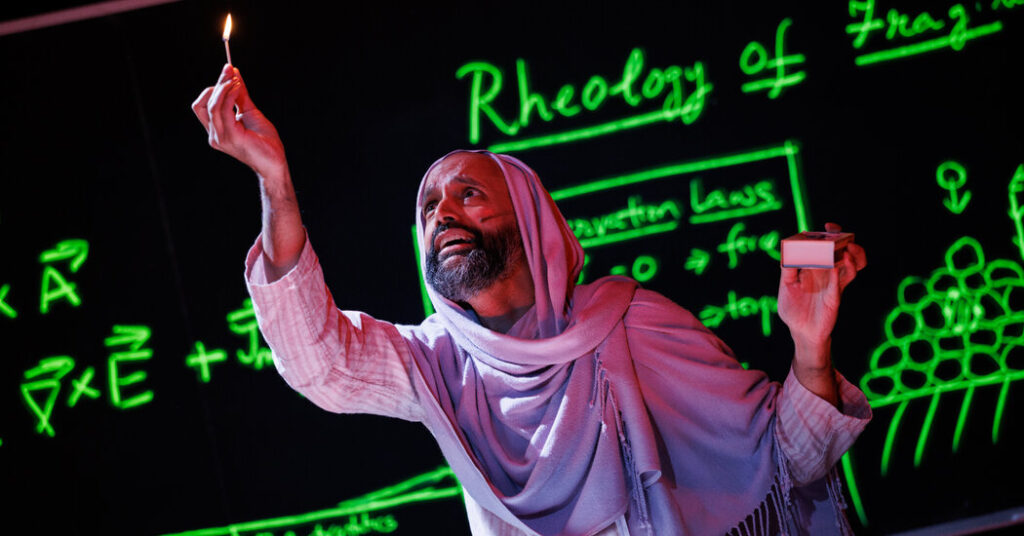
At a recent performance of “Rheology,” just after the theoretical physicist Bulbul Chakraborty delivered an illuminating lecture on the nature of matter, she suddenly choked in apparent life-threatening discomfort.
An audience member exclaimed: “Isn’t anyone going to help her?” Their anger soon focused on Shayok Misha Chowdhury, Chakraborty’s son sitting in the audience at Playwrights Horizons, who revealed himself as the director of the shocking tableau. Later, Chakraborty enacted her own death, lying inert under a sheet.
The dynamic between Chakraborty, 72, and Chowdhury, 41, seems loving, intense, witty and respectful. The play — written by Chowdhury (a theater maker known for “Public Obscenities” and “Prince Faggot”) with his mother, a professor at Brandeis University — is a very personal investigation into her dying, which he is terrified of.
Chakraborty, in response to her son’s distressingly acute alarm, delivers calm, science-based explanations of mortality, using rheology — the science of how matter responds to external stresses — as a narrative frame to allay his fears, examine her own feelings about mortality and consider their intense relationship.
“Love and death are inextricably linked in Bengali literature and music,” Chowdhury said. “My mother’s father passed before I was born, and her grief at his loss was a constitutive element of her identity.”
Chakraborty grew up in India, singing “Rabindrasangeet,” a repertoire of songs about the natural world by Rabindranath Tagore (1861-1941), a Nobel Prize-winning Bengali poet and dramatist. Chowdhury’s father, Partha, 71, is also a physics professor.
Mother and son have both won Obie Awards; Chowdhury in 2024 for directing “Public Obscenities,” and Chakraborty for her performance in “Rheology,” after its premiere at the Bushwick Starr last year.
The exchanges between Chowdhury and Chakraborty in “Rheology” are in Bengali and English. When he imagines his life devoid of meaning without her, she tells him, “Natok korish na” (“Don’t be so dramatic”). She has her own loving hypothesis for him to test: that he has a life to live after hers is over. Fragile matter has its own rheology, Chakraborty says: “You might fall apart. But when you do, you’ll rearrange yourself.”
Before a recent performance, Chowdhury discussed his artistic inspirations. These are edited excerpts from the conversation.
Bedtime lullaby
When Chowdhury was little, Chakraborty would sing Tagore’s poem “Diner Sheshe Ghumer Deshe” to him at bedtime. Originally published in 1907 by Tagore as “Shesh Kheya” (“The Last Boat”), and put to music in 1922 by Pankaj Kumar Mullick, the song became known by the first line of the poem.
In “Rheology,” Chowdhury recites the opening lines: “Diner sheshe, ghumer deshe, ghomta pora oy chhaya bhulalo re, bhulalo mor praan.” (“At day’s end, in the land of sleep, there’s a shadow there, with her veil drawn low, lulling me into forgetting, washing my waking life away.”) The lullaby has a “tragic quality,” Chowdhury said.
“Ghomta” is a word that’s difficult to translate, he said, because it refers to the way a woman, or a wife, covers her head with the loose end of sari as a gesture of modesty or respect. “I remember being intrigued by Tagore’s choice to make this shadowy figure, this personification of death, a woman wearing a ghomta.” The gesture of the ghomta, he said, is one he is parodying in “Rheology” when he puts his mother’s pink scarf around his head to become her widow.
Radio daze
As a boy, Chowdhury was enthralled by two Tagore plays played on tape during car rides: “Raktakarabi” (1924, “Red Oleanders”) and “Dak Ghar” (1912, “The Post Office”). The plays were produced by a theater company, Bahurupee, founded by the husband and wife Sombhu and Tripti Mitra. Chowdhury was particularly struck by Tripti’s “explosion of very feminine grief” in “Blood Oleanders,” in her role as Nandini.
Dad’s starring moment
At family get-togethers featuring song, dance and poetry, which the young Chowdhury would organize, his father would recite Tagore’s poem “Jhulon” (“Swing”). “Growing up, my dad heard a recording of Tagore at the end of his life reciting this poem,” Chowdhury said. “His parody of the poem mimics Tagore as a toothless old man, reciting this poem about ‘playing with death.’ It would crack everyone up, including my grandmother,” who was herself nearing death.
‘The Apu Trilogy’
Satyajit Ray’s “The Apu Trilogy,” especially the first installment, “Pather Panchali” (1955), is a favorite of Chowdhury’s. A scene featuring the death of a daughter, Durka (Runki Banerjee), and the shattering grief of her mother and father, played by Karuna Banerjee and Kanu Banerjee, remains a strong influence. “Even talking about it gives me the chills,” Chowdhury said.
‘The Hours’
As a teenager, Chowdhury watched Julianne Moore’s character, Laura Brown, in “The Hours” as she tussled with the “largeness of her feelings.” It mirrored Chowdhury’s own hidden turmoil, and the expressions of grief he watched onscreen “were so ear- and heart-splitting, it felt like if my loved ones — if my mom — were to die, this is what it would sound like. It would tear — it must tear — the world open.”
‘Dancer in the Dark’
Björk’s performance as Selma Jezkova “kind of broke me,” Chowdhury said, recalling that it was probably the hardest he’d ever cried up to that point in his life. It was an “unflinching approach to tragedy, to the worst things that might destroy a human life. Since I harbored my own nightmares about how my seemingly good and easy life might unravel at any moment, this film, and films like ‘The Hours,’ mirrored my sense that there’s an ocean of tragedy and grief surging underneath the surface of our lives, threatening to change everything.”
Annie Baker, Amy Herzog and Richard Linklater
As a contrast to epic performances of grief, Chowdhury is drawn to the sensibilities of Baker, Herzog and Linklater, “but also a little terrified by their force,” he said. “As a maker, I’m equally attracted to a really granular, dare I say Chekhovian, naturalism.”
For Chowdhury, Baker’s “The Flick,” Herzog’s “4000 Miles” and Linklater’s “Boyhood” allow “very human dramas to bubble up unexpectedly from the textures of daily life,” he said. “As a gay artist only child of two academics, two scientists, I had a complicated relationship to exaggerated performances, to things that called attention to oneself cosmetically or aesthetically. I’ve always toggled between a kind of magnetic attraction and repulsion to high drama. My own creative time signature tends toward the more patient rhythms of real life.”
The post Can Physics Soften a Mother’s Death? appeared first on New York Times.