BOISE, Idaho — An invasion of stowaways had arrived from liberal coastal states, the lawmakers asserted. “Decisive action” was needed, one said, to “slash this problem through the heart and stop the proliferation.” Failure to act, another warned, would transform Boise and its neighbors in the wider Treasure Valley into nothing less than “sanctuary cities.”
The cause of their intense alarm: rats.
In a recent legislative session gripped by cost-cutting and culture war issues, state lawmakers here also spent hours debating a surge in foreign-to-Idaho rodents menacing Boise-area gardens and kitchens and threatening agriculture and public health. Bipartisan bills called for naming two species — Norway and roof rats, both native to Asia — as invasive, dangerous and worthy of state action.
Despite pleas for help from local officials, the proposals died amid concerns of government overreach. Even so, the rats’ starring role at the Capitol reflected the latest growing pain for a state that has undergone one of the nation’s most rapid population booms in recent years. And given that much of the growth since 2020 has been driven by an influx of Californians, it is perhaps no surprise that lawmakers also linked the rats’ appearance to migration from blue states.
“What’s suspected is that these rats basically hitchhiked in storage containers that would be moving furniture from residences in some major city on the West Coast into Idaho,” state Sen. Steve Berch, a Boise Democrat who co-sponsored an anti-rat bill that mandated a state-level response. “People are moving into all parts of Idaho, which means these rats can turn up anywhere in the state.”
There is no concrete proof tying the rat boom to what some here call “C.O.W.s” — California, Oregon and Washington transplants. Both historical surveys and pest management operators’ testimony indicate that the presence of Norway rats, the sizable rodents familiar to residents of Washington and New York, predates recent years. Roof rats, which do scurry across roofs and tend to prefer warm or coastal regions, are more likely new arrivals, Idahoans say.
But research suggests that rats are thriving amid a warming climate and denser human population — both features of modern-day Idaho. And no matter the rats’ origins, the irrigation canals that weave through the Treasure Valley offer convenient thoroughfares for rodents that are strong swimmers.
“It’s just a built-in, natural rat highway that allows them to move basically from neighborhood to neighborhood,” said Bob Mitchell, owner of Capitol Pest Management in Boise.
The Treasure Valley is now among many urban areas contending with a gnawing rat problem, many of which worsened after the covid-19 pandemic. Washington recently turned to rat birth control and improved trash disposal, while New York appointed a rat czar. Teams of terriers have been deployed in both cities.
Berch began hearing about rats and noticing spiraling sightings on Nextdoor about three years ago. Ground zero, everyone seemed to agree, was the suburb of Eagle, where rapid residential growth offered plenty of infrastructure for rats to infiltrate. He teamed up with one of the most hard-right lawmakers in a Republican supermajority to sponsor what they named the “Rodents of Unusual Size Act.”
Inaction, they warned, could eventually cost the state millions of dollars in damage to crops and livestock feed, disease response and property destruction. They acknowledged that major U.S. cities had failed to vanquish the pests. But the Canadian province of Alberta’s successful rat control program could be Idaho’s model for early intervention, they said.
The attention at the Capitol was cheered by Boise city council member Jimmy Hallyburton, who represents what he calls the city’s rat “hot spot.” While door-knocking ahead of last fall’s election, he was stunned by the volume of rat complaints he heard. By early this year, he said, he was getting about five rat-related emails a week from frustrated Boiseans.
Figuring rat riddance was a unifying political cause, Hallyburton soon invited the director of weed, pest and mosquito abatement for Ada County, which includes Boise, to a council meeting. Rats were a growing problem, the director confirmed in a presentation that listed “prevent rat apocalypse” among the goals. But without direction from the state, he said, his department had little authority to do anything.
A conservative city council member, Luci Willits, urged state lawmakers to act, citing stories of rats in dishwashers and attics and entering homes through pet doors.
“Last night, I got an email from a family that said they could no longer enjoy sitting out in their hot tub because the rats have invaded the base and cover. The horrors are real,” she said while testifying in favor of Berch’s bill. “I’m pro-life — except for the rats. They need to go.”
A 30-year veteran of the pest control industry, Mitchell is known to his customers as Bugman Bob and says most calls he gets are about ants and wasps. But rat calls are rising.
Mitchell pointed on a recent morning to a tunnel next to a nearly dry canal in West Boise: perfect for nesting. The thick vegetation farther down: excellent habitat. The seeds in the reeds: rat food. A nearby marsh: rat water source.
Across the canal was Mitchell’s target, a tidy four-bedroom house on a quiet street of green lawns and American flags. He had been hired by a realtor who had just sold the property, the listing for which boasted of “rare parkside living!” But beneath the floor lurked a rat problem.
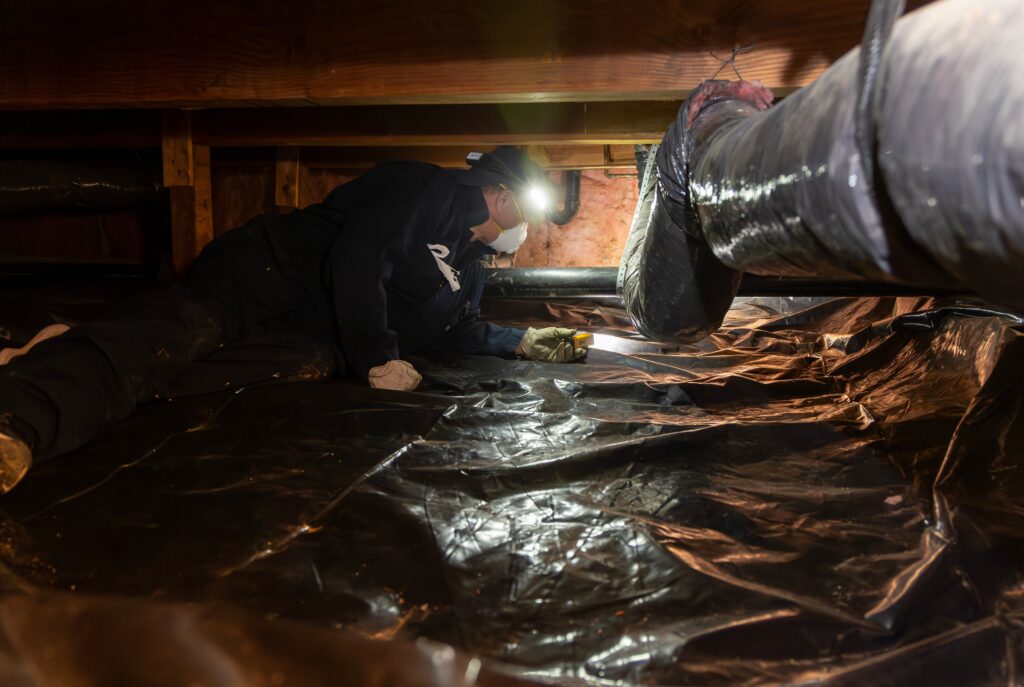
Dressed in coveralls and a face mask, Mitchell squeezed through a hole in a hall closet into the home’s crawlspace, noting immediately that it “smells like the boys’ bathroom at the second grade” — a telltale sign of rats. On the moisture barrier below, he spotted feces, tiny pools of urine and, in the dust, constellations of dots: rat pawprints.
The rat explosion may bring business, but Mitchell insisted he was not celebrating. Rats are disgusting, destructive and disease-carrying, he said.
“If somebody was like, ‘You know what, Bob, we’re gonna take three fingers off your left hand, and no more rats in the Treasure Valley.’ Oh, I’d do it in a minute,” Mitchell said. Not that he thinks any effort to beat them back would work: “Oh no, that bridge burned down three years ago.”
As rat proposals made their way through the legislature, the Idaho Pest Management Association emerged as their primary opponent. Representatives raised the specter of government workers inspecting homes, and of neighbors, well, ratting out neighbors who harbor rodents. But mostly, the association made clear, it did not want government competition.
“We agree rats need to be taken care of,” Ben Miller, an association board member, told a House committee last month. “We feel we can take care of it better than anybody out there.”
In Idaho’s House, where any government program is viewed with skepticism, a rat bill was a bridge too far for many Boise-area Republicans, let alone those from elsewhere. “This is really a local issue,” said Rep. David Leavitt, a southern Idaho Republican. “The danger of all this is that every problem seems to become an excuse for government expansion.”
The rat bills’ demise frustrated Berch, who said they did not require the state to do much beyond studying, coordinating and educating. If anything, he argued, legislation would be a win for pest control companies, likely leading to government contracts. But he also predicted that the naysayers might soon face a reckoning.
“Vermin knows no partisanship,” Berch said. “They’re going to get into your pantry whether you’re a Republican or a Democrat.”
That message is echoed by Eagle resident Jane Rohling, who has become the region’s unofficial rat tracker as the administrator of the 1,200-member strong Nextdoor group “Rats in Eagle and Beyond.”
An avid gardener and longtime wildlife educator, she spent decades cultivating a backyard Eden for birds and squirrels. Then, in 2022, she was sitting at her kitchen counter when she spotted a new species dash by her window. It was a Norway rat — the first of dozens she has since spotted circling the base of her bird feeder, skittering across a fence, climbing her trumpet vine and lying dead in her traps.
Rohling dove into learning about rats and sharing information with her “rat group” — and fortifying her home. Rohling said she has spent nearly $40,000 to replace a deck that rats nested under with pavers and a moisture barrier, insulation and ducts that rats damaged. Given the rats’ non-native status, Rohling says she has no qualms about dispatching them, though she eschews poison, which can harm other wildlife.
Her theory is that rats were already around and exploded alongside growth.
“Idahoans think Californians have brought every possible evil to this area, whether it’s liberal politics or rats,” she said, though she noted that most Californian newcomers are conservative. “We just had the perfect storm here to end up with this problem.”
Over in West Boise, Mitchell was finishing the rat job, which he estimated would cost upward of $700.
He had already blocked rat entry points. Now he pulled a jar of organic peanut butter from his “rodent bag,” then used his gloved pinkie to mix a dollop with crumbled rat droppings he had collected. He smeared the mixture — foul to humans; appealing to rats — on blocks of toxic bait, which he would screw into posts in the crawl space and plant inside boxes armed with snap traps.
“Once we get one rat to feed on it, if there’s more down there, now they’ll all come to that same spot to feed,” he said.
Six days later, Mitchell returned to the house to find a deceased rat in a trap. He planned to follow up with the new owners once they moved in. He figured they might need his services.
The post Bills to tackle a rat boom died in a state Capitol. The rats did not. appeared first on Washington Post.