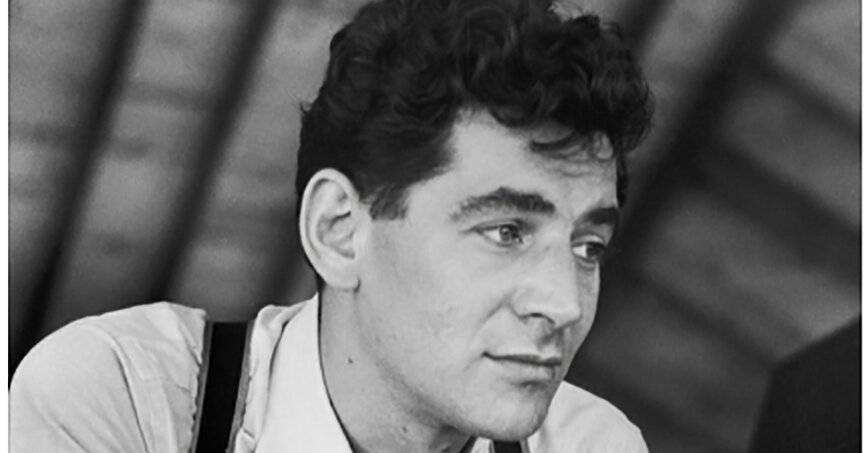
Some documentary portraits introduce you to a person you ought to know better, and some cast fresh light on a person you think you know. But “Bernstein’s Wall” (in theaters), directed by Douglas Tirola, takes a third approach. Its subject, the conductor and composer Leonard Bernstein (1918-90), was a celebrity in his time, not least for his many years at the helm of CBS’s internationally broadcast “Young People’s Concerts.” His political views and activism were no secret, either.
So “Bernstein’s Wall” doesn’t tell us new information; instead, it makes an argument about the urgent necessity of promoting art for the preservation of democracy, and it uses Bernstein as the spokesman for that case, in his own words. In fact, the new documentary is entirely narrated by Bernstein, using footage from archival interviews, like an extensive conversation with Bernstein’s friend and eventual biographer, John Gruen, in the late 1960s and outtakes from the production of Peter Rosen’s 1978 film “Leonard Bernstein: Reflections.” Archival video and photographs round out the documentary. Often Bernstein speaks straight to the camera, candidly discussing his views on freedom, art and creativity.
That’s where his interests — or the film’s, anyhow — are centered: his belief that art can “move people whereby they can wake up and be active,” as he puts it. His best demonstration is himself, it seems. While Bradley Cooper’s 2023 biopic, “Maestro,” examined the relationship between Bernstein and his wife, the actress Felicia Montealegre Bernstein, “Bernstein’s Wall” focuses more squarely on Bernstein’s advocacy for antiwar causes, the civil rights movement, human rights and world peace. We hear him speak repeatedly about his belief that artists are natural dissenters because freedom is essential to artistic expression. He voices frustration with politically divisive figures and admiration for those who unite and inspire, particularly John F. Kennedy.
He also addresses several instances of backlash to his politics, including a gathering at his home raising money for the Black Panthers, made controversial by Tom Wolfe’s New York Magazine article “Radical Chic: That Party at Lenny’s,” which Bernstein calls “lies.” And he speaks with frustration about negative politically tinged responses to his work, particularly “Mass,” which premiered at the opening of the Kennedy Center in 1971. He’s especially frustrated by Harold C. Schonberg’s dismissive review in The New York Times. (The movie suggests that President Richard M. Nixon’s chief of staff, H.R. Haldeman, had been tipped off to the negative review coming in The Times, according to archival audio from the Nixon White House tapes; the review was actually published in the morning paper on the day this conversation between Haldeman and Nixon was recorded.)
The movie does explore Bernstein’s personal life. He speaks frankly of his contentious relationship with his father, whom he hated for his treatment of his wife and children and yet venerated for his love of learning. Bernstein’s sexuality is largely unpacked quietly, via onscreen text from letters to important people in his life, including the composer Aaron Copland and Felicia — a method that fits his nearly lifelong public silence about his sexual relationships with men.
Mostly, though, the film dwells on what Bernstein found uplifting — the idea that music, and art more generally, can be an elevating and engaging experience for everyone, and that it has great potential as a uniting force in a divided world. That, he tells us, is what drove his decision to talk to audiences, especially young ones, and to work to build a more “cultured” America. The two things, music and freedom, go hand in hand.
So while Bernstein’s life is at the center of the documentary, it’s really his philosophy of art that is the focus. It feels like the filmmakers found in Bernstein a mouthpiece for a view worth advancing, in a country increasingly hostile to the arts — particularly the fine arts — as a public good. (It’s worth noting that the film had its festival premiere in 2021, before federal cuts to arts funding and the imminent Kennedy Center shutdown.) That Bernstein seemed willing to speak directly to audiences about classical music, to promote popular culture like the Beatles and to integrate jazz and blues elements into his work (such as “West Side Story”) made him an ambassador to the broader culture in his day. But while his celebrity has largely faded, “Bernstein’s Wall” makes the case that his charge to artists to lead the way in culture is timeless, and more vital than ever.
Alissa Wilkinson is a Times movie critic. She’s been writing about movies since 2005.
The post Zeroing In on the Joy Leonard Bernstein Found in Music appeared first on New York Times.