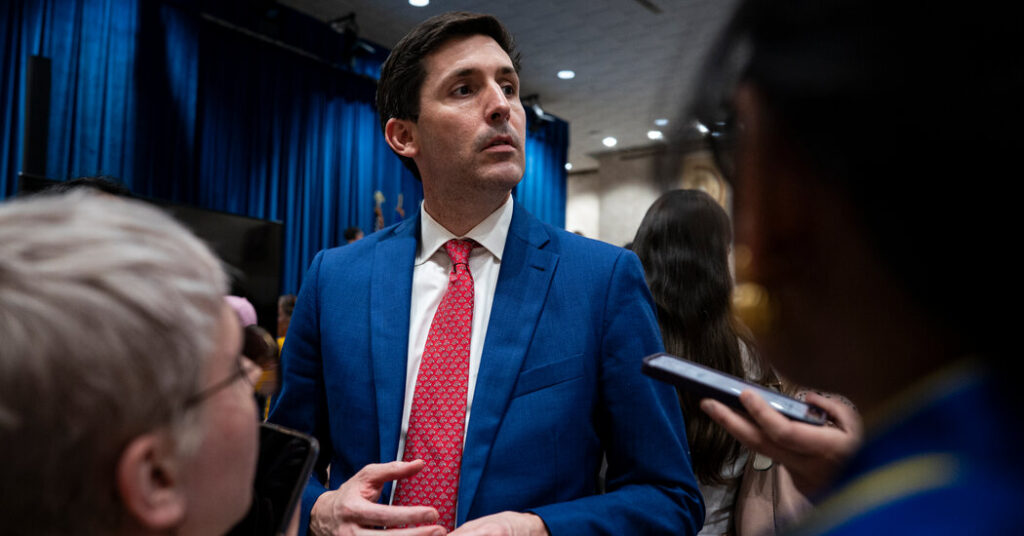
For most of last year, Calley Means, a top aide to Health Secretary Robert F. Kennedy Jr., was advising on changes to the American health system while running a rapidly growing wellness company poised to benefit from Trump administration health policies.
Records released to The New York Times by an ethics office at the Department of Health and Human Services show that Mr. Means held between $25 million and $50 million in stock in the company, Truemed, through November, as he continued to serve as its president. For months, Mr. Means has ignored questions from Democrats in Congress about his finances, including the extent of his stake in Truemed, and how they related to federal policy.
Truemed helps people buy products, including $10,000 saunas and radiation-blocking underwear, with health savings accounts that are not subject to federal income tax. President Trump broadened the pool of people who could use such accounts last summer when he signed a wide-ranging law allowing an estimated 10 million additional Americans to open health savings accounts.
The records The Times obtained cover a period when Mr. Means worked as a special government employee. In November he became a permanent full-time employee and, he said, divested and resigned from Truemed.
“When I was asked to serve as an S.G.E., I worked to support wins like removing food dyes and flipping the food pyramid — never touching H.S.A. policy,” Mr. Means said in a statement. “When asked to join full time, I fully divested shares from the thriving company and nonprofit I built to incentivize healthier food.”
He said that some people thought he was “crazy” to leave the thriving company he founded, but that “the decision to support the Trump administration’s efforts to reverse childhood chronic disease is the best professional decision of my life and I have no regrets.”
Kush Desai, a White House spokesman, said, “Calley Means complies with all ethics and conflict of interest requirements” and plays “no role” in policy affecting health savings accounts. Andrew Nixon, a Health Department spokesman, said Mr. Means complied “with all applicable ethics laws and regulations.”
“Mr. Means has been an invaluable asset to Secretary Kennedy and the Trump administration, advancing key priorities to improve health outcomes while strengthening nutrition and public health policy,” Mr. Nixon said in a statement.
In his special government employee role, Mr. Means was permitted to keep his stake in Truemed under ethics rules that also allowed him to bypass public reporting obligations but barred him from being involved in policymaking related to his financial interests. He was only required to file financial disclosures when he joined the Health and Human Services Department as a full-time employee in November.
Having duties as an officer and top shareholder at a health company while working on federal health policy is a problem, said Anthony Alfieri, a professor of law, public health sciences and ethics at the University of Miami.
“Dual roles create divided loyalties and create an appearance of a kind of double game for personal interests and public policy,” he said. “And that is as troubling for Americans, because it creates a sense of distrust and a sense that public officials are advancing their own interests over the interests of ordinary Americans.”
Mr. Trump has relied heavily upon on special government employees in his second term, including Elon Musk and the venture capitalist David Sacks, who both had influence over areas touching on their business interests. Such employees are expected to perform “important, but limited, services to the government” and work for no longer than 130 days. Many of them have traditionally served more narrow roles as private-sector experts on advisory boards.
In the Trump administration, those special government employees have been given broad mandates to juggle the work of running businesses while changing policies that could affect their ventures.
Mr. Means sold his stake in Truemed late in 2025 to the venture capital firms Andreessen Horowitz, which invests in a number of health and wellness companies, and Bessemer Venture Partners, according to a person familiar with the transaction. Such sales are not unusual among business owners who divest when they go into government, said Richard Painter, a former White House ethics lawyer under President George W. Bush and a professor at the University of Minnesota.
Truemed announced late last year that it had raised $34 million in venture capital funds and had tripled its year-over-year revenue growth for the previous two years. The fund-raising was completed before Mr. Trump’s inauguration, a Truemed spokesman said.
The financial disclosures also show that Mr. Means worked until November on the board of End Chronic Disease, a nonprofit that hired a lobbyist late last year to promote the HOPE Act, a bill that also proposed expanding access to tax-advantaged savings accounts for medical expenses. Mr. Means said that he had no knowledge of the lobbying and that it occurred after he resigned.
Truemed operates by enlisting online medical providers to supply customers with so-called letters of medical necessity that attest to their need for products like supplements, fitness devices and cold-plunge pools to prevent or treat medical conditions. With those letters, the company tells people, they can use health savings or flexible spending accounts to buy the items.
The accounts allow people to set aside a limited portion of their income, without paying federal income tax, for qualified medical expenses.
But the letters facilitated by Truemed sometimes misapplied medical research and contained incorrect or extraneous information, The Times found last year. The Internal Revenue Service warned in 2024 that “general health and wellness” purchases were “not considered medical expenses under the tax law.”
Truemed partnered last year with a meat company to help people buy products like ground beef and hot dogs with money from tax-favored accounts.
Mr. Means’s financial disclosure records, which he signed in September, also list a $40,000 speaking fee to be paid for appearing next month at Meatstock, a convention in Tennessee sponsored in part by ranchers and meat vendors. Mr. Means said this month that he did not and does not plan to accept the fee.
New dietary guidelines released earlier this year by the Trump administration put red meat near the top of the food pyramid. While special government employees are allowed to accept income outside of government service, Mr. Painter said meat-related income would have created an appearance of impropriety for a special employee or top adviser.
After Mr. Means divested from Truemed late last year, he was no longer bound by ethics rules walling him off from policies that could enrich the company.
In January, health savings accounts emerged as a centerpiece of President Trump’s “Great Healthcare Plan.” In an Oval Office address, Mr. Trump said his administration wanted to limit subsidies for people who buy insurance through the Affordable Care Act, furthering a policy that in his second term has left many with crippling premium increases. He called on Congress to bolster health savings accounts instead.
“I want to end this flagrant scam and put extra money straight into the health care savings account in your name,” Mr. Trump said at the time, “and you go out and buy your own health care.”
The year before, Mr. Trump’s sweeping domestic policy bill expanded eligibility for health savings accounts by allowing enrollees in certain Affordable Care Act coverage plans to qualify.
Republicans have embraced the concept of health savings accounts for decades, arguing that they would give consumers more power and bring stronger market forces to the country’s health system.
But many researchers argue that they overwhelmingly benefit affluent people, who have more to gain from diverting money into tax-privileged accounts and more money to contribute.
“Health savings accounts are effectively a tax shelter for the wealthy,” said Nicole Rapfogel, a senior policy analyst at the left-leaning Center on Budget and Policy Priorities.
In a series of podcast appearances, Mr. Means argued in favor of the accounts in the lead-up to Mr. Trump’s election in 2024. He called for steering medical spending away from federal health care programs and into the sort of tax-favored accounts that enable discounted purchases through Truemed.
“There could be actually over a trillion dollars in HSAs if people max out their contributions,” Mr. Means said on the podcast of the wellness influencer Dr. Mark Hyman in January 2024, adding: “So we should have universal H.S.A.s, unlimited caps.”
Christina Jewett covers the Food and Drug Administration, which means keeping a close eye on drugs, medical devices, food safety and tobacco policy.
The post While Advising Kennedy, Top Aide Had More Than $25 Million Stake in Wellness Company appeared first on New York Times.