TOLEDO, Ohio — William Werner’s first-grade class was squirming.
Some of his students at McKinley STEAM Academy were still completing reading worksheets one morning last month while others who had long finished were building pyramids out of red cups, putting together puzzles and playing with Legos. With each passing minute, the volume in the room grew louder.
Werner has a few tricks for moments like this — what teachers call “brain breaks.”
“Give me 10,” he told the students. The first-graders rushed to do 10 jumping jacks, giggling and jumping up and down. Brain breaks, which usually involve short bursts of activity, are among the strategies Werner uses when he notices a critical mass of students losing focus fast.
“Their attention spans are short,” Werner said. “Any way to get up and move, reset their brains so they can sit down and focus for a couple more minutes.”
In recent years, educators say, it has grown more challenging to get students to pay attention. Eighty-eight percent of respondents in an international survey from 2025 of more than 3,000 teachers believed their students’ attention spans were getting shorter. In a study published last year about kindergarten through second-grade classrooms in the United States, 75 percent of teachers said attention spans had dropped since the coronavirus pandemic, when the use of laptops and other technology for schooling spread rapidly.
A growing body of research says that excessive screen time and short-form content such as TikTok videos are part of the problem. At least 36 states, including Ohio, have laws requiring schools to have some form of a cellphone ban. There is debate over whether screen time reduces people’s ability to focus or their desire to — many developmental experts lean toward the latter, suggesting that it is possible to help students regain longer attention spans.
To cope with and remedy shorter attention spans, educators are employing a list of new and old brain breaks, including limiting screen time; cutting the time students spend on one activity; adding more engaging, hands-on projects; and practicing meditation.
Some teachers say the efforts are helping, at least a little.
“In that 6½ hours a day that we see our babies here, we can’t undo all of the other distractions that are around,” said Andrea Bennett, an instructional coach at McKinley STEAM, a K-8 public school.
Still, educators are noticing that as a result of strategies to improve attention spans, students aren’t reaching for their phones during class time and sometimes actually get drawn into lessons, Bennett said.
Related: Parents are pushing back on screens in the early grades
A key to fixing the attention span problem is recognizing that the amount of time students focus on a topic affects their ability to remember it, said Emily Elliott, a Louisiana State University professor of psychology who studies the development of memory and attention. Remembering information long-term requires repeated attention over time — it’s why cramming the night before a test might work to remember the information the next morning, but not for remembering it weeks, or even days, into the future.
“Our memories take time to consolidate,” Elliott said. “The more times that you are exposed to something, you learn it, you have to try to remember it. You practice retrieving it, and then you have a break. Then you do something else and come back and try again. That’s strengthening your neural network.”
At McKinley STEAM, one of a growing number of schools nationwide where students are not allowed to have cellphones, Laurel Daniels’s computer science students start each class with a group discussion. Daniels breaks her 45-minute lessons into smaller chunks, called microlessons, which she says allows her students to stay focused. And if a lesson doesn’t work the first time, sometimes Daniels repeats it in a different format.
Related: A lot goes on in classrooms from kindergarten to high school
“Having such easy access to technology is a detriment to our students,” she said. “They don’t have what I tell them is the ‘productive struggle.’ So we have to build that as teachers,” Daniels said.
To engage students, teachers say they often feel the need to deliver teaching not only in shorter bursts, but also in more entertaining ways.
“The new word is ‘edutainment,’” said Curtis Finch, superintendent of Deer Valley Unified School District in Arizona. “How can you make your lesson applicable, interactive? Teachers are going to have to be more engaging for students.”
In a fifth-grade science class at McKinley STEAM, students cleared away their desks and walked in a big circle in the middle of the classroom, spinning around the teacher. McKinley’s fifth-grade students have had a hard time distinguishing the difference between the Earth’s rotation and revolution around the sun, Bennett said.
Moving around the room with her classmates made the lesson stand out in fifth-grader Nyilah Carter’s mind the next day.
“Rotation is light and night, and it takes 24 hours,” Carter recited. “Revolution is going around one year — 365 days and a quarter.”
Related: The schools where even young children change classes
Entertaining, physical activities can keep students’ brains engaged, said Elliott, the LSU psychology professor.
“There was this belief for a long time that if you were a visual learner, you could only learn visually, and that’s really not accurate,” Elliott said. “What is accurate is our brains are busy using all of it all of the time.”
In an eighth-grade science classroom at McKinley STEAM, students separated into groups to use marshmallows and candy for a lesson on genetics. Depending on the traits students were given about hypothetical parents, they were supposed to determine what traits the resulting marshmallow babies had: red Twizzlers for hair, blue M&Ms as eyes.
“I noticed some people are eating their children without permission,” the teacher, Colleen Dezsi, called out.
The activity was a reprieve for most of the students, who had spent the previous day taking tests on computers for the National Assessment of Educational Progress, a standardized exam given to a representative sample of eighth-graders across the country every two years.
Working in a group with classmates is the kind of lesson student Mia Taylor said she enjoys most. During lessons in which the teacher is talking at the front of the class, Taylor said she can probably pay attention for about 20 minutes or so.
“And then I lose all interest,” Taylor said. “I think it helps the students a lot if we start doing an activity after.”
Another strategy for getting students on board is to be transparent with them, Elliott said. Tell them the amount of time they will have to spend doing something hard and why they’re doing it, and let them know when they can do something else. They should know that they can focus on hard things and that they will be better for it.
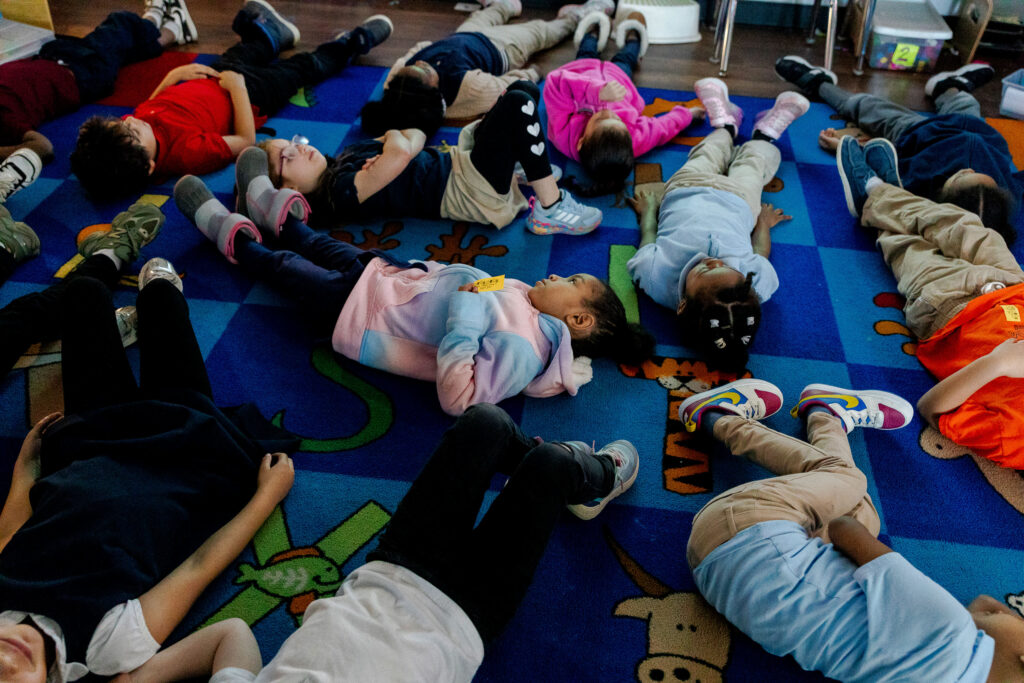
In a kindergarten classroom at McKinley STEAM, students start the day with a meditation. The classroom of two dozen children is perhaps its quietest during this short activity every morning. Imagine you’re in the Arctic, a voice from a meditation video tells them, with snowflakes melting on your skin. Silently, the children lay down on the carpet and close their eyes for a moment. After the meditation, the students gather in a circle and do a few deep breathing exercises before taking turns proclaiming what they are capable of each day.
“I can be a good student,” one little boy said before the child next to him replied: “I can listen to the teacher.”
The goal is that these mantras will stay with the children hours later, when they have to sit through the more tedious lessons of the day. Students should be empowered, even at a young age, to know they can, and sometimes must, do things that are boring, Elliott said.
“Learning should be fun. You are getting new information that is teaching you how to solve puzzles that you can use for the rest of your life, and that’s amazing,” Elliott said. “But is every second of it going to be fun? No. And that’s just the truth.”
This story about attention span was produced by The Hechinger Report, a nonprofit, independent news organization focused on inequality and innovation in education.
The post The tricks teachers are trying to fix students’ shortening attention spans appeared first on Washington Post.