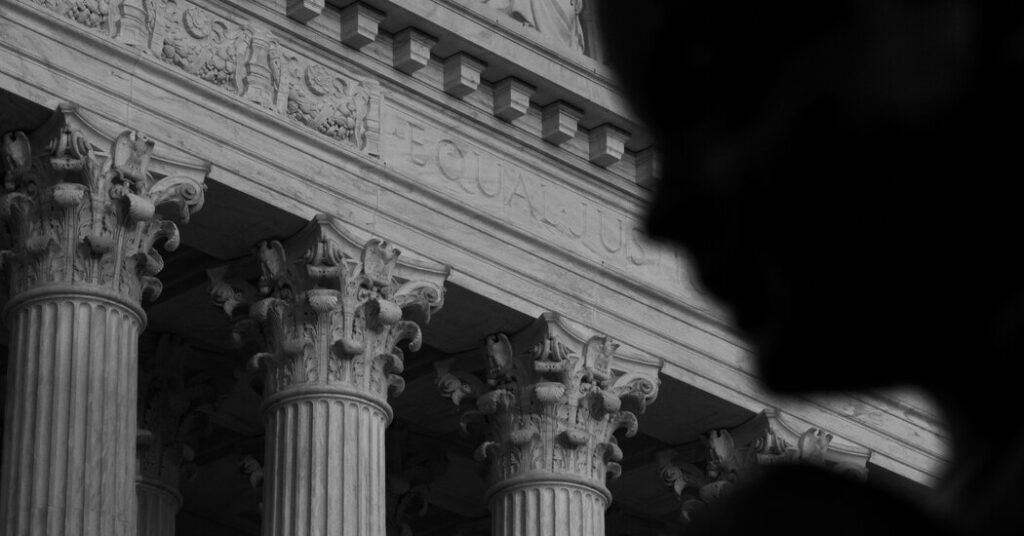
It is referred to as the shadow docket, the emergency docket, the interim-orders docket. Whatever you call it, this fast track now accounts for a substantial part of the Supreme Court’s workload.
“The Shadow Papers,” a New York Times report by Jodi Kantor and Adam Liptak, digs into a turning point in the Supreme Court’s use of the shadow docket — the practice of issuing orders and summary decisions typically without full briefing, oral arguments or explanations. For many legal scholars, the revelations in the report, which included leaked documents from the justices, offer further proof that the court is too partisan and outcome-oriented.
William Baude, a law professor at the University of Chicago — who coined the term “shadow docket” — has a different assessment. He shared his thoughts in a written conversation with John Guida, an editor in Times Opinion. It has been edited for length and clarity.
John Guida: In 2016, the Supreme Court blocked in a shadow docket ruling an ambitious new environmental policy from the administration of President Barack Obama, the Clean Power Plan. That judicial stay is now identified as a turning point for the court. Legal scholars noted that it was highly unusual or even unprecedented for the court to block an executive branch regulation before any lower courts had ruled on it. You said the Times report was “non-scandalous.” Why?
William Baude: It’s important to separate two things. One is the fact of the stay, which was widely reported and discussed in 2016. The stay was a big deal, and it was rightly controversial. It can be seen as an important landmark in the growth of the shadow docket and in the growth of the major questions doctrine. But we have known all of that for 10 years.
The other thing is what we learn from the memos, which provide a glimpse into the justices’ reasoning and deliberation. And what the memos tell us, frankly, is that the justices applied the expected legal standards, which they argued about in a somewhat predictable fashion. If anything, I think that reasoning makes the court look pretty good.
Guida: Look pretty good in what ways?
Baude: The chief justice cites the court’s traditional tests, which focus mostly on the likelihood that the court will grant certiorari and rule against the government, and on the presence of “irreparable harm,” which is to say, the need for the court to intervene with an immediate stay. His memo provides good arguments on both points. The memo argues that the Clean Power Plan is most likely unlawful, which the full court later held in West Virginia v. E.P.A. And it notes that without a stay, it might be effectively impossible for the court to intervene later, because the parties were under such strong pressure to comply with the regulations immediately and might not be able to wait for judicial review. On this last point, it draws from a statement by an administration official who seemed to celebrate this fact.
These two factors — the unlawfulness of the regulation, and the need for immediate relief to preserve the court’s authority — are at the core of the tests about when the court needs to intervene. Chief Justice Roberts cites a case called Nken v. Holder that calls those two factors “the most critical.” Until last week, we didn’t really know how carefully the court considered those issues, because the stay was issued without any written opinion or dissenting opinion. Now we know that the justices did consider the major arguments in a substantial way.
Guida: You clerked for Chief Justice Roberts, but I know you can’t speak for him or read his mind. You are no doubt also aware of public perceptions of him. This shadow docket reporting and the memos seem to contradict some common characteristics applied to him. I’m curious if you share these perceptions of him, or if legal and political observers have been misunderstanding him.
First, his claim (from his nomination appearance) that it’s his job only to “call balls and strikes, and not to pitch or bat.” Does that apply to this episode?
Baude: Yes, this is calling balls and strikes! That is, taking the existing legal rules and applying them to the case at hand. Obviously, the Supreme Court takes some of the hardest cases, where people disagree about the call and get mad about it (just like an umpire’s close call in a crucial at-bat). But the memos actually show us how ordinary and legal these decisions can be.
Guida: He is also known as a consensus builder. In this case, two of the liberal justices — Justices Elena Kagan and Stephen Breyer — offered a compromise, basically to buy more time for the court. The chief justice rejected them. Is it at least a little surprising that he so aggressively got behind what would be an enormously consequential move with a 5-4 partisan split?
Baude: Well, we already knew that there was a 5-4 split on issuing this stay in 2016, and the Supreme Court has had 5-4 splits virtually every year. So I don’t see that as a surprise either. And as Chief Justice Roberts once said (in his concurring opinion in Citizens United): “It should go without saying, however, that we cannot embrace a narrow ground of decision simply because it is narrow; it must also be right.”
Guida: Chief Justice Roberts is often referred to as an institutionalist. In your post on the new report, you wrote that people “overread” or “misunderstand” that term as applied to him.
Baude: People use that word in so many ways that I’m not always sure what they mean, and I’m not sure they do either. But sometimes it seems as though people use “institutionalist” to mean “makes compromises to give up his own views and favor mine.” If you disagree with a lot of the chief justice’s views, I can see why you would want him to do that. But I think he focuses on applying the law as he understands it.
On the other hand, if institutionalism means caring about our institutions — having great concern for the Constitution’s separation of powers, for the powers and constraints given by Article III of the Constitution, and being vigilant against those who try to evade or defy the authority of the judiciary — those themes are all evident in Chief Justice Roberts’s jurisprudence, including in the Clean Power Plan ruling.
Guida: In trying to maintain a separation-of-powers balance, do you think one concern for the Supreme Court was the expansion of presidential executive orders? That has only accelerated since 2016, but it was a concern then — as the legal scholar Richard Re wrote at your Divided Argument blog, the executive branch “was moving too fast for the justices to stop them.”
Was this use of, and the subsequent growth of, the shadow docket a response by the Supreme Court to new separation-of-powers challenges?
Baude: Again, I don’t have any inside information about any of this. But it is important to remember that in 2016 the court had pending before it a major challenge to the Obama administration’s DAPA program in United States v. Texas — which was a very controversial use of executive power to effect a major change in immigration law. The court may well written a 5-4 opinion invalidating that program (But then Justice Antonin Scalia died, and so the case was affirmed without opinion because the court was split 4-4.)
That kind of executive unilateralism has indeed only compounded over the Trump, Biden and Trump 2.0 administrations, but I’m sure the court was concerned about it, and has remained concerned. Indeed, it’s possible that aggressive executive action is one of the biggest factors in the growth of the shadow docket.
Guida: But when you coined the term “shadow docket” in 2015, you didn’t think at the time that it would necessarily come to take up so much of the Supreme Court’s business?
Baude: As the great Yogi Berra is said to have observed, it’s tough to make predictions, especially about the future. When I wrote about the shadow docket in 2015, I was sure that something important and underappreciated was happening outside of the court’s merits docket, and I wanted journalists and scholars to pay more attention to it. But I didn’t have any specific predictions about what would happen next — let alone that it would so dominate the discourse today.
Guida: Steve Vladeck, someone you’ve worked (and sparred!) with over the years and the author of a book on the shadow docket, wrote of the Times report that he has long “flagged the court’s tendency to act inconsistently in ways that are more favorable to Republican litigants (and presidents) and more unfavorable to Democrats. ” Do you think the Supreme Court has, on balance, used the shadow docket in ways that make it feel like a partisan tool?
Baude: The court’s critics are too quick to accuse it of partisanship, but I also think the court’s defenders are often too quick to absolve it. I do think it sometimes looks as if the court was not as solicitous of the Biden administration’s emergency applications, for instance, as it was of the Trump administration’s. But every case is different, and there are a lot of variables. This is where the fact that these rulings often lack opinions or substantial reasoning doesn’t do the court any favors and makes it easy to infer cynical explanations.
And yet, we don’t know. Despite the large amount that has been written about the court’s shadow docket rulings, I don’t think there has been enough systematic, careful study for us to fully understand the past decade or two.
Guida: How should we think about a tension within this court: On the one hand, an executive branch that is aggressive in its use of power is going to be hard to keep up with for the courts. Judicial authority will strain to keep pace. On the other hand, this court has largely embraced the unitary executive theory, which has expanded the powers of the president.
Baude: At his confirmation hearing, Justice Alito made a point that I think helps clarify this tension a lot. He said it’s important to distinguish between the scope of executive power — what can the executive branch do? — and who controls the executive power — how much do other officials answer to the president? The unitary executive debates are about the second question, while the Clean Power Plan and many other aggressive executive actions the court is skeptical of are about the first.
Guida: Do you also see this 2016 episode as a precursor or inflection point for the fraught relationship between the Supreme Court and lower courts?
Baude: We had already seen some tensions between the Supreme Court and the lower courts. In my 2015 article, I wrote about how the court was summarily reversing some lower courts, especially the Ninth Circuit in federal habeas cases. But in hindsight, 2016 was a possible inflection point for when those cases started happening much faster, and it is why we now talk about the “emergency docket” or “interim docket” so much. Whatever you call it, the shadow docket has put the conflicts on superspeed.
Guida: In hindsight, 2016 now looks like a very consequential year for the courts, and for the country. It was the start of the modern shadow docket. Justice Antonin Scalia passed away, and Senate Republicans refused to carry out their advise-and-consent role for any Supreme Court nominee from President Obama (which would have been Merrick Garland). Donald Trump was elected president, and that Supreme Court pick would go to Neil Gorsuch. How do you think that year shaped the conflicts in the courts, and in the country, today?
Baude: Let me put it this way. In fall 2015, I was teaching the separation of powers in constitutional law, and many of my students were very favorable to executive power. It seemed likely that presidents they liked and trusted were going to be elected for a while. I told them: “I know it is hard to imagine, but one day somebody is going to be elected president who you think is bad. Even dangerous. And that president is going to have all of the powers that we decided to give to President Obama.” I think they rolled their eyes at this. But the plot twist happened much sooner than they, or I, predicted.
It’s always a part of our constitutional system that we have to think about what will happen when the tables are turned. But what 2016 showed us is just how fast the table can spin, and how dizzy it can make us.
William Baude is a professor at the University of Chicago Law School and a host of the “Divided Argument” podcast. John Guida is a Times Opinion editor.
The Times is committed to publishing a diversity of letters to the editor. We’d like to hear what you think about this or any of our articles. Here are some tips. And here’s our email: [email protected].
Follow the New York Times Opinion section on Facebook, Instagram, TikTok, Bluesky, WhatsApp and Threads.
The post Don’t Blame John Roberts for the Shadow Docket appeared first on New York Times.