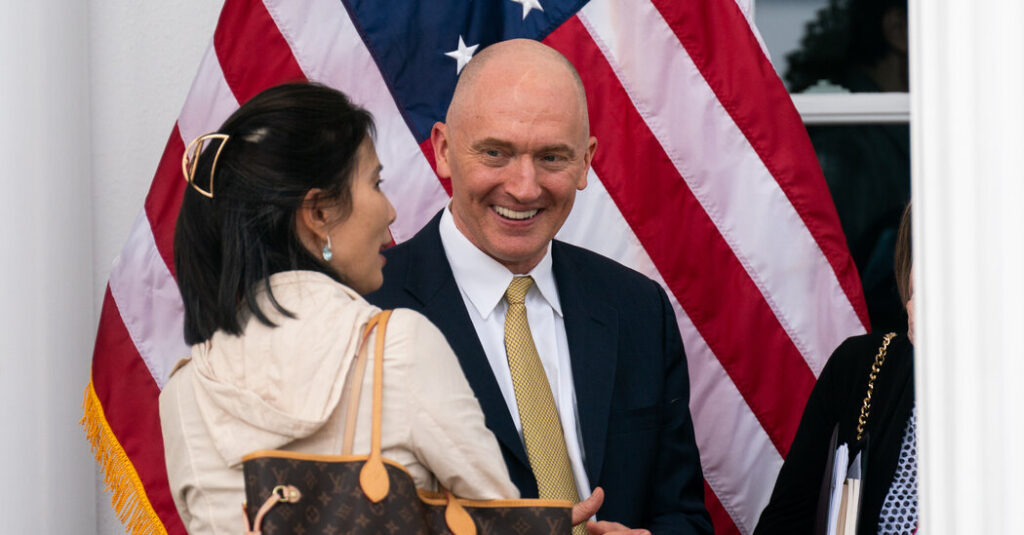
The Trump administration has agreed to pay $1.25 million to settle a lawsuit brought by Carter Page, a 2016 Trump campaign adviser who was wiretapped during the investigation into Russia’s interference in that year’s election, a person familiar with the matter said on Wednesday.
There is no dispute that the F.B.I. significantly botched its applications for four rounds of court orders authorizing surveillance of Mr. Page’s phone calls and emails between late 2016 and mid-2017. An inspector general report uncovered numerous errors and material omissions that made Mr. Page look more suspicious.
But whether Mr. Page had a legal right to compensation from taxpayers was in doubt. Lower courts had dismissed his lawsuit, leading him to appeal to the Supreme Court. The solicitor general, D. John Sauer, told the justices on Wednesday that there was a settlement.
This was the latest payout by the Justice Department to someone aligned with President Trump. Last month, the department agreed to pay $1.25 million to Michael T. Flynn, Mr. Trump’s former national security adviser, who claimed that he was wrongfully prosecuted by Robert S. Mueller III, the former special counsel. Last year, the government paid nearly $5 million to the estate of Ashli Babbitt, a rioter who was shot by a police officer during the Jan. 6, 2021, attack on the Capitol.
To date, however, the Justice Department has declined to settle wrongful prosecution lawsuits brought by people who were charged for taking part in the Jan. 6 riot.
Reached by text on Wednesday, Mr. Page did not dispute the $1.25 million figure, but declined to comment. The person who provided the settlement figure spoke on condition of anonymity to discuss a sensitive issue. The Justice Department press office issued a statement saying the Page inquiry had relied on flawed and uncorroborated information, calling it a political sham.
Mr. Page was never charged with a crime. While his wiretapping was a minor part of the Russia investigation, it took on major political significance as Mr. Trump and his allies sought to use its flaws to discredit the broader effort.
After Russia dumped out stolen Democratic emails timed to disrupt the party’s July 2016 national convention, Australian diplomats told the F.B.I. that another Trump campaign aide had previously revealed that the campaign had received outreach from Russia and had some knowledge of what it was planning.
The F.B.I. launched a counterintelligence inquiry into the nature of links between associates of the Trump campaign and Moscow. But it did not know who in the Trump campaign had been the recipient of the reported outreach from Russia, so its early task was to try to identify that person. It initially focused on four aides to Mr. Trump, including Mr. Flynn and Mr. Page.
Mr. Page had already been the subject of a known recruiting effort by Russian spies, and in October 2016, as he was preparing to travel to Russia, the F.B.I. applied to the Foreign Intelligence Surveillance Court for a warrant to intercept his phone calls and emails. It cited, along with other information related to his past ties to Russia, claims about Mr. Page from the so-called Steele dossier, a compendium of later-discredited political opposition research.
The suspicions about Mr. Page proved to be a dead end. The investigation found myriad other links between the campaign and Russia, but only a few pages of Mr. Mueller’s 448-page final report mentioned him.
The Page wiretap applications were the only investigative use the F.B.I. made of the Steele dossier. But as it became clear that the dossier was not reliable, Mr. Trump and his allies gave the Page wiretaps particular focus politically.
That effort began in early 2018 when Republicans on the House Intelligence Committee, then led by Representative Devin Nunes of California, produced the so-called Nunes memo. That document listed purported flaws in the wiretap applications, which remained classified at the time. Democrats produced their own memo saying those claims were false or misleading.
The Nunes memo helped fuel the rise of its principal author, Kash Patel, who is now the F.B.I. director.
When the applications were declassified, many of the criticisms in the Nunes memo proved to be false or misleading. But then, in a scathing 2019 report, the Justice Department’s inspector general, Michael E. Horowitz, found that the F.B.I. had botched the applications in numerous ways that were not listed in the memo.
A major one involved the Steele dossier. In January 2017, the bureau interviewed the chief researcher for the dossier, who made statements that revealed that it was not reliable. Nevertheless, the F.B.I. repeated the claims from the dossier in the last two renewal applications without telling the court of the reason to doubt their credibility.
But Mr. Horowitz’s findings went well beyond the dossier. His team identified errors and omissions in the F.B.I.’s account of what the government knew about Mr. Page at the time of all four applications. Agents cherry-picked the file, presenting information that would cast suspicion on Mr. Page but omitting information that undercut their application.
Most egregiously, Mr. Horowitz uncovered that during preparation for the final renewal application before the surveillance was dropped, questions arose inside the F.B.I. that could have brought to light that all four applications had omitted a material fact — that Mr. Page had a history of telling the C.I.A. about his interactions with Russians.
But an F.B.I. lawyer, Kevin Clinesmith, doctored an email from the C.I.A. in a way that papered over the problem. Mr. Clinesmith was later prosecuted and pleaded guilty to making a false statement.
Alan Feuer contributed reporting from New York.
Charlie Savage writes about national security and legal policy for The Times.
The post U.S. Settles Carter Page Wiretap Lawsuit for $1.25 Million appeared first on New York Times.