Josef Slenczynski lay on the battlefield and bargained.
A down-at-the-heels young man from Poland who had come to the United States not long before, Mr. Slenczynski was serving in World War I with the American Expeditionary Forces in Europe. In civilian life he was a violinist of large ambition but no large reputation, and now he lay in his own blood, his left wrist shattered by shrapnel.
If God would only spare his life, he vowed, he would redeem his lost career by fathering and training the greatest musician the world had ever known.
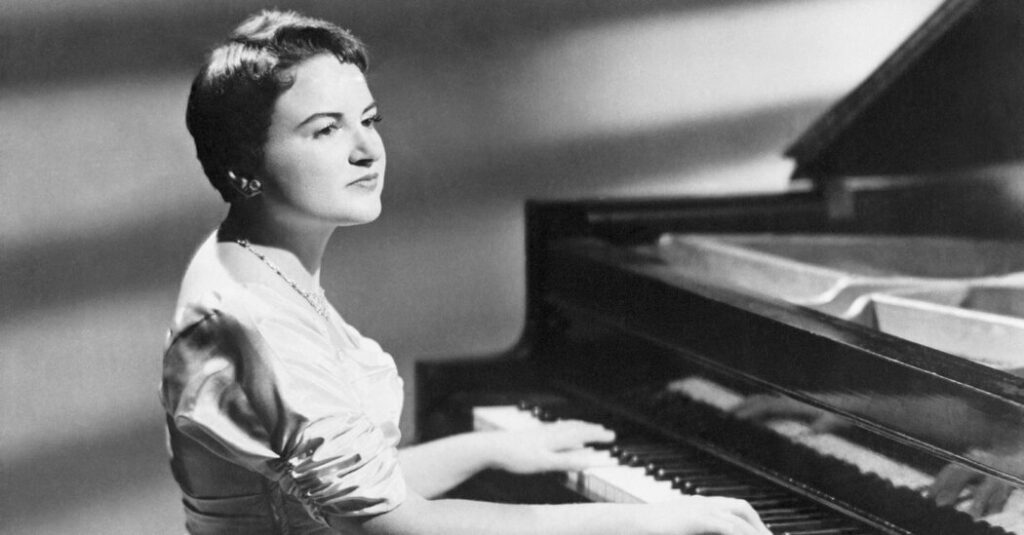
Mr. Slenczynski kept his word, or tried to. For much of the 1930s, until the toll his methods exacted nearly consumed her, his daughter Ruth was one of the most celebrated child prodigies of her time, performing worldwide on a grand piano with its legs shortened to accommodate hers — a Mozart in bobby socks and pinafores.
Known from young adulthood on as Ruth Slenczynska (pronounced slen-CHIN-ska), she ultimately made a life outside the lucrative limelight her father craved for her, building a quiet, highly respected career as a teacher, performer and recording artist.
The truly remarkable thing is that Ms. Slenczynska was able to make a life, in or out of music, at all. For after submitting for years to a punishing practice schedule, withheld nourishment, verbal abuse and physical violence — a regime that on its glittering surface made her a darling of the press, carried her to the world’s most celebrated concert stages and had her hobnobbing with film stars and heads of state — she was deemed, in the words of one critic, a “burned-out candle” by the age of 15.
Ms. Slenczynska, who against considerable odds resumed performing as a young woman and continued to do so nearly until the end of her life, died on Monday at an assisted living facility in Cupertino, Calif. She was 101.
Her death, from complications from a fall, was confirmed by Randy Stahlman, a close friend whose family she lived with for a few years and whose wife, Shelly Moorman-Stahlman, was a student of hers.
At her death, she was an emeritus professor of music at Southern Illinois University Edwardsville, where she taught from 1964 until her retirement in 1988. In 2022, at 97, she released a new album, “My Life in Music,” on the Decca label, for which she had recorded in the 1950s and ’60s.
As an adult, Ms. Slenczynska spoke often in interviews of the psychological and musical costs of her upbringing. With the publication in 1957 of her cautionary memoir, “Forbidden Childhood,” written with Louis Biancolli, she became one of the first people to illuminate the long-hidden world of the exploited child prodigy.
Since then, her story has been cited by the news media and psychologists as a textbook example of the toxic consequences that can result when a controlling, ambitious parent and a gifted child collide.
If Ms. Slenczynska’s early headlines were on the order of “New Wonder Child Astonishes Berlin,” as The New York Times wrote in 1931, when she made her debut there at 6, by the late 20th century her name was cropping up in articles about the emotional price many prodigies pay in childhood and the suffering they can face after.
Yet by her own account, Ms. Slenczynska in later decades led a life of great contentment.
“I’m one of these survivors,” Ms. Slenczynska, then 74, told USA Today in 1999 for an article on prodigies. “But I think I’m the only happy one.”
As she approached her 80s, Ms. Slenczynska enjoyed a renaissance bordering on a cult following in Japan, where she began performing regularly. For her 80th birthday, in 2005, she celebrated by playing three concertos in one night with the NHK Symphony Orchestra of Tokyo.
But for all her accomplishments, her later life was far removed from the whirlwind of fortune and acclaim that her father had sought for her and, through despotic pedagogy, briefly won.
When Ruth Julia Slenczynski — born in Sacramento on Jan. 15, 1925 — was 2 hours old, her father inspected her hands and wept with joy.
“Look at those good sturdy wrists!” he said, according to Ms. Slenczynska’s memoir. “Look at the tips of her fingers!”
She added, “He never once raised his eyes to my face.”
A small, round, sweet-faced thing, Ruth began piano lessons at 3 with her father at their home in Berkeley, Calif. Though she would later study with some of the most eminent pianists in the world — including Artur Schnabel, Alfred Cortot, Sergei Rachmaninoff and Nadia Boulanger — Mr. Slenczynski, no pianist himself, always told reporters that he was her only teacher.
She gave her first public performance at 4, playing Bach, Beethoven and Chopin in recital at Mills College in Oakland, Calif. (Billed in her youth as Ruth Slenczynski, she took the feminine form of her surname as a young adult to demarcate her own identity.)
Recital engagements throughout the United States and Europe followed and, before long, concerto appearances with the world’s major orchestras. On tour, Ruth traveled with one of the two concert grands built for her by the Baldwin Piano Company, with legs six inches shorter than normal so she could reach the pedals.
In the early 1930s, Ruth moved with her parents and two younger sisters to Europe, where she was to study and perform. They settled in Paris, returning periodically to the United States for her concert engagements.
The press was full of her comings and goings, chronicling her meetings with luminaries including former President Herbert Hoover and the Hollywood star Robert Montgomery. (Ruth had no idea who Mr. Montgomery was; she had never been to the movies.)
The papers also made much of her earnings. By the age of 10, in the thick of the Depression, she was making more than $75,000 a year — the equivalent of about $1.8 million today.
Critics waxed eloquent about her lightning technique and resonant tone. Writing in The Times in 1933, Howard Taubman reviewed the 8-year-old Ruth’s formal American debut, at Town Hall in New York, in a recital of Bach, Beethoven, Mendelssohn and Chopin.
“It was an electrifying experience, full of the excitements and the wonder of hearing what nature had produced in one of her most bounteous moods,” Mr. Taubman wrote, adding, “Ruth played through this program with the temperament, the brilliance and the confidence of the born virtuoso.”
But there was much that the critics, and the public, did not see. Ruth rose each morning at dawn to practice under her father’s supervision; by the time she was 4, the sessions lasted nine hours daily. She had to play perfectly to earn her meals and was rarely permitted to leave the piano to visit the bathroom. She was allowed no dolls, no toys, no storybooks, no movies and no friends — nothing that would keep her from her lifework.
That was the least of it. “The moment I missed a note I got a whack across the cheek,” Ms. Slenczynska wrote. “If the mistake was bad enough, I was almost hurled bodily from the piano.”
If she defied her father at all — interpreting a piece of music her way instead of his counted as defiance — he beat her with his fists. When his hands grew weary, he beat her with a stick. When the stick broke, he beat her with his belt. He beat her up and down her body, sparing only her hands.
He made her repeat aloud: “My life is yours. I must do as you say.”
In 1939, after war broke out in Europe, the Slenczynskis returned to Berkeley. Ruth was now an adolescent, a watershed stage for child prodigies. For many, the fleet-fingered technique that once dazzled concertgoers is no longer enough. True interpretive artistry — which for most musicians comes only with true maturity — eludes them, and the critics begin to say so.
That is what happened to Ruth.
Her life as a prodigy ended in December 1940, on the stage of Town Hall in New York. She was ill with what turned out to be acute appendicitis, but at her father’s insistence, she played the recital anyway.
The reviews were corrosive, and her father disowned her. She was a month shy of her 16th birthday.
She found herself adrift in Berkeley, without friends, without social skills and now without music. She was also without money: Her father, Ms. Slenczynska later wrote, had kept all her earnings for himself. She sold her blood to buy food.
Deeply depressed, she was occupied only, as she wrote, with “the mechanical job of remaining alive.” She assumed she would never perform again.
Little by little, she made forays into adult life, studying at the University of California, Berkeley, and, at 19, marrying a classmate, George Born.
She began to play again, though at first only for herself. In her 20s, she returned to the concert stage. The reviews were unfavorable early on — critics still took her to task for immature interpretations — but grew stronger over time, and she made recordings, with a focus on Chopin and Liszt.
For several years in the 1950s, she toured with Arthur Fiedler and the Boston Pops; that experience, she later said, helped her cultivate nuanced understandings of the big Romantic works her father had valued for their crowd-pleasing flash.
Ms. Slenczynska’s marriage to Mr. Born ended in divorce in 1953. Her second husband, James Kerr, a political scientist at Southern Illinois University Edwardsville whom she married in 1967, died in 2001. She has no immediate survivors.
Josef Slenczynski died in 1951. As Ms. Slenczynska recalled in an interview with The Chicago Tribune in 1988, she tried to see him during his final illness to tell him that she forgave him.
“He wouldn’t see me,” she said, “but he told my mother that it was he who would have to forgive me.”
Interviewers often asked Ms. Slenczynska how she ever transcended her upbringing.
For one thing, she replied, her experience gave her great strength. For another, the music itself was a steadfast anchor.
“I can’t remember a time when I couldn’t play the piano,” Ms. Slenczynska told The St. Louis Post-Dispatch in 1999. “I know what to do with it. I have my own ideas about interpretation, and now that I’m an old lady, I dare to carry them through.”
Some late-in-life recordings were well received. In 2000, American Record Guide published a glowing review of “Ruth Slenczynska Plays Schumann,” made the year before for the Ivory Classics label.
The review singled out Ms. Slenczynska’s “lyrical, heartfelt” and “bittersweet” interpretation of the composer’s “Kinderszenen” — “Scenes From Childhood.”
Ash Wu and Charlotte Dulany contributed reporting.
The post Ruth Slenczynska, 101, Dies; Piano Prodigy Overcame Father’s Abuse appeared first on New York Times.