Los Angeles is a city of public art, and perhaps no work is more far-reaching and ambitious than the artist Judith F. Baca’s “Great Wall of Los Angeles,” a half-mile-long mural that portrays California and American history from prehistoric times to the 1950s. An expansion that is underway will add another half mile and complete the story, bringing it up to modern times.
That means Cesar Chavez is about to enter the picture.
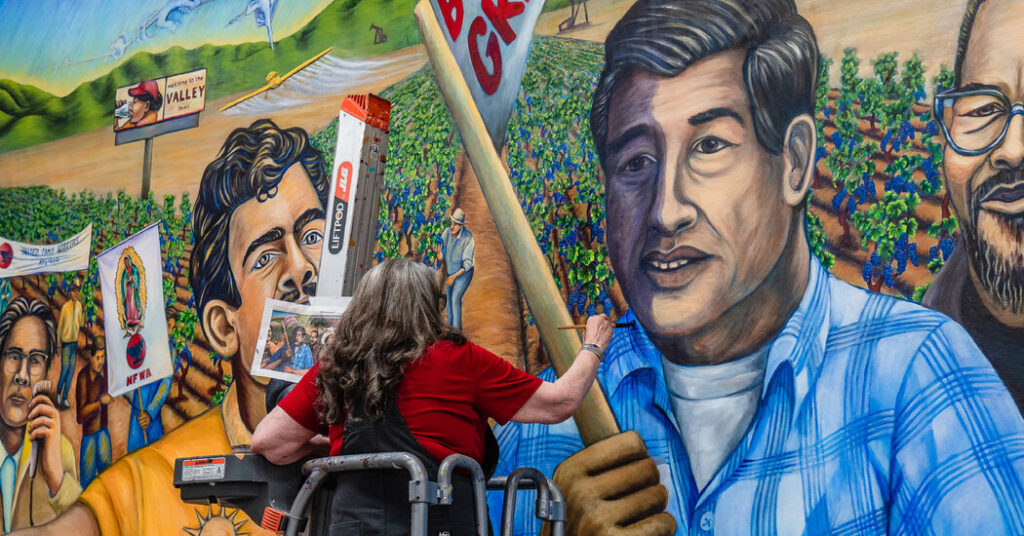
Along the walls of Ms. Baca’s cavernous studio in Santa Monica are canvas panels for the 1960s: colorful depictions of the civil rights era, the Vietnam War and the farmworkers’ movement led by Mr. Chavez. When the paintings are completed — the public has been invited in to watch their creation — the panels will be installed on the concrete wall of the Tujunga Wash, a tributary of the Los Angeles River, in the San Fernando Valley.
Mr. Chavez was painted before The New York Times published detailed allegations that he had sexually abused young girls and raped another union leader, Dolores Huerta. In response to the revelations, some cities and institutions in California and across the country have been quick to remove Mr. Chavez’s name from street signs, take down statues of him and cover up artwork depicting him.
The public debate over what to do with such art is not unique to Mr. Chavez. American culture is constantly grappling with changing views of historical figures. After the murder of George Floyd by a police officer in 2020, for instance, Confederate statues were toppled across the country. After Donald J. Trump began his second term as president, his administration sought to return Confederate monuments to the public square and remove mentions of slavery from museums and historical sites.
Ms. Baca and her team of artists agonized over how to respond to the revelations about Mr. Chavez, and they considered erasing him from the mural.
But removing him did not feel right to Ms. Baca, 79, whose long career as an artist and social activist has been defined, she said, by “nonerasure” and the “recovery of lost history.” As a young Chicana artist in the 1960s, Ms. Baca had painted banners for the farmworker marches organized by Mr. Chavez. “We got $5 a day, and of course he never paid me,” she said in an interview. “I got a burrito — that was my payment.”
Nevertheless, Ms. Baca felt that her art needed to reflect the new information about Mr. Chavez. So, the other morning, she took her paintbrush and began darkening the right side of Mr. Chavez’s face, creating a shadow to represent, she said, “his dark side arising.”
On Mr. Chavez’s left arm, she and her artists are stamping a tattoo depicting Coyolxāuhqui, the Aztec moon goddess whose mythical story has been interpreted as a struggle against patriarchy.
“We are going to tattoo him like a homeboy,” she said.
The reckoning with art and public images of the powerful and once powerful is a familiar story in the history of all cultures, said Erin L. Thompson, a professor at the John Jay College of Criminal Justice and the author of “Smashing Statues: On the Rise and Fall of America’s Public Monuments.”
“The Romans were practically once a decade putting up some emperor’s portrait and chipping the face off the old one,” she said.
Ms. Baca pointed to two other subjects in her works with dark sides to their personal lives: Mohandas K. Gandhi, the Indian independence leader who espoused racist views and slept naked next to a grandniece to test his willpower to resist sex; and the Rev. Dr. Martin Luther King Jr., the civil rights leader who historians say carried on many affairs.
“It’s about men in power,” Ms. Baca said.
Not all artists are adamant that their works of Mr. Chavez should be maintained in some way.
Near the Boyle Heights neighborhood of Los Angeles, a heavily Latino section of the city, J.D. Estrada has for three decades maintained a mural on the walls of the Maravilla Meat Market that he first painted in 1994. It is pocked with bullet holes from a drive-by shooting, and features Mr. Chavez at its center holding a candle.
“My first reaction was a little bit of unbelief,” Mr. Estrada said of when he first heard the news about Mr. Chavez’s sexual abuse.
Then, he saw reports about cities moving quickly to remove Mr. Chavez from the public square and decided to be proactive about his art. “That’s when I said, ‘Ah, I better do something about these murals now,’” he said.
Mr. Estrada is ready to revamp his three murals in Boyle Heights and has presented mock-ups to local officials. For the mural at the meat market, he plans to replace Mr. Chavez with the images of two graduating students with raised fists.
On a recent afternoon, Mr. Estrada drove to the neighborhood of Highland Park, where he planned to clean up one of his Chavez murals, which had recently been tagged with graffiti. While Mr. Estrada is ready to work with local officials to change his murals, he does not want his works tarnished in the meantime, he said.
But on the way to the mural, he received a phone call from a leader in the local arts community. Better to leave Mr. Chavez defaced, he was told, than give the impression, by removing the graffiti, that the community is defending the disgraced hero.
“It’s touchy,” he said.
As communities across America grapple with Mr. Chavez’s legacy, Ms. Baca counsels that decisions on how to handle art portraying him should not be “knee-jerk reactions to the rage that we feel.” In the “Great Wall,” she said, she had originally intended to depict Mr. Chavez as a heroic figure, and therefore needed to alter the work.
But with some of her other artwork associated with Mr. Chavez, Ms. Baca said she would take a different approach.
Across town from her studio in Santa Monica is a public school on the site of the old Ambassador Hotel, where Robert F. Kennedy was assassinated in 1968. There, Ms. Baca had painted a mural capturing a moment in time: when Mr. Kennedy flew to California and met with Mr. Chavez as he ended a 25-day fast.
“That breaking of the bread is a historical moment because it changed the entire movement,” she said. “I don’t think that should be changed. I don’t think he’s a hero in that. He’s the man who’s done this fast, and the fast has changed people’s ideas, and he has engaged Bobby Kennedy and that transformed the movement. So to take that away is erasure of history.”
The future of that mural, though, may not be her decision. While the painting at the school remains today, the Los Angeles Unified Public School District has said it has begun a process to remove murals featuring Mr. Chavez.
Then there is the Arch of Dignity, Equality and Justice, a soaring public monument on the campus of San Jose State University created by Ms. Baca and featuring mosaic depictions of Mr. Chavez, Mr. Kennedy, Ms. Huerta and Mr. Gandhi.
On one mosaic, Mr. Chavez appears with twisted vines that Ms. Baca now sees as “tortured vineyards.”
“Now it’s taken on an entirely new meaning,” she said. “Are these the women he’s raped? Could it be that?”
Ms. Baca has been discussing the future of the monument with university officials, and hopes to add a description of Mr. Chavez’s abuse. “And who he is,” she said. “Both his contributions and his failure. Wouldn’t that be a better teaching tool and an examination?”
The recent debates have reminded Ms. Baca of when she was in Moscow during the collapse of the Soviet Union, as people clamored to remove statues and busts of Lenin.
“I said, ‘I don’t think so,’” she said. “Create new ones, and let Lenin fight with them in the public square. In other words, let’s look at the history and let that history still be present so that there isn’t an erasure or loss about the decisions that were made historically. So that we don’t have to keep making them.”
Tim Arango is a correspondent covering national news. He is based in Los Angeles.
The post After a Hero’s Fall, What to Do With the Art That Honored Him? appeared first on New York Times.