For a hype house, the humble wood and brick structure in the shadow of Woodhull Medical Center is unconventional.
Outside, the facade is cracked and peeling, and the blinds are drawn. Inside, young men spend their days hunched over dense texts, and a tiny pool is hidden away in the basement.
Meanwhile, the resident influencer doesn’t use social media and favors a flip phone — and no phone at all from sundown Friday to sundown Saturday.
On Shabbos, it’s strictly forbidden.
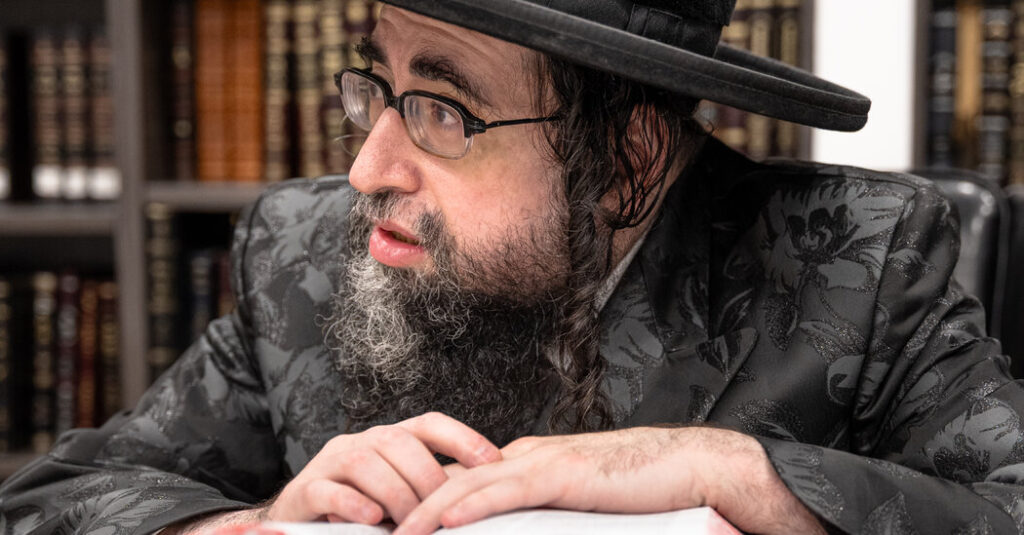
This is the office of Shalom Landau, a 48-year-old Hasidic rabbi in the Williamsburg section of Brooklyn. The young men are his yeshiva students; the pool a ritual bath called a mikvah.
He’s the spiritual leader of Rivnitz, a group of Hasidic Jews who follow the example of the Ribnitzer Rebbe, a 20th-century rabbi from present-day Moldova who stressed the need to spread God’s divine light amid the anti-religious atmosphere of the former Soviet Union.
He is also, of late, an unlikely star on Instagram and TikTok for videos offering pearls of Torah-based wisdom on topics ranging from business and personal finance to marriage and parenting. The short clips marry self-help and “seichel,” Yiddish for “common sense.” They typically start with a provocative statement — “Wealth is in your wiring, not in your wallet,” for instance, or “A child is not a second chance at your past” — and then move backward to proclamations from the sages of the Talmud.
His 250,000 followers on Instagram may not put him in the social media big leagues, but they greatly outnumber the several hundred men who come to study and pray at his shul. And they’re an awful lot for a guy who speaks in Yiddish-inflected English and appears on video in front of bookshelves of Hasidic philosophy.
From his digital pulpit, Rabbi Landau wields a particular kind of influence, beaming his message through social media onto a mosaic of overlapping audiences, each of whom interprets him differently.
There are practicing Jews who share his content earnestly over WhatsApp; secular internet addicts who take his videos with a heavy dose of irony; curious non-Jews seeking a pure form of religious authenticity; young conservatives attracted to the traditional gender roles he preaches; and commenters who make antisemitic jokes about Jews holding the secret to attaining material wealth.
In other words, everyone is seeking something slightly different from Rabbi Landau. Does he know what he’s giving them?
On a recent, chilly March afternoon, the rabbi took a break from preparations for the Passover holiday to reflect on his newfound digital fame. Joining him in his windowless, tome-lined study was Shragi Kalmanowitz, his 25-year-old student and assistant.
It had been a year, the men recalled, since another student suggested to the rabbi that he should record and distribute his speeches in order to raise money for the yeshiva.
“Why are we keeping your light just closed into this small building?” Rabbi Landau remembered his student asking.
The rabbi addresses his congregation in Yiddish, but he gives frequent small talks in English to groups of Bukharian and Syrian Jews who come from other parts of Brooklyn to seek his counsel and his blessings.
(Rabbi Landau’s influential status among some in these entrepreneurial communities may come from being the brother of Joel Landau, a politically-connected businessman and philanthropist. Mr. Landau is a controversial figure who has been accused of exploitative business practices.)
Mr. Kalmanowitz had the idea to tape these talks and clip out the best bits. As for Instagram and TikTok, the rabbi delegated.
“I was not so much understanding what social media is,” the rabbi said.
Mr. Kalmanowitz uploaded the first videos to Instagram last July, and by August, he had outsourced production to freelancers overseas, who punch up the clips with stock footage. In October, the rabbi’s rising online fame brought him to the attention of Zohran Mamdani, then a mayoral hopeful. As the candidate tried to make inroads with Jewish voters, Rabbi Landau invited him to Williamsburg to celebrate the harvest festival of Sukkot.
Rabbi Landau quickly built a large audience of followers under the age of 50, though donations for the yeshiva, Mr. Kalmanowitz said, were not forthcoming.
But Rabbi Landau said he didn’t watch the videos, for two reasons. The first is that he worries he will be critical of himself.
“I think when you see yourself, you can see too much,” he said.
The second is that he fears his message may be oversimplified.
“When you take all of this, you have to be a Torah-learning Jew to understand,” he said, gesturing to handwritten notes in Hebrew script on his desk. “A lot of statements they take out, they cut it. So I’m questioning, Why do you take out my point? They say we outgrew the—”
“The Jewish community,” Mr. Kalmanowitz interjected. “We cut it out. Why do we cut it? Because we have to make applicable to everyone.”
Indeed, the version of the rabbi’s message that appears on social media is so broadly appealing that it has started to attract not just fans, but potential converts to a religion that famously is hard to join. Mr. Kalmanowitz estimates that he gets several hundred such requests a day. When the messages first started, Mr. Kalmanowitz asked the rabbi what to say.
“The answer is, Judaism doesn’t encourage conversion,” Mr. Kalmanowitz recalled. “No, Hashem likes it the way you are.”
Rabbi Landau spends much of his day giving rulings based on precedent in Jewish law; he paused the interview to intervene on his flip phone on the question of whether a Jew could sell non-kosher goods on Passover to a non-Jew (yes). But he had a hard time putting his new influence in historical context.
“Someone came over here this shabbos,” he said, “and he’s asking me, like, ‘Has this ever been in the Jewish history that a Jewish rabbi can speak to so much non-Jewish people?’ I said, ‘I don’t know, we got to look it up.’”
He’s not the only Orthodox influencer; Miriam Malnik-Ezagui, a Brooklyn-based labor and delivery nurse, commands some 1.4 million followers on Instagram. But he seems to be the only rabbinical social media star from the patriarchal ultra-Orthodox world, where men study Torah until they marry and then work and lead the family.
Indeed, the rabbi’s advice is targeted to men. And though some of it will resonate with women (videos in which he admonishes men to let their wives win arguments and to do household chores on time come to mind), it has found him an audience in those masculinist precincts of the internet that prize male authority and initiative.
It’s an audience that sometimes leaves comments on his videos reflecting stereotypical or negative views about Jews.
In Rabbi Landau’s office, Mr. Kalmanowitz tried to explain an antisemitic meme to his mentor.
“It means, basically, that you created the game, like us Jews rule the world, like you create the system and you’re leaking information about how to cheat the system,” Mr. Kalmanowitz said. “A lot of our fans are actually big antisemites.”
The men agreed that the solution was to continue to post.
“Some of them end up turning into big fans of the rabbi,” said Mr. Kalmanowitz. “You just shine your light, and eventually they will learn to enjoy it.”
There’s no question that many people have learned to enjoy Rabbi Landau, as well as his competitors in the booming space of bite-size, ethnically-coded social media wisdom, some of whom have gone through a much different kind of training. Recently, a series of caricaturish, A.I.-generated rabbis have been removed from Instagram after gaining millions of followers while dispensing business advice and antisemitic conspiracy theories.
Similar fake accounts offering supposed ancient cultural sagacity feature A.I. Asian businessmen and A.I. Buddhist monks. (An Israeli man recently took credit for developing one such account, which gained 2.5 million followers.)
It’s easy to understand why young people lost in the representational fun house of digital media seek content that promotes an authentic particularity. But the idea of finding spiritual authenticity in the culturally alien is nothing new. Krister Stendahl, a Swedish bishop and former dean of Harvard Divinity School, coined the term “holy envy” to refer to the sense that the religious grass is greener.
In other words, it’s no accident that the version of Rabbi Landau that has gone viral is the version he performs for Jews from outside his own culture who seek his special wisdom.
“This is the conjoining of certain deep, centuries-old mystical traditions with the contemporary American moment,” said Nathaniel Deutsch, a professor of Jewish studies at the University of California, Santa Cruz. “He’s being read by these non-Jews in this other way.”
Of course, being read in strange new contexts is fundamental to the joy and the horror of the social internet. For his part, Rabbi Landau seems to regard these inevitable misinterpretations with the wry ambivalence of a Talmud scholar — as the price of spreading his message in the 21st century.
“The way the world is heading to is, basically, punchlines are taking it over,” the rabbi said with a sigh. “And from the punchline becomes the next punchline.”
Joseph Bernstein is a Times reporter who writes feature stories for the Styles section.
The post Talking Talmud on TikTok appeared first on New York Times.