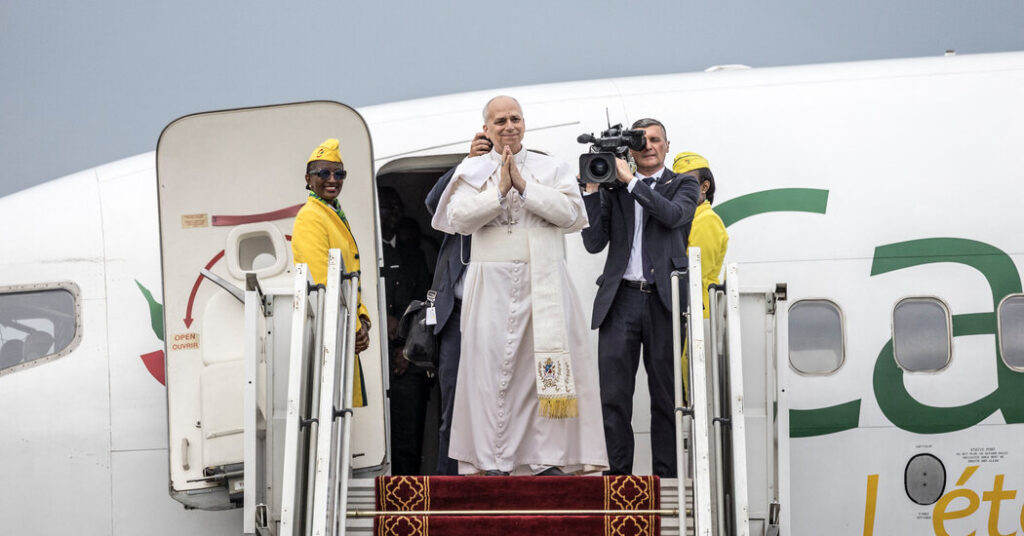
From the point of view of pastoral efficiency, some of the nations that Pope Leo XIV has visited on his African tour this month make a lot of sense. Cameroon and Angola, for example, are each home to millions of Catholics.
But in other African nations that fuel Catholicism’s global growth — nations not on the Pope’s itinerary — some are puzzled by their exclusion.
The Pope spent three days in almost entirely Muslim Algeria, home to only a few thousand Catholics. On Tuesday, he began a two-day trip in Equatorial Guinea, which is majority Catholic but one of the continent’s smallest countries.
He is bypassing the Democratic Republic of Congo and Nigeria, which together are home to some 90 million Catholics.
Some see the visits to Equatorial Guinea and Algeria as important missionary work. Others said they hoped their papal visit from Leo would come in the future. Still others wondered whether security concerns, such as the war in eastern Congo or recent terrorist attacks in Nigeria, kept the pope away.
A Vatican spokesman did not respond to a request for comment about how Pope Leo’s itinerary was decided, and why the continent’s biggest Catholic nations were bypassed.
Many craved his presence. “Africa is suffering, and we need peace,” said Francine Mukweya Catherus, 52, the assistant director of the choir at the Lumiere de Saint Leonard church in Kinshasa. Here are four mostly Catholic nations on the continent that didn’t make the cut for Leo’s first visit to Africa as pope.
The Heavyweight: Democratic Republic of Congo
Congo is home to 55 million Catholics, and the Central African country’s high fertility rate means it is an essential part of the church’s global future.
Pope Francis visited the country in 2023, drawing millions of people to meetings and masses in the capital, Kinshasa. For this reason, many Congolese Catholics said they understood why their country didn’t make the cut. “When he came to Kinshasa, other countries were not visited either,” Mrs. Catherus said.
Since that visit, however, the stakes have changed. The long-running conflict in the country’s east has escalated, with thousands of innocent people killed along the border with Rwanda.
In Congo, the Roman Catholic Church is one of the few institutions capable of challenging the state; church leaders have publicly opposed President Félix Tshisekedi’s proposed constitutional changes, warning that they could further destabilize the country.
Angelique Mitaku, 57, a Catholic who attends St. Leonard’s parish in Mazale, said she hoped the pope would use his tour in Africa to challenge African leaders to restore peace. She viewed him as one of the few people who could “bring together the Rwandan and Congolese presidents for sincere and Christian discussions to find solutions.”
“God will not come down from the sky to resolve our problems,” she said, but the pope could plead for peace. “We expect this support from him.”
The Giant: Nigeria
Nigeria has the continent’s biggest population, and, after Congo, the highest number of Catholics. Yet no pope has visited the country since 1998, when John Paul II arrived to beatify the Rev. Cyprian Michael Iwene Tansi, a Nigerian monk known for his simple life and devotion to the poor.
At the time of that visit, Williams Oboshi Ari, who was raised in a Catholic family, was a child. Now 32 and a medical administrator in the central state of Nasarawa, Mr. Ari said he felt “very, very bad” when he heard about Leo’s itinerary. To him, Nigeria should be a stop on any papal tour of Africa, especially given the security crises in the country.
For years, communities in rural Nigeria have suffered mass killings and kidnappings perpetrated by extremist groups like Boko Haram and Islamic State West Africa Province, as well as armed bandits. Though the victims are of all faiths, yearslong efforts to persuade the Trump administration to view the crisis through the lens of Christian persecution have lately gained traction.
If he had come to Nigeria, Leo would likely have had to address this issue.
“Maybe he wants to avoid all those controversies,” Mr. Ari said.
Other young Nigerians interpreted their country’s omission differently. Naomi Peters Omoruwa, 28, argued that the pope is perhaps less needed in Nigeria because it already has one of the world’s youngest and most active Catholic populations. Visiting other countries is “a chance to reach out to people who may not yet have a strong relationship with God,” she said.
Nigeria is such a colossus that it needs a visit all its own, said Cardinal emeritus John Olorunfemi Onaiyekan, the retired archbishop of Abuja. “We cannot be packed onto an African tour,” he said.
The Stalwart: Kenya
In Kenya, unlike in the United States and Europe, attending daily mass is still a common practice for many Catholics — 74 percent say they attend daily or weekly.
The devotion in Nairobi, the Kenyan capital, is visible daily. On Monday, people arrived for Mass at the main Catholic church in Nairobi after work.
The church, the Cathedral Basilica of the Holy Family, is close to government buildings and the Kenyan Parliament. Those who attended Mass included civil servants and small business people.
Several Kenyans said they had no idea that the Pope was visiting Africa this month. Aside from mild surprise, none said they took his absence in East Africa as a slight.
Coming to the continent at all “means he is with us together because Africa is one nation,” said Josephene Mwende, 28. “Maybe he will come to Kenya one day. Hopefully.”
The Provider: Uganda
Last year, Pope Leo appointed the first African-born bishop to lead a diocese in the mainland United States. That bishop, Simon Peter Engurait, is from Uganda. Now serving in Louisiana, he has spoken of the challenges of trying to get young Americans interested in the Catholic faith.
But that is less of a problem where he is from.
Uganda’s Catholic population has exploded to 21 million. Africa is the only continent where the number of seminarians is growing. Many of them become missionaries abroad, including in Europe and the United States, two places that traditionally sent missionaries to Africa.
Uganda is one of the engines of this switch. The country is producing many young priests who travel abroad to serve the emptying churches of the West.
Francis Twesigye, a Catholic from western Uganda, said he was sad Leo would not be visiting, in part because he had missed Francis, who made a papal visit in 2015. “I had no money to travel to Kampala to see him,” he said, referring to the capital.
But Geodon Peter Ssebulime, a parishioner in the Nsambya neighborhood of the city, endorsed the pope visiting countries with smaller numbers of Catholics. He noted that both John Paul II and Francis visited Uganda and Kenya.
“It sends a message of openness and encourages better relations with non-Catholics,” he said.
Reporting was contributed by Babatunde Samuel from Lagos, Nigeria; Matthew Mpoke Bigg from Nairobi, Kenya; Musinguzi Blanshe from Kampala, Uganda; and Motoko Rich from Rome.
Ruth Maclean is the West Africa bureau chief for The Times, covering 25 countries including Nigeria, Congo, the countries in the Sahel region as well as Central Africa.
The post Pope Leo Is Skipping Some of Africa’s Biggest Catholic Nations appeared first on New York Times.