Democrats maintained their electoral momentum on Tuesday by securing the passage of an aggressively gerrymandered House map in Virginia, which could deliver the party up to four extra seats as it tries to win back control of Congress.
National party leaders had been heavily invested in the outcome, with Representative Hakeem Jeffries of New York, the minority leader, helping orchestrate the statewide Virginia referendum with Democratic state legislators. Speaker Mike Johnson, hanging on to a slim majority, tried to rally the state’s Republicans.
Democrats sought to focus the campaign on President Trump, who instigated the nationwide redistricting fight last summer in Texas to help House Republicans in the midterms. A vote for a gerrymandered House map, Democrats argued, was a vote to help their party stop Mr. Trump’s agenda. The president stayed out of the contest until the final hours before Election Day, when he urged Virginians to block the map.
“Donald Trump tried to rig the midterm elections by gerrymandering the national congressional map,” Mr. Jeffries said in an interview on Tuesday night. “He has failed.”
Here are four takeaways from the election:
Democrats have fought to a draw in the clash over maps — for now.
The vote in Virginia erased the small structural advantage that Republicans had built in the country’s redistricting battle.
Republicans could still seize back their edge, however, with the prospect of a new map in Florida. And the Supreme Court may well set off a political earthquake with a ruling that upends a key provision of the Voting Rights Act, which could lead to more Republican gains.
But for now, Democrats have averted their fears from the start of the gerrymandering fight that Republicans could gain an overwhelming cartographic advantage. And with the political environment shifting in their favor, they are increasingly optimistic about winning back the House.
Mr. Jeffries, in the interview, made clear that he expected Democrats to claim nearly all of Virginia’s 11 House districts.
“In November, we’re going to win 10 congressional seats in Virginia and take back control of the House of Representatives,” he said.
Republicans fell short, but gained ground in a blue state.
Democrats and Republicans were watching the Virginia election closely for any hints about the national mood before the midterms.
Both parties found bright spots.
For Democrats, a win is a win, and they are thrilled to pick up more House seats.
But Republicans were happy to not be blown out in a state whose last major election was not very competitive. After an ill-funded G.O.P. candidate lost the governor’s race in November to Abigail Spanberger by 15 percentage points, the Republican side of the Virginia referendum kept the race to about a three-point margin as of late Tuesday.
Republicans argued that the relatively tight result in a left-leaning state was evidence of overreach from a Democratic Party that is again building its political identity around opposition to Mr. Trump.
“Virginia Democrats can’t redraw reality,” said Representative Richard Hudson of North Carolina, the chairman of House Republicans’ campaign arm. “This close margin reinforces that Virginia is a purple state that shouldn’t be represented by a severe partisan gerrymander.”
Democrats attributed the narrow result to what they called a Republican effort to confuse voters. The “No” ads included old footage of former President Barack Obama and Ms. Spanberger — who both backed the referendum — speaking out against partisan gerrymandering.
“There definitely was a strong campaign on the Republican side spreading mis- and disinformation,” Representative Suzan DelBene of Washington State, the chairwoman of the House Democrats’ campaign arm, said in an interview on Tuesday night.
Democrats won with a belated focus on Trump.
When Gov. Gavin Newsom of California orchestrated an election to redraw his state’s congressional map last fall, he cast the race as an opportunity to fight back against Mr. Trump.
By contrast, the “Yes” campaign’s first ads in Virginia portrayed the referendum not as a fight against Mr. Trump, but as a broad bipartisan effort to level the national playing field by redrawing congressional maps. The result was that the election was framed at the start as a question about gerrymandering more than about Mr. Trump.
In the first six weeks of the campaign, the “Yes” side spent $13.5 million on advertising compared with the “No” campaign’s $640,000, according to data from AdImpact, a media tracking firm. But over that time period, “Yes” did not gain ground in private polling, according to multiple people briefed on the data.
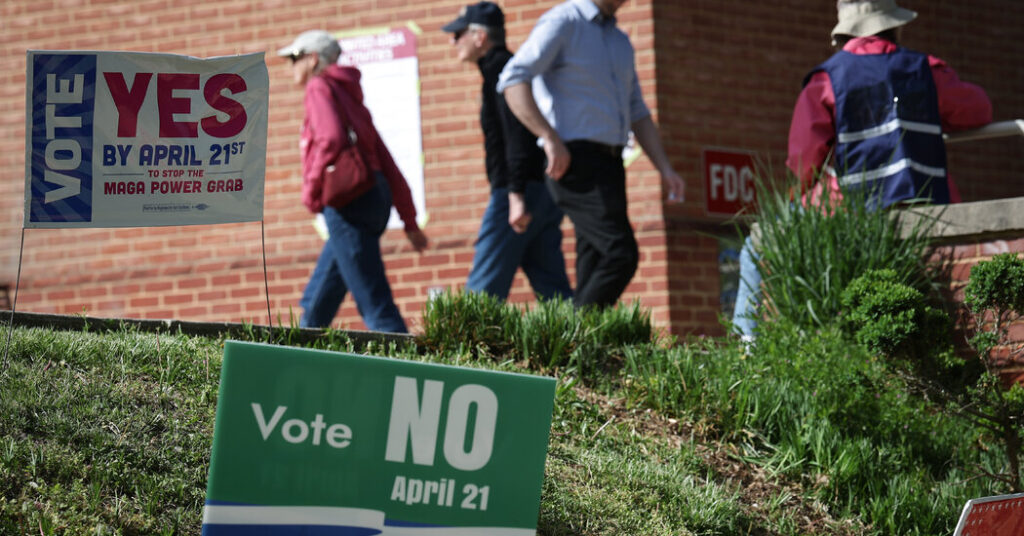
By the campaign’s end, the “Yes” side had shifted to an all-Trump, all-the-time message. Advertising, mailers and campaign signs urged voters to “stop the MAGA power grab,” and Virginia Democrats painted a dire picture of allowing Republicans to maintain a House majority.
“To be frank, I think the messaging of late has been better than it was when this effort first started,” Representative Suhas Subramanyam, a Democrat, said in an interview days before the vote. “When they understand it as evening the playing field and a check on President Trump, we do better.”
Ms. Spanberger also played a complicated role.
Unlike Mr. Newsom in California, the Virginia governor did not make herself the centerpiece of the “Yes” campaign. She filmed a TV ad, but it did not air, and she often seemed uncomfortable speaking in support of the referendum.
On Tuesday, while other Democrats including Mr. Jeffries did local news interviews and made public appearances to urge people to vote, Ms. Spanberger, aside from a couple of social media posts, remained out of sight until after the election was over and “Yes” had won.
Everybody is fine with gerrymandering as long as they get to do it.
There was a time, not very long ago, when an extreme political gerrymander could elicit an outcry from both parties. That era is over.
Now it is clear that pushing for maximal partisan advantage is part of the expectation of being in power, and there is little political risk in vying to shut out the other side.
In fact, there may be risk in not doing so. Mr. Trump is backing primary challenges to several Republicans in the Indiana State Senate who resisted his effort to redraw the state’s congressional map.
After the Virginia result, Trump allies were quick to condemn Democrats for their newfound affinity for gerrymandering.
“The hypocrisy is thick,” said J. Christian Adams, the president of the Public Interest Legal Foundation, a conservative legal group. “We have been lectured for years about political gerrymandering by the left. They hate it, until it delivers them power.”
Indeed, Eric H. Holder Jr., the Democratic former attorney general, started a political organization in 2017 that has spent years denouncing Republican-drawn gerrymanders.
But in Virginia, he campaigned for the “Yes” side, and on Tuesday night he celebrated Virginia’s voter-approved gerrymander as a victory against Republican-drawn gerrymanders elsewhere.
Mr. Jeffries, in the interview, argued that Virginia’s vote did not constitute gerrymandering in the same breath as he condemned gerrymandering carried out by Republicans.
“We’re not engaged in political gerrymandering,” Mr. Jeffries said. “We are engaged in responding to the Republican effort to rig the midterm elections.”
Reid J. Epstein is a Times reporter covering campaigns and elections from Washington.
The post Democrats Win a Big Battle in the Fight Over Midterm Maps: 4 Takeaways appeared first on New York Times.