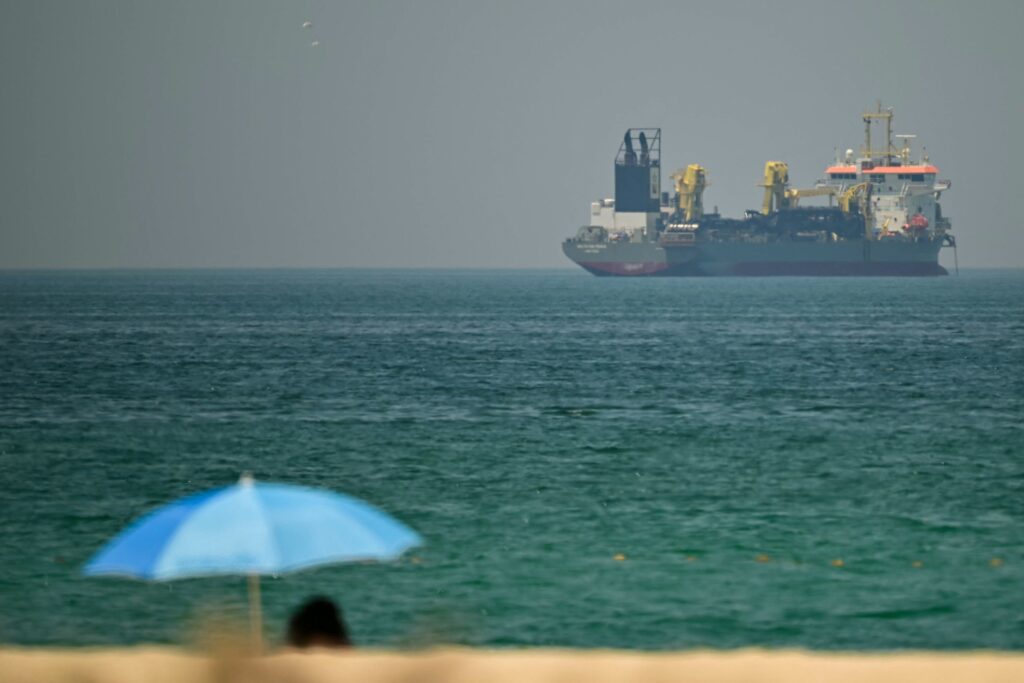
ISLAMABAD, Pakistan — Iranian forces opened fire on a container ship in the Strait of Hormuz on Wednesday, according to the British military, just hours after President Donald Trump initially calmed fears of renewed violence by extending indefinitely his ceasefire with Iran.
An Islamic Revolutionary Guard Corps gunboat fired on a container ship and “caused heavy damage to the bridge” in an attack about 15 miles northeast of Oman, according to the United Kingdom Maritime Trade Operations Center (UKMTO), a monitoring agency that is part of the British Royal Navy.
A battle for control of the Strait of Hormuz, a vital passageway for global energy supplies, has emerged as a major stumbling block in negotiations to end the U.S.-Israeli war against Iran.
Trump said Tuesday that he extended the ceasefire, just as it was due to expire, to allow more time for negotiations with no new concession by Tehran — a sign that the president is eager for a way out of what has become an increasingly costly and unpopular war. Trump insists that most U.S. military objectives have been met and that Iran has little negotiating leverage. However, Iran has refused to bow to Trump’s demands, including a longtime moratorium on its nuclear enrichment program.
Meanwhile, renewed Iranian attacks on vessels in the strait and U.S. seizures of ships linked to Iran threaten to scuttle the diplomatic efforts.
A U.S. delegation led by Vice President JD Vance and a high-level team of Iranian officials were set to travel to Islamabad, the capital of Pakistan, for a second round of face-to-face negotiations, but the Iranians informed mediators at the last minute that they would not attend so long as a U.S. blockade of the strait continues, according to an Iranian official, who spoke on the condition of anonymity because he was not authorized to brief the press.
Deep distrust of the White House and Trump’s “maximalist” demands are also frustrating diplomatic progress, the official said. In Islamabad, uncertainty had swirled around the prospective talks for days. While Trump publicly threw his support behind a second round, Tehran refused to commit.
By late Tuesday night in Islamabad, Iranian officials had informed Pakistani mediators they would not attend. The Trump administration put Vance’s trip on hold and said the naval blockade would continue, even as the president announced that the ceasefire would be extended.
Pakistani Prime Minister Shehbaz Sharif welcomed the news but, behind the scenes, Pakistani mediators were furious with Iran over the last-minute reversal, according to an individual briefed on the diplomatic efforts who spoke on the condition of anonymity to discuss sensitive closed-door discussions.
Trump imposed the blockade on Iranian ports on April 12, after the first round of in-person talks in Islamabad failed to reach a deal. As of Tuesday, naval operations had forced at least 28 vessels to turn back, according to U.S. military officials. The Trump administration has said the blockade is intended to increase economic pressure on Tehran.
While the first round of negotiations ended without an agreement, the sides appeared to develop a rapport, lifting hopes that the meeting would lay the groundwork for an eventual deal. But a standoff over the status of the Strait of Hormuz quickly overshadowed the diplomacy. Iran on Friday announced the strait would reopen only to reverse course the following day after Trump refused to lift the U.S. blockade.
Iranian forces also attacked at least two other vessels in the strait over the weekend. On Saturday, Iranian forces fired on a tanker, according to UKMTO, and a container ship reported damage caused by an unknown projectile.
The United States began seizing ships linked to Iran in the area over the weekend as well. Touska, an Iranian-flagged cargo ship, was seized by U.S. forces as it moved west through the Arabian Sea, seemingly headed for Iran. And on Tuesday in the Indian Ocean, U.S. forces seized a tanker ship suspected of smuggling oil and escorted at least one other vessel off India’s western coast.
Economic damage from the war in Iran has been extensive. Traffic in the Strait of Hormuz has been at a near halt over seven weeks, triggering the largest global energy crisis in decades, including fuel shortages in many countries and spiking prices everywhere.
For Iran, control of the strait provides powerful leverage that it has only now flexed in response to the U.S. and Israeli bombing campaign that began in late February and killed Iran’s supreme leader, Ayatollah Ali Khamenei.
Tehran’s decision not to attend talks reflects the country’s perception that it is still operating from a position of strength, according to a European diplomat based in the Middle East, who spoke on the condition of anonymity to discuss sensitive closed-door discussions.
“This is defiance, this is Tehran saying ‘don’t test us, we say what we mean and we do what we say,’” the diplomat said. The diplomat said shipping and insurance companies see Iranian attacks in the strait and U.S. seizures there as a “significant” escalation. But the diplomat said both Iran and the U.S. remain motivated to reach a deal.
The Iranian negotiators “are playing hard to get,” the diplomat said.
Another factor that could be slowing negotiations is the relatively recent tenure of the new supreme leader, according to the diplomat.
In negotiations with the U.S. before the war, Ali Khamenei acted as an arbiter between competing centers of power within the Iranian leadership. Now, it appears that his son and successor, Mojtaba Khamenei, is instead allowing Iran’s empowered military and security apparatus to have greater sway over the talks.
It is unclear if Khamenei aligns more with Iran’s military or if his role is reduced because of injuries that he sustained in the attack that killed his father, according to the diplomat.
Iran’s ambassador to the United Nations, Amir-Saeid Iravani, on Tuesday told reporters that as soon as Washington ends the blockade, “I think the next round of the negotiations will take place in Islamabad,” according to a readout of the remarks from his office.
If the U.S. wants to “find a political solution, they will find us ready,” Iravani said. “If they want to go to the war, in this case also Iran is ready for that.”
The post Attacks and ship seizures in Strait of Hormuz imperil talks to end Iran war appeared first on Washington Post.