Europe’s nationalist right rejoiced when Donald Trump was first elected in 2016. It celebrated again when he returned to the White House last year. His triumph was seen as a vindication of the anti-immigrant, anti-woke platforms that have been gaining momentum on their side of the Atlantic, too.
But over the past year, Trump’s aggressive tariffs, his threats to invade Greenland, his war on Iran — and the energy crisis it has spawned — not to mention his attacks on the pope, have changed that.
Today my colleague Jason Horowitz, our Madrid bureau chief, writes about how Trump’s brand is now so toxic in Europe that left-wingers and conservatives are both opposing him.
Why so many leaders in Europe want to stand up to Trump
By Jason Horowitz
He’s the newly anointed leader of the global left.
She’s a pioneer of Europe’s new nationalist right.
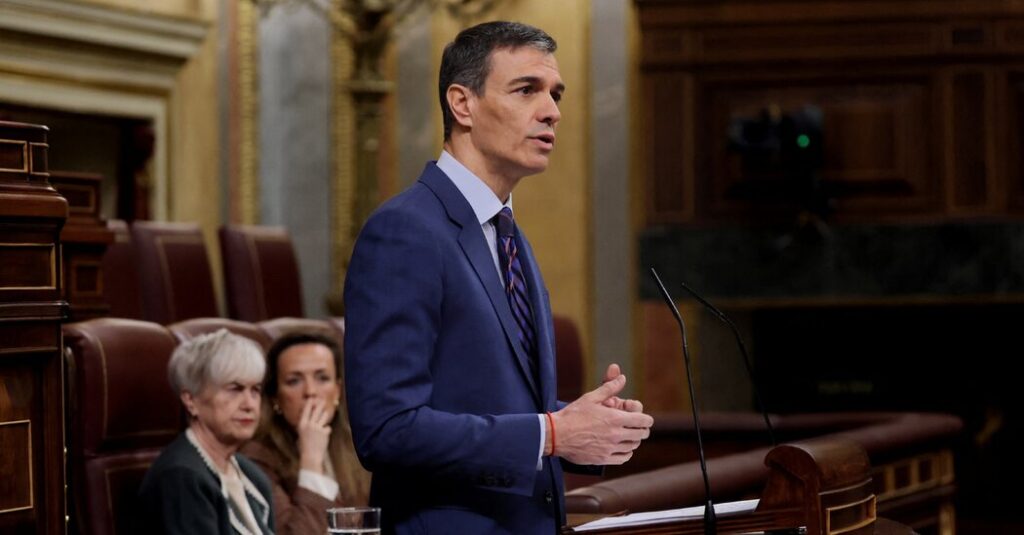
Even though Pedro Sánchez of Spain and Giorgia Meloni of Italy are two European prime ministers on opposite ends of the ideological spectrum, last week they both found themselves walking the same path to political survival: standing up to President Trump.
It’s a sign of just how low Trump’s standing in Europe has fallen.
Trump as life preserver
In Spain, Sánchez has emerged as the darling of the international left for his early-and-often opposition to Trump, whether it be the American president’s tariff threats, his demands for increased military spending, his Greenland ambitions or, most critically, his war in Iran.
“No to war,” Sánchez bellowed at a conference in Barcelona that I attended over the weekend. He spoke to a rapturous crowd consisting of his Spanish base, but also liberal leaders from Europe, South America, Africa and the United States. “Shame on those who defend the privileges of the elites,” he said, “who support war.”
But as many Spanish analysts have pointed out, Sánchez’s standing up to Trump, and Trump’s repeated put-downs of Sánchez, have served not only to elevate the prime minister’s stature abroad, but to distract from his troubles at home. Sánchez’s former political associates are facing embarrassing corruption scandals and trials in the Spanish Supreme Court this month. (They say that they are innocent, and Sánchez himself is not implicated.)
Sánchez had been sinking in polls since the summer. But Trump has become a life preserver. The more Sánchez seeks to distance Spain from the U.S., the better his poll numbers look. Since taking on Trump, he is stirring enthusiasm among a base he desperately needs to mobilize. His popularity is swelling.
Trump as albatross
Something not dissimilar is playing out across the Mediterranean Sea, in Italy.
Sánchez and Meloni don’t have much in common politically. She’s the standard-bearer of a hard-right European ideology that had long embraced Trump for his nationalism, opposition to immigration and disdain for liberal identity politics. For years, Meloni had sought leverage in Europe as a sort of right-wing bridge to Trump.
And yet last week, she found herself traveling the same Trump-divergent road.
Meloni recently lost a referendum that many analysts attributed to her close association with Trump. His popularity in Italy has plummeted since he threatened tariffs, including on pasta, and launched the war in Iran.
Then Trump attacked Pope Leo XIV.
In Catholic Italy, where the Vatican matters, a choice between taking the side of a popular pope standing up for peace in a war that most Italians oppose and an American president digging popularity ditches isn’t much of a choice at all. Meloni, who has governed more as a pragmatist than an ideologue, took the pope’s side.
“I find President Trump’s remarks about the Holy Father unacceptable,” Meloni said.
Trump did the hard work for Meloni in response, attacking her as disloyal, not the person he thought he knew. For Meloni, who, like Sánchez, is expected to face elections next year, the breakup message was essentially a political gift.
A toxic American president
That distance from Trump is a political imperative for such diametrically ideological opposites as Sánchez and Meloni demonstrates how toxic the American president has become across the continent.
On the left, Trump has been a boogeyman from Day 1, and Sánchez has clearly made the calculation that the political benefits of running hard against the American president are worth whatever blowback may come. His advisers say the country, which has a growing economy, a trade surplus with the United States and the protection of the European Union when it comes to trade agreements, is well equipped for any reprisals. Trump is so unpopular that he is more useful to Sánchez as a foil than a friend.
On the other hand, European conservatives for years saw Trump as an energizing figure, someone who broke with taboos against the far-right, who created momentum as they sought to dismantle the European Union and carry out more nationalist agendas back home.
But the distance sought by Meloni suggests that may be changing.
In Britain, Nigel Farage, a onetime Trump fan, is increasingly critical of him. A leading figure in Germany’s far-right AfD party called him a “millstone.” In France, leaders of the National Rally have explicitly called for distance. Now it seems that Meloni, too, has decided he is a bridge too far.
And if she wanted more evidence that Trump’s embrace could be electorally unhelpful, she would need to look no further than Hungary, where, despite good tidings from Trump and a personal visit from Vice President JD Vance, Meloni’s ally, Viktor Orban, recently lost in a landslide.
MORE TOP NEWS
The battle for the Strait of Hormuz intensifies
Iran’s Islamic Revolutionary Guards Corps said it had seized two cargo ships yesterday near the Strait of Hormuz, a day after Trump extended a cease-fire with Iran but kept in place a blockade on the country’s ports.
The seizures underscore how the U.S. and Iran have been turning to their navies to try to exert pressure on each other as the future of diplomatic talks remain unclear. Pakistan said it was ready to host a new round of U.S.-Iran talks aimed at ending the war, but neither Washington nor Tehran gave a clear indication of what it would take to precipitate them.
Other developments:
-
The U.S. has halted shipments of dollars to Iraq in an effort to force the Baghdad government to distance itself from Iran.
-
Attacks along the Israeli-Lebanese border threatened a tenuous truce.
-
Wealthy countries are scrambling to secure stocks of oil, threatening shortages in vulnerable countries.
A 90 billion euro loan to Ukraine
After months of stonewalling by Hungary, the European Union took a critical step yesterday to extend a lifeline to Ukraine as the war with Russia drags on.
The 90 billion euro loan had been held up since February by Prime Minister Viktor Orban, who had accused Kyiv of not moving fast enough to repair an oil pipeline that was damaged in an attack. He was ousted in an election this month.
OTHER NEWS
-
At a national independence day ceremony, the Israeli government honored a rabbi who has called to “flatten” the Gaza Strip.
-
Pope Leo, visiting a prison in Equatorial Guinea, told inmates to find hope amid despair, as “life is not defined solely by one’s mistakes.”
-
South Korea said a 2021 midair fighter jet crash was caused by crew members taking photos and videos on their phones.
-
Lufthansa plans to cut 20,000 flights over the next six months to conserve jet fuel.
-
Anthropic’s new A.I. model, Mythos, has been deemed too dangerous to release widely. Some companies and governments have early access — and they’re all American or British.
-
Moscow is threatening residents with eviction from the occupied Ukrainian city of Mariupol if they do not obtain Russian title deeds.
-
Nathalie Baye, one of the most familiar faces in French cinema over four decades, has died. She was 77.
TOP OF THE WORLD
The most clicked link in your newsletter yesterday was about the war’s shock waves hitting Asia.
SPORTS
Football: Liam Rosenior was sacked by Chelsea after less than four months as the club’s head coach.
World Cup: With just 50 days to go until the tournament, catch up on where things stand for top-ranked teams like France, Spain and England.
INSULT QUIZ OF THE DAY
Can you tell the real British put-downs from the fakes?
How do I snub thee? Some British researchers are counting the ways. They’re asking people to send them swear words and insults that might be little known to outsiders. Take our quiz to find out if you can spot a genuine British insult.
MORNING READ
These images show Antelope Reef, a large artificial island that China has been quietly and quickly building in disputed waters off the coast of Vietnam. A stretch of reef that was under water just four months ago now has buildings, a helipad and several jetties.
The island could help Beijing continue to dominate the South China Sea, a key waterway for global shipping. Analysts say it is likely to become one of Beijing’s largest military outposts in the region. Take a look.
AROUND THE WORLD
No fancy studio. Plenty of amazing dance.
The main studio of the École des Sables, a dance school in Senegal, has no sprung floor and no mirrored walls. Actually, there are no walls at all.
The dancers work outdoors, under a large canopy, and the floor is unusually treacherous: It’s sand.
The sand studio is part of the nature-oriented vision of Germaine Acogny, who founded the school in 1998 in Toubab Dialao, a fishing village about an hour’s drive from Dakar. Over the years, the École des Sables has established itself as the highest-profile dance training hub in Africa. But money is a persistent concern, and there are plans to build a new port in the green space nearby. Read more about the École des Sables as it prepares to host the African Dance Biennial this month.
RECOMMENDATIONS
Day 3 of the Poetry Challenge: The third stanza of “The More Loving One” is a miniature showcase of W.H. Auden’s skill. Learn more about this star poet.
Watch: In “This Is a Gardening Show,” the comedian Zach Galifianakis digs into one of his greatest passions.
Listen: The voice of the Finnish singer Vilma Jää is unlike anything in opera.
RECIPE
This Hawaii-style garlic shrimp recipe uses mochiko (sweet rice flour) for extra crispness. It calls for one head of garlic, but feel free to adjust according to your taste.
WHERE IS THIS?
Where is this art museum?
TIME TO PLAY
Here are today’s Spelling Bee, Mini Crossword, Wordle and Sudoku. Find all our games here.
That’s it for today. See you tomorrow! — Katrin
Jason Horowitz was our guest writer today.
We welcome your feedback. Send us your suggestions at [email protected].
Katrin Bennhold is the host of The World, the flagship global newsletter of The New York Times.
The post Anti-Trumpism Unites Europe appeared first on New York Times.