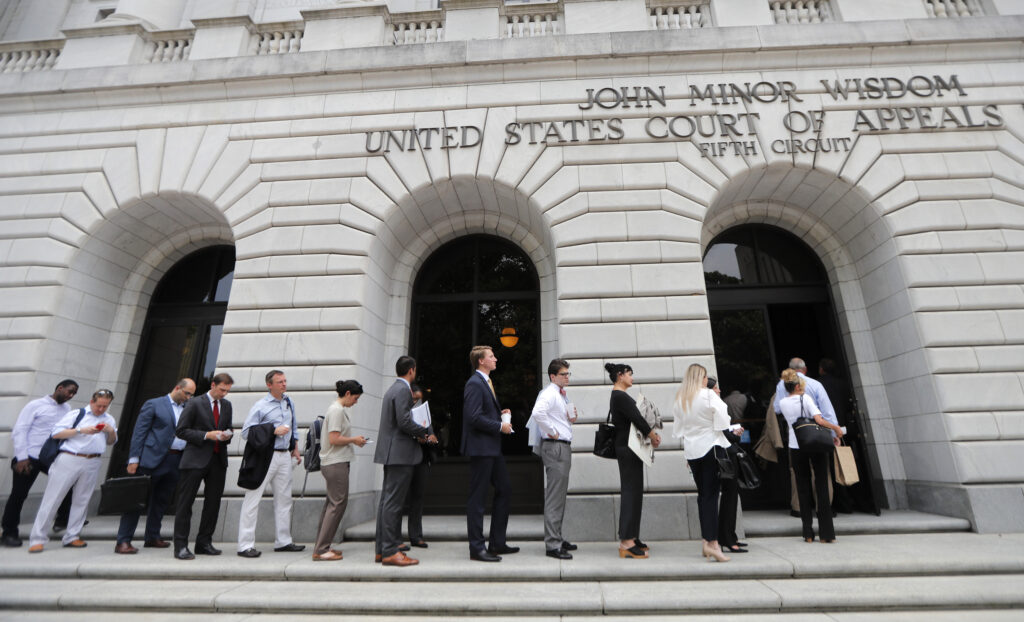
An appellate court ruled Tuesday that Texas may require that public school classrooms display the Ten Commandments, a significant win for the conservative campaign to break down the legal walls between church and state and inject more religion into the public square.
The 9-8 ruling came from the conservative Court of Appeals for the 5th Circuit in New Orleans. The case is widely expected to head next to the Supreme Court, where the conservative majority has been steadily removing restrictions on government support for religion.
Texas passed its Ten Commandments law in 2025, one of several efforts in recent years to infuse religion into public education. The Texas Board of Education, for instance, has also approved Bible-infused teaching materials and the state lets chaplains serve as school counselors.
A similar law requiring display of the Ten Commandments was approved in Louisiana in 2024. Federal judges blocked both statutes from taking effect, and a three-judge panel of the 5th Circuit Court of Appeals called Louisiana’s law “plainly unconstitutional.” Both states appealed to the full court, and the 17 active justices heard the case in January.
In February, the court ruled that it was too soon to challenge Louisiana’s law because it had not yet taken effect. On Tuesday, the court rendered its narrowly divided decision in the Texas case.
“This is a major victory for Texas and our moral values,” Texas Attorney General Ken Paxton said in a post on X. “ … The Ten Commandments have had a profound impact on our nation, and it’s important that students learn from them every single day.”
The American Civil Liberties Union and other groups representing challengers to the law said they were “extremely disappointed” and anticipate appealing to the Supreme Court.
“The Court’s ruling goes against fundamental First Amendment principles and binding U.S. Supreme Court authority,” the groups said in a statement. “The First Amendment safeguards the separation of church and state, and the freedom of families to choose how, when and if to provide their children with religious instruction. This decision tramples those rights.”
Central to the case is the reach and interpretation of the Supreme Court’s 2022 decision in Kennedy v. Bremerton School District, where the court allowed a football coach to pray at midfield after a game, calling it a personal religious observance protected by the right of free expression of one’s beliefs. In its decision, the court disavowed a long-standing legal standard known as the Lemon test, which for decades was used to invalidate policies that have a religious purpose or foster excessive government entanglement with religion.
A landmark Supreme Court decision in 1980 had relied at least in part on that test in invalidating a Kentucky law very much like recent laws passed in Texas and Louisiana mandating display of the Ten Commandments. In the Kentucky case, the court ruled that the mandatory displays were unconstitutional because the law had no secular purpose.
The question now is whether the football coach’s case means that other religious expressions are also permissible. In that case, the court endorsed considering “historical practices and understandings” in assessing the constitutionality of religious actions.
In its ruling Tuesday, the appellate court noted that the Lemon test had been jettisoned and said the Kentucky precedent no longer applied. Instead, it said, the court must consider whether the Texas law would have been considered an unconstitutional establishment of religion at the time of the nation’s founding.
Using this lens, the appellate court said Tuesday, displaying the Ten Commandments does not look like the establishment of religion.
“It does not tell churches or synagogues or mosques what to believe or how to worship or whom to employ as priests, rabbis, or imams. It punishes no one who rejects the Ten Commandments, no matter the reason. It levies no taxes to support any clergy. It does not co-opt churches to perform civic functions,” it said.
The court said that students would not be coerced into any religious exercise or observance.
The court majority also rejected comparisons to a recent caseout of Montgomery County, Maryland, in which the Supreme Court said that parents could opt their children out of LGBTQ+ material that contradicted their religious beliefs.
“All the law requires is a poster on a classroom wall. To be sure, Plaintiffs disagree with the poster’s content, but that disagreement alone does not transform S.B. 10 into religious coercion,” the court wrote.
Michael A. Helfand, a law professor at Pepperdine Caruso School of Law who is an expert in church-state law, said the court was right to look to how this practice would have been viewed at the founding of the country but said the court’s answer to that question was wrong.
“The historical record provides evidence that when government acts to manipulate the religious preferences of its citizens, it violates the Establishment Clause. And requiring the Ten Commandments in every public school classroom should have been interpreted as an attempt to do just that,” Helfand said.
Supporters of the Texas law argue that the teachings of Christianity, including the Ten Commandments, are an important part of American history. Many also embrace the religious message as useful for children in schools to see.
“It is incumbent on all of us to follow God’s law and I think we would all be better off if we did,” Texas state Rep. Candy Noble (R), one of the bill’s sponsors, said during the legislative debate last year.
Groups fighting to repeal the Texas and Louisiana laws argue that posting a religious text could make students of other faiths, or no faith at all, feel excluded. And they objected to the melding of church and state, saying it was both inappropriate and unconstitutional.
“The key issue is whether or not the state can impose biblical scripture on children,” said Heather Weaver, senior counsel with the ACLU.
The first of the Ten Commandments is, “I am the Lord thy God,” and the second is, “Thou shalt have no other gods before me.”
She said the law was “religiously coercive” and gives preference to one religion over others, something she argued is unconstitutional. And she said the law violates the religious rights of students and the rights of parents to decide how their children engage with religion.
The unsettled legal landscape has led to confusion among Texas schools about what they are required to do. The court put the law on hold last summer, but Paxton told schools not directly involved in the case to comply, and he has filed lawsuits against school districts that didn’t.
The post 5th Circuit allows Texas to require Ten Commandments in classrooms appeared first on Washington Post.