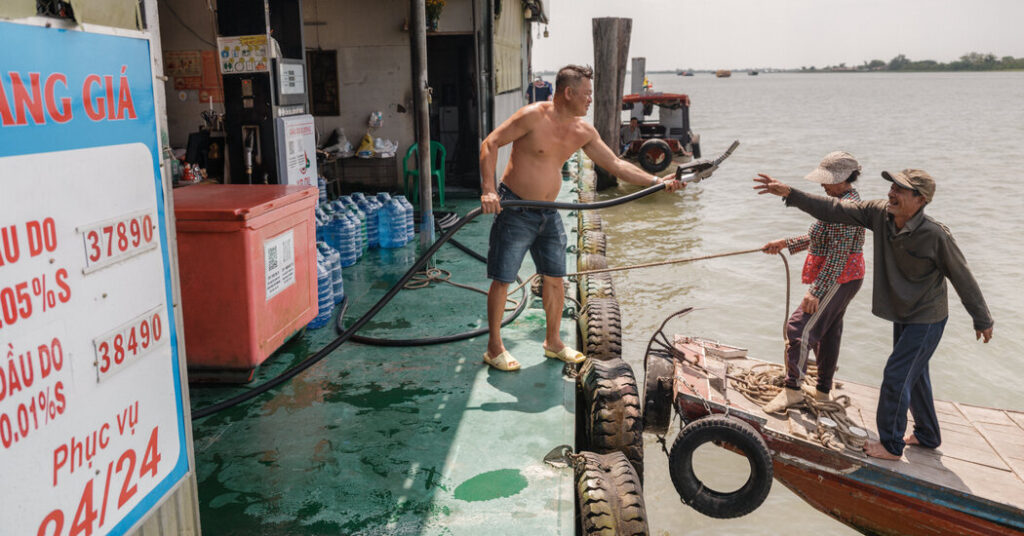
There is no country that has been untouched by the energy crisis set off by the war in Iran. With gas prices rising in the United States, and a looming shortage of jet fuel in Europe, the ripples are being felt widely. The biggest impact outside the Middle East has been in Asia.
My colleague Damien Cave reports that several countries in the region could face recession and unrest, with cascading consequences for the rest of the world.
The crisis in Asia
By Damien Cave
Businesses across Asia are on the verge of insolvency. Governments are taking on enormous debt. By year’s end, in the most dire projections, millions of people across the Asia-Pacific region could be pushed into poverty by the war in Iran.
Even if there is a peace deal soon, the region, which has driven global economic growth for decades, is likely to face months of canceled flights, surging food prices and shelves emptied of everyday products: plastic bags, instant noodles, vaccines, syringes, lipstick, microchips and sportswear.
The Asia-Pacific has been the war’s first and worst zone of impact outside the Middle East. It is vulnerable because it relies heavily on Middle Eastern energy imports. And its huge economies are deeply integrated, with complex supply chains that crisscross borders.
The war, by keeping oil, gas and vital byproducts like fertilizer from Asia, has added pressure to these vulnerabilities. As a result, three pillars of stability in the region — transportation, manufacturing and upward mobility — are confronting powerful shock waves at once. If commercial traffic through the Middle East remains strangled for even a few more weeks, experts told me, shortages could push several countries into unrest and recession.
A sprawling transportation crisis
Within hours of the first strikes on Feb. 28, trucks, ships and planes stopped operating in Asia, a region defined by near-constant motion. Air travel, in particular, veered toward chaos.
In March, there were more than 92,000 flights canceled worldwide, with the largest number in eliminated flights linked to the Asia-Pacific. Jet fuel has nearly doubled in price, and some airlines have slashed routes indefinitely.
Qantas, Air New Zealand, Lion Air of Indonesia, VietJet Air, AirAsia, Air India and Cathay Pacific are just a few of the companies cutting service. One airline, Batik Air of Malaysia, cut flights by 35 percent this month to avoid insolvency.
Smaller airlines are losing millions of dollars weekly. Larger airlines in the region may survive, but discount players are likely to shrivel, merge or die. One aviation expert told me Asia’s air traffic could revert to levels last seen in the 1980s.
Halted production
Many of Asia’s most successful export industries require enormous amounts of energy and other inputs from the Middle East. Seven weeks in, stockpiles are running out, revealing new vulnerabilities.
Copper and nickel production, for example, rely on high heat from natural gas and sulfur, a fossil fuel byproduct. Both are in short supply. Several Indonesian nickel processors have reduced their output.
Polyester and nylon are also derived from petroleum. In Gazipur and Ashulia, the sewing hubs of Bangladesh, where clothes are made for Walmart, Zara and Uniqlo, there have been severe disruptions to production and shipment schedules.
Prices have soared for helium, a gas byproduct used for semiconductors. On Thursday, Taiwan Semiconductor Manufacturing Company, the world’s largest producer of high-end chips, said it had enough helium on hand to avoid a near-term impact. But a prolonged shortage could force chip makers to seek supplies from other locations, like Russia, or force production cuts that would affect everything from electronics to cars.
Human suffering
Last week, a new U.N. report estimated that 8.8 million people in Asia and the Pacific are at risk of falling into poverty because of the war, depending on how long hostilities last. Most of those, about five million, would be in Iran. But in a region where most employment is informal, without a robust safety net, the conflict’s effects are starting to compound.
In interviews, farmers in Vietnam, laborers in India, innkeepers in Sri Lanka, drivers in the Philippines and executives in Hong Kong and Singapore all sounded more worried than many of the region’s politicians, who are seeking to project a stoic calm that often understates the scramble occurring offscreen.
In India, where entire industrial clusters have been shut down for weeks by fuel shortages, workers are reversing urbanization, returning to rural villages to thresh wheat.
In Manila, minibus drivers gathered in groups this week for a three-day work strike to protest runaway gas and diesel prices.
In the northern region of the Philippines, crops ready to be harvested last week are rotting in fertile fields, with farmers unable to afford the costs of transporting them to market.
The war’s damage, so quick and deep across the Asia-Pacific, will not be easy to contain. Even if the U.S. and Iran reach a lasting peace, the forces of scarcity and inflation have gained momentum and are on the move. (Read my full story here.)
Other developments in the war:
-
President Trump said he was extending the cease-fire between the U.S. and Iran, but that his blockade of Iranian ports would continue. Follow our live updates.
-
Vice President JD Vance’s trip to Pakistan for negotiations with Iran has been put on hold, after the U.S. said Tehran had failed to respond to its terms. Iran said it had not yet decided whether to resume talks.
-
The U.S. military boarded a tanker in the Indian Ocean carrying oil from Iran. The Navy boarded an Iranian cargo ship near the Strait of Hormuz on Sunday.
-
China’s leader, Xi Jinping, called for the Strait of Hormuz to reopen.
IN ONE IMAGE
My colleague David Guttenfelder took this photograph in southern Lebanon of a boy being welcomed by his aunt and uncle after crossing a destroyed bridge. Since the cease-fire between Israel and Lebanon began on Friday, thousands of displaced people are trying to return to their homes.
MORE TOP NEWS
Japan will sell more weapons abroad
Prime Minister Sanae Takaichi yesterday reversed limits on arms exports, the latest shift away from the pacifist policies Japan adopted after World War II.
The changes will allow defense contractors to sell weapons systems to 17 countries. The government on Saturday finalized contracts to deliver the first three of 11 warships to Australia, beginning in 2029.
Takaichi, an outspoken critic of Beijing, is seeking to shore up Japan’s defense industry and to build a more diverse network of allies because of the unpredictability of its main partner, the U.S.
OTHER NEWS
-
Israeli soldiers and settlers fired on Palestinians in the West Bank, killing two, including a child, according to the Palestinian health ministry.
-
Two Israeli soldiers received 30-day jail sentences after one photographed the other damaging a statue of Jesus in southern Lebanon.
-
The gunman who killed a tourist at a Mexican pyramid and wounded several others was carrying notes related to past U.S. mass shootings.
-
Two Americans killed in a car crash in Mexico while returning from a counter-cartel operation were C.I.A. officers.
-
New Zealand declared a state of emergency in its capital and the surrounding region after heavy rains set off flash flooding and landslides.
-
A Ukrainian official suggested naming the Donbas region that Russia is fighting for “Donnyland,” after Trump.
TOP OF THE WORLD
The most clicked link in your newsletter yesterday was about Day 1 of our Poetry Challenge.
Onward to Day 2! Learn the second stanza of W.H. Auden’s “The More Loving One” and find out why it is truly a love poem.
SPORTS
Golf: The PGA Tour will not return to Hawaii in 2027 for the first time in more than half a century, after a water dispute caused grass to die at the host course.
World Cup: FIFA is struggling to sell tickets for the U.S. team’s opening match against Paraguay, which cost as much as $2,730 apiece.
LOST ITEM OF THE DAY
Madonna’s outfit
A vintage outfit worn by Madonna during her surprise performance at Coachella on Friday is missing. The ensemble, which included a purple jacket, corset and dress, was from her personal collection, she wrote on social media. She offered a reward for its safe return.
MORNING READ
Javier Milei stunned the world with his meteoric rise to Argentina’s presidency in 2023. Since then, he has tamed the country’s runaway inflation, made friends with Donald Trump and became a star of the global right.
Now, he wants to use his power to dismantle what he calls the “aberrant” concepts of social justice and economic equality, and to make capitalism, a limited state, the free market and individualism the country’s core principles. Read about the struggle for Argentina’s soul.
AROUND THE WORLD
Fountains, frescoes and fly rods
Treviso, an Italian city near Venice that’s elegantly threaded by rivers and canals, has a long history of fishing. Its waterways, fed by a series of springs to the north, teem with trout, carp and chub, attracting waterfowl and plenty of people with rods.
My colleague Paul Abercrombie hired a guide and spent four days learning about the delights and peculiarities of Treviso street fishing. Read more about the serene experience.
RECOMMENDATIONS
Read: Gwendoline Riley’s novels contain themes not totally befitting cocktail conversation.
Check: What can you do to fall-proof your house? Here are simple ways to reduce risks.
Munch: These are seven ways to turn a can of tuna into a delectable lunch.
RECIPE
Vietnamese-style spring rolls, also known as gỏi cuốn, are refreshing, light and the ideal vehicle for crunchy vegetables, fragrant herbs and simple proteins. Switch out the shrimp for tofu, chicken, pork, fish or mushrooms, and use bite-size vegetables.
WHERE IS THIS?
Where is this coastline?
TIME TO PLAY
Here are today’s Spelling Bee, Mini Crossword, Wordle and Sudoku. Find all our games here.
That’s it for today. See you tomorrow! — Katrin
Damien Cave was our guest writer today.
We welcome your feedback. Send us your suggestions at [email protected].
Katrin Bennhold is the host of The World, the flagship global newsletter of The New York Times.
The post War Shock in Asia appeared first on New York Times.