U.S. naval operations against Iran have expanded beyond the Middle East, as U.S. forces on Tuesday seized a tanker ship suspected of smuggling oil in the Indian Ocean and escorted at least one other vessel off India’s western coast, officials said.
The capture of the tanker ship Tifani in open waters between Sri Lanka and Indonesia follows a Trump administration directive to interdict sanctioned vessels believed to be aiding Iran through the purchase of its oil. The Pentagon posted a brief video clip showing U.S. troops moving by helicopters from a Navy vessel to the tanker ship without incident.
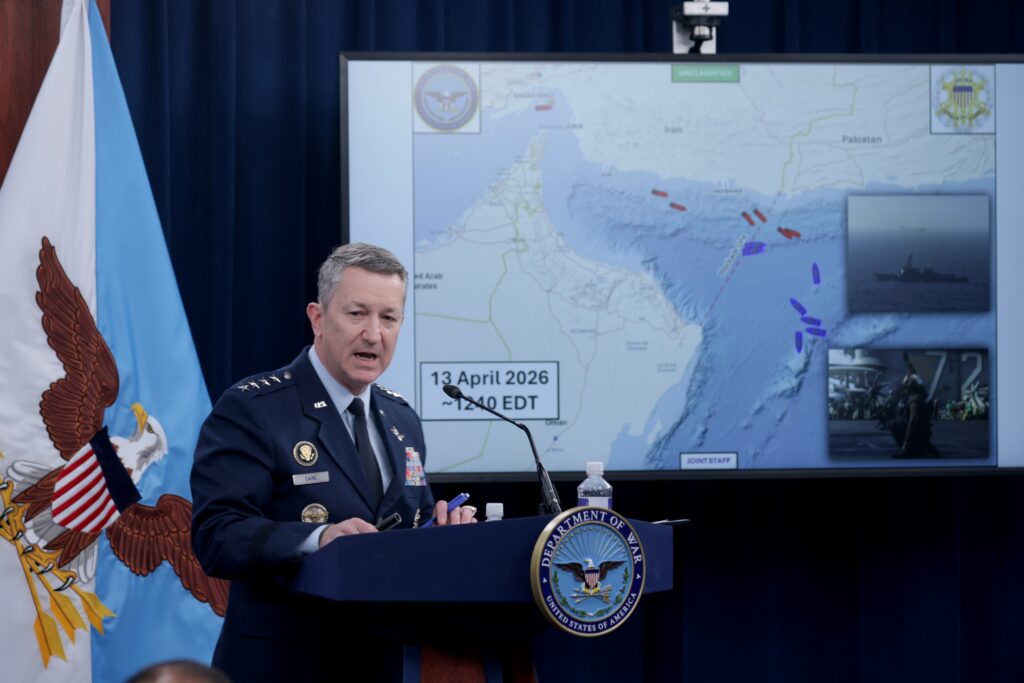
The administration imposed sanctions on the Tifani last summer, after U.S. officials said it was observed making ship-to-ship transfers of Iranian oil as part of what the Pentagon calls a “dark fleet” involved in smuggling. The seizure of the vessel, which has the capacity to carry about 2 billion barrels of oil, marks the first in what Gen. Dan Caine, chairman of the Joint Chiefs of Staff, suggested last week could be a series of operations targeting such vessels. He said that operations could occur in the Indo-Pacific region, with U.S. forces pursuing “any Iranian-flagged vessel or any vessel attempting to provide material support to Iran.”
A U.S. official, who like others in this story spoke on the condition of anonymity to discuss military operations, said the United States will determine next steps for the Tifani and its crew in the next couple of days. Tracking data shows the vessel was 400 miles east of Sri Lanka on Monday evening, taking a sharp turn south before continuing in the direction of Indonesia. It was loaded this month at Kharg Island, Iran’s main oil terminal in the Persian Gulf, according to shipping data.
U.S. Central Command, which oversees operations in the Middle East, and U.S. Indo-Pacific Command, which leads missions in the Indian Ocean, referred questions to the Pentagon, which declined to provide additional details.
The Tifani’s seizure coincides with a separate but complementary U.S. mission blockading Iranian ports — enacted as the Trump administration attempts to force the regime in Tehran to accept Washington’s terms for ending the war that began Feb. 28. At least 28 vessels had been turned back as of Tuesday, military officials said.
President Donald Trump has said that he wants assurances that Iran will end its nuclear program, turn over its highly enriched uranium and reopen the Strait of Hormuz, a vital waterway for the movement of Middle Eastern oil through the Persian Gulf. The strait’s closure has caused the global economy to convulse and triggered a rise in energy prices, including the cost of gas.
Trump said in a statement Tuesday afternoon that he had agreed to extend a two-week ceasefire with Iran, due to expire Wednesday, “based on the fact that the Government of Iran is seriously fractured” and that U.S. officials had been asked to hold their fire until Iran’s leaders “can come up with a unified proposal.”
The U.S. naval blockade of Iran will continue, Trump said. Iran has demanded that the U.S. halt its blockade as a condition of resuming talks.
Operations continued in earnest on Tuesday, with U.S. destroyers escorting at least two Iranian tankers, the Dorena and Sevin, that had departed from the Iranian port of Chabahar before the blockade commenced April 13.
Satellite imagery obtained by The Washington Post showed the Dorena was in the Arabian Sea on April 18, about 300 miles west of India’s southern coast. It was among a group of vessels that satellite photographs had shown in the port of Chabahar before the blockade took effect.
A U.S. official declined to say where the Dorena or Sevin will be escorted, or where the Sevin was located as of Tuesday. U.S. forces continue to monitor numerous other vessels as part of the blockade, relying in part on the superior speed of the Navy’s destroyers to shadow and potentially intercept them, the official said.
Meanwhile, U.S. Marines continued their search of shipping containers aboard the Touska, an Iranian-flagged cargo ship that was seized by U.S. forces on Sunday as it moved west through the Arabian Sea, seemingly headed for Iran. Officials said U.S. forces disabled the Touska using naval gunfire and have since moved it farther away from Iran.
The Navy is preparing for the arrival of a third aircraft carrier in the Middle East in the coming days, according to three officials familiar with the matter. The USS George H.W. Bush was ordered to the region earlier this month and on Tuesday was transiting east of Africa.
Once the Bush and the warships escorting it arrive in the Middle East, the Navy will have more firepower in the region than at any time since the start of the war with Iran. Two other aircraft carriers, the USS Gerald R. Ford and USS Abraham Lincoln, are in the Red Sea and Arabian Sea, respectively, each carrying dozens of fighter jets.
Tara Copp contributed to this report.
The post U.S. operations against Iran expand to Indian Ocean with tanker capture appeared first on Washington Post.