The Trump administration’s contract governing hundreds of millions of dollars in private donations to build President Donald Trump’s White House ballroom shields donors’ identities, excludes the White House from conflict of interest protections and was disclosed only after a lawsuit and a judge’s order, records obtained by The Washington Post show.
The agreement establishing the legal and financial framework for the planned $400 million undertaking — the most significant change to the White House in decades — was signed in early October, less than two weeks before demolition crews started destroying the East Wing. Public Citizen, a government watchdog organization, sued to obtain the contract between the White House, the National Park Service and the Trust for the National Mall, the nonprofit managing donations for the project, and shared the document with The Post.
“The Trump administration’s failure to disclose this contract was flatly unlawful,” said Wendy Liu, a Public Citizen attorney and lead counsel on the lawsuit, filed after the National Park Service and the Interior Department failed to fulfill a public records request for the document. “The American people are entitled to transparency over this multi-million-dollar project.”
The secrecy surrounding the contract mirrors the administration’s broader approach to the project. White House officials have declined to disclose the total amount raised, the identities of all donors or, until recently, basic details about the building’s design. Court documents show Trump knew he was going to tear down the East Wing at least two months before doing so, but he never told the public.
The contract provisions, taken together, allow wealthy donors with business before the federal government to contribute anonymously to a sitting president’s pet project, while exempting the White House from key conflict of interest safeguards and limiting scrutiny by Congress and the public.
“President Trump is working 24/7 to Make America Great Again, including his historic beautification of the White House, at no taxpayer expense,” White House spokesman Davis Ingle said in a statement defending the administration’s process.
White House officials said not publicly posting the contract was standard practice for contracts involving the executive residence, citing security concerns. They also said offering anonymity for donors was standard for significant projects and framed the use of private funds as a boon for taxpayers. The administration did not respond to questions about failing to respond to the public records request for the contract or fighting the release of the document in court. Trump has said that the administration has raised about $300 million for the project.
The contract resembles templates used by the National Park Service for more routine fundraising partnerships — with several notable differences: Provisions peppered throughout the agreement prevent the signatories from revealing the identities of anonymous donors, and a review process for detecting conflicts of interest with the Park Service and Interior Department makes no mention of doing the same for the president, other White House officials or the 15 other executive departments he oversees.
Dozens of the project’s known donors — which include Amazon, Lockheed Martin, Palantir and Google — collectively have billions of dollars in federal contracts before the administration. (Amazon founder Jeff Bezos owns The Post.) Critics have argued that allowing anonymous gifts to a sitting president’s signature project creates precisely the kind of conflict the contract itself states it seeks to prevent.
“This document reveals that anonymous donations are the heart of this agreement,” said Jon Golinger, a lawyer and public policy advocate with Public Citizen. “Who are these anonymous donors, and what are they hiding?”
Charles Tiefer, a retired law professor at the University of Baltimore who spent three years on a congressionally authorized commission scrutinizing wartime contracting in Iraq and Afghanistan, said the anonymity provisions potentially set up the Trump administration to block congressional inquiries into the project’s funding.
“If Congress knocks on the door, the White House is going to slam it shut and say, ‘You’re not allowed to know these donors,’” Tiefer said.
The Park Service did not immediately respond to questions about the agreement. The Trust for the National Mall said the Park Service asked it to accept and manage private donations for the project and that it is “not involved in the fundraising, planning, design, contracting, or execution” of the ballroom, spokeswoman Julie Moore said in an email. Donations are subject to the same vetting process the Trust uses for other Park Service projects, and donor names are disclosed in its annual report, website and tax filings, she added.
Except those who don’t want to be.
“Some donors may wish to remain anonymous, and we respect donor wishes, while in compliance with all applicable laws and regulations,” Moore said.
The Trust has performed a similar role on previous White House projects, including first lady Melania Trump’s Rose Garden restoration and tennis pavilion during her husband’s first term.
The contract excludes the White House from its conflict of interest review, which explicitly obligates the Trust and the National Park Service to ensure that fundraising does not give rise to “an appearance of a loss of integrity or impartiality.” But the Executive Residence at the White House, the party responsible for identifying and referring donors to the Trust — and which the Trump administration has said in court filings is helping manage the overall ballroom project — is not required to face that scrutiny.
Kathleen Clark, a government ethics lawyer and law professor at Washington University in St. Louis, called the agreement’s review process “nothing more than a sham,” because it mandates the Trust conduct a narrowly scoped conflict of interest examination while ignoring the vast majority of the federal government. Meanwhile, companies and individuals could be anonymously donating tens of millions of dollars as they stand to gain billion-dollar government contracts, want to avoid a Justice Department criminal investigation, or rid their companies of onerous labor or environmental regulations, she said.
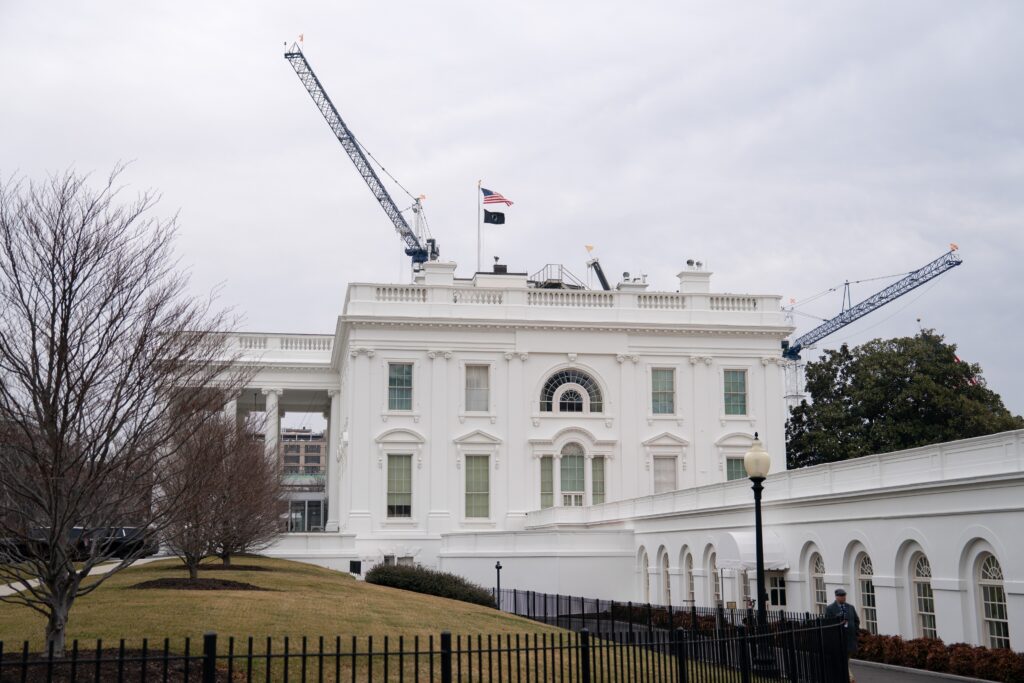
The contract was signed as work on the ballroom project was already underway. Crews had begun clearing trees and foliage from the White House grounds in September. Twelve days after it was signed, demolition crews started tearing down the East Wing. The existence of the contract was not disclosed at the time. Trump, who says the ballroom is needed to host VIPs at larger functions, is pushing to finish it before the end of his second term in 2029.
Congressional Democrats have pressed the Trust for months to share more information about the project. Sen. Elizabeth Warren (D-Massachusetts) and colleagues sent a letter in January demanding to know how much money had been raised, whether donors had been promised special access or other perks, and whether the organization had internal controls to prevent preferential treatment. The Trust declined to disclose the amount raised but said it was adhering to all National Park Service guidelines.
Sen. Richard Blumenthal (D-Connecticut), the top Democrat on the Senate Homeland Security and Governmental Affairs Permanent Subcommittee on Investigations, demanded answers from dozens of ballroom donors and contractors about their involvement and questioned the “rapidly changing and secretive terms” of Trump’s planned ballroom. He also sent letters to several people who attended a White House dinner in October, which Trump held to honor ballroom donors. Blumenthal asked whether they had contributed and under what terms, noting that the administration had acknowledged it had not publicly identified all donors.
“At every turn, President Trump has sought to conceal the facts about his monstrous multimillion-dollar ballroom,” Blumenthal said in an statement to The Post. “His Administration has kept the contract under wraps, the identities of big dollar donors secret, and the American people in the dark about what big corporations have to gain by funding this boondoggle.”
Blumenthal, Warren and other Democrats have introduced legislation to ban anonymous donations for the ballroom and other projects on the White House grounds.
“There’s only one good explanation for why Trump’s ultra-wealthy ballroom donors want to stay anonymous: They have something to hide,” Warren told The Post.
A federal judge last month also criticized the Trump administration’s approach to soliciting private donors through its contract with the National Park Service, calling it a “Rube Goldberg contraption” that allowed the president to avoid congressional oversight while building the ballroom. U.S. District Judge Richard Leon, an appointee of President George W. Bush, ruled last month that construction must be halted on the ballroom until Congress authorizes the project. The Trump administration has appealed that ruling, and a three-judge panel at the U.S. Court of Appeals for the D.C. Circuit has allowed construction to continue while the case proceeds.
The White House has repeatedly declined to release the government’s contracts with the private companies designing, engineering and building the ballroom.
The post Trump fought to keep the ballroom fundraising contract secret. Here’s what’s in it. appeared first on Washington Post.