THE PALM HOUSE, by Gwendoline Riley
When a new editor is appointed to run an old magazine or newspaper, beware if the green boss’s opening statements to a seasoned staff include the formula: “It’s great to be here at X, and now that I am, we’re all going to do our best to make X more like Y.” Translation: “Surrender your standards and idiosyncrasies because it’s time to join the rest of the world (and I have no idea what I’m doing or what it is I’m wrecking).”
In the English writer Gwendoline Riley’s new novel, “The Palm House,” Edmund Putnam, a longtime editor at a London magazine called Sequence, resigns after the appointment of Simon Halfpenny, shifted over from a sports rag by the corporate board after the death of Putnam’s esteemed boss, George. Simon, who goes by Shove, is one of those career men or women placed in a position of authority where he has little expertise because the brass see it as a way to gain leadership experience on the way to the next rung on the corporate ladder.
It’s the aptly named Shove who tells the staff that he wants to make Sequence, a haven of critics and historians, into “a sort of London version of The New Yorker.” Putnam and his colleagues ask what this will entail. Listings? Restaurant reviews? More newsy items and lifestyle coverage? “As long as it’s not boring,” says Shove. “That’s our motto now.”
It’s not exactly what the former New Yorker editor Tina Brown called “buzz.” The staff wonders if Shove considered Sequence boring when he took the job. He starts opening his editor’s notes with lines like “What is it about dogs?” and “April is the cruellest month, as the poet T.S. Eliot famously wrote.” His other colorful habits include chattering about Twitter and celebrities and wheeling about the office on his chair. One senses that Sequence comes from a time before chairs had wheels and that its editors would have preferred to stay there.
“The Palm House” is narrated by Laura, a friend of Putnam’s (that’s what she calls him; Shove is the only one who calls him Ed). She’s a contributor to Sequence and an occasional attendee at the weekly staff drinks at a pub called the Crown. There we meet a couple of editors who will stick out the new regime: the apathetic Vik (“I just tune it out”) and the charmingly insouciant Katherine, who says Shove is “not nixing other people’s work. It’s just his own bright ideas stinking the place up.”
At the pub, shortly before his resignation, Putnam calls the scenario a case of “black serendipity”: “George dying when he did. The rest of the world exists for people like Shove. God knows. It really does. Thick-skinned philistine like him; he could thrive anywhere. Yet we’re being asked to accommodate him. Sequence, of all places.”
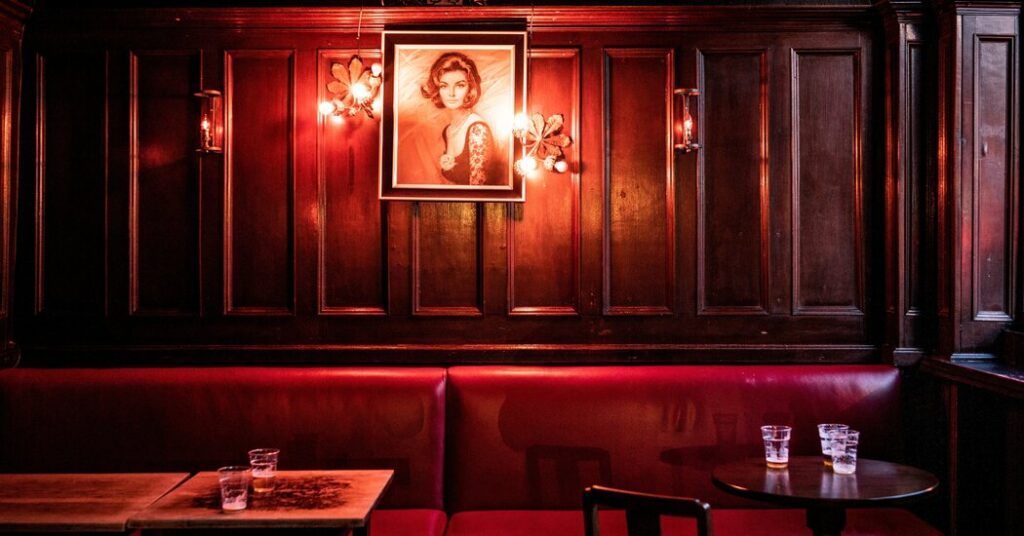
The conversation turns quickly to the next round of drinks, as it often does in “The Palm House,” a novel largely composed of set pieces that take place in unrenovated pubs with old rugs and wobbly stools. It is Riley’s eighth book of fiction but only her third novel to be published in the United States, after “First Love” (2017) and “My Phantoms” (2021).
She is a writer as thoroughly unsentimental as J.M. Coetzee or Michel Houellebecq. Unlike the latter she doesn’t embed her human dramas in superstructures of melodramatic social upheaval, and unlike the former she doesn’t make efforts to sound the overtones of history. But like both of them she eschews euphemism and writes in a stark, exacting prose that achieves a clarity of vision when it comes to human behavior. Among American writers, Riley resembles Lydia Davis for the fine calibration and fragility of her sentences.
There is a lot of wreckage in “The Palm House” (the title refers to a glass hothouse in London’s Kew Gardens that goes unmentioned in the novel), not only at Sequence, which survives the tenure of Shove — who naturally turns to podcasting — but also in London itself.
The city has started to conceal the damaged traces of its old self. Putnam is given to reveries of his youth in the 1980s, when structures bombed during the war were still unbulldozed in spaces not yet converted to chain coffee shops or dormitories. His father dies during the course of the narrative, as does Laura’s. “The seesaw of life just tips, doesn’t it?” he says of his father’s later years. “And then it’s downhill all the way.”
We glimpse other men in Laura’s life. There is Chris Patrick, a popular and unscrupulous touring comedian with whom she had an unsavory encounter as a teenager in his untidy flat; Lawrence Wells, a hard-drinking stage actor who lives in “a palazzo about to go under,” with a bathroom that has “a Miss Havisham aspect”; and Mitch Seiler, who invites Laura to stay for a few months in his house, where one evening she finds him standing alone in the dark. Nothing too creepy happens and Riley doesn’t push the scene further than ominous awkwardness.
Laura soon moves out and into a flat she’s bought with her inheritance from her father. The chapter ends outside Mitch’s house: “I stood on the curb with my impedimenta, stepping from foot to foot and grinning.”
It’s an ambiguous image typical of Riley’s powers of lyrical understatement. Relative to her previous two novels, there is something clipped and minimalist about “The Palm House,” but satisfyingly so, narrative threads trimmed just as they threaten to take over the book. With the beginning of each short section, I found myself wondering whether it might end with an evocative treading of boots on the Waterloo concourse or some deadpan remark of Putnam’s.
His friendship with Laura is the novel’s core. You sense that they keep the rest of the world at bay for each other, not that everything is perfect between them. Putnam disapproves when Laura takes a part-time job editing a magazine that traffics in historical nostalgia. She doesn’t disagree exactly, but her line about the gig — “There wasn’t much I didn’t like about it” — says a lot about Riley’s refusal to countenance either hyperbolic doom or phony happiness. Leave those to the rest of the world.
THE PALM HOUSE | By Gwendoline Riley | New York Review Books | 211 pp. | Paperback, $16.95
The post Surrender Your Standards. It’s Time to Join the Rest of the World. appeared first on New York Times.