Of course his songs are great. Of course his dancing is sublime. You might be lulled into thinking that’s the point of “Michael”: to spend a couple hours basking in a string of showstoppers, reveling in the transcendent talents of the King of Pop, from his days fronting the Jackson 5 to — well, to performing “Bad” at Wembley Stadium in London, anyhow.
But that was never the point of this movie, and that’s as plain as day.
Near the start of Antoine Fuqua’s “Michael,” 10-year-old Jackson (Juliano Valdi), on his way to stardom, is advised by the Motown founder Berry Gordy (Larenz Tate) to say he’s 8 years old. “In this business you can make up just about anything,” Gordy says. Maybe that line introduced a theme in some earlier draft of John Logan’s screenplay; the initial version of the film, for which Jackson’s executors serve as producers, used as its framing device the 1993 allegations of child sexual abuse against the singer, aiming to exonerate him of those charges. Implicitly, that would suggest those charges — and by extension, subsequent allegations — were made up, too.
In fact, they shot that version of that film. Then, the estate’s lawyers realized the terms of the settlement with the accuser prohibited them from releasing it. So this version of “Michael” is a rewritten, reshot version, with a new third act and a new gist. It’s now an uplifting tale about Jackson’s triumph over his father, Joe Jackson (a gruff Colman Domingo). You can feel that late-breaking scramble in the film, especially in a clunky few final scenes. It’s now a case study about a young person differentiating himself from his family of origin, wrapped up in fairy-tale trappings, complete with a happily-ever-after ending.
And it’s a standard-issue musician biopic, so familiar you can plot it in your sleep. Begin with the opening shot of the star — from behind, of course — walking down a corridor toward some stage, from which we can hear a screaming audience. Pause for a moment as the lights get brighter. Then flash back to his childhood, in Gary, Ind., where he lives in a tiny home with his overbearing father, his mother, Katherine (Nia Long), his brothers Jermaine (Jayden Harville), Marlon (Jaylen Lyndon Hunter), Tito (Judah Edwards) and Jackie (Nathaniel Logan McIntyre), and his sister LaToya (Amaya Mendoza). (Jackson’s brother Randy and sisters Rebbie and Janet — the three Jackson siblings who are not executive producers on the film — are, curiously, not characters in it either.)
Watch as Joe drives his sons relentlessly to perform, whipping Michael with his belt when he isn’t perfect. Watch them become stars. Watch them grow up, but stay in Joe Jackson’s now-palatial home. (Jamal Henderson, Tre’ Horton, Rhyan Hill and Joseph David-Jones play the brothers as adults, while Jessica Sula plays the older LaToya. )
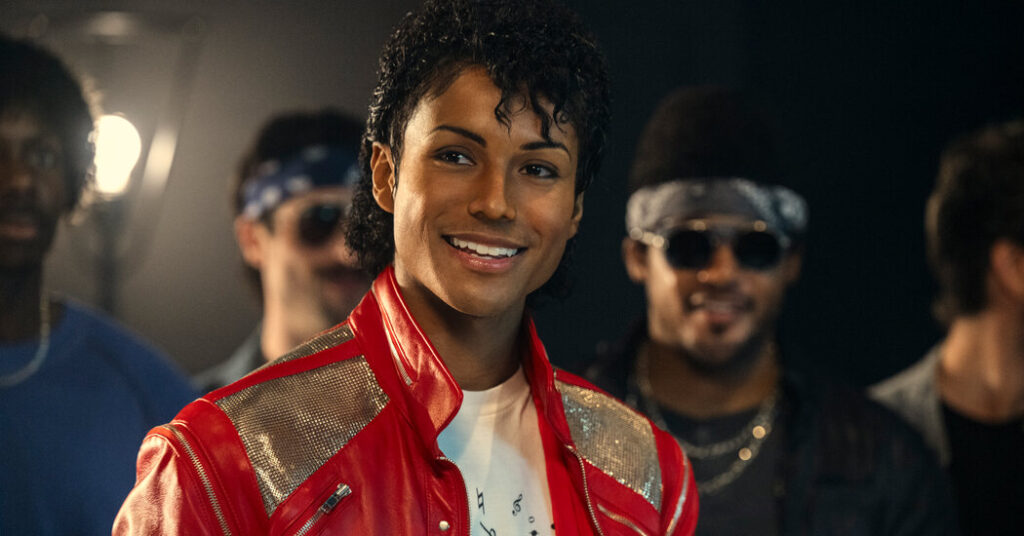
Watch Michael (now played by Jaafar Jackson, the son of Jermaine Jackson), struggle to find his place in the world. Saddled with immense talent but certain he is not like other people, he has only his mother, his bodyguard Bill (KeiLyn Durrel Jones) and eventually his lawyer John Branca (Miles Teller) for friends. (Branca is also one of the film’s producers.)
Now the movie gets mushy, and weirdly vague. “Michael” has some of what makes this kind of movie appealing — spectacular songs, recreations of legendary performances — but it lacks certain crucial elements, like the moment when the struggling artist finally gets the song to come together. This Michael arrives almost fully-formed, and his songs pop out apparently without a problem. The hardest thing he has to do, outside of his family unit, is figure out which track makes the best title, or get MTV to play “Billie Jean,” which only really takes one phone call.
“Michael” portrays its subject as a kind of otherworldly angel who, when he acts oddly, has been goaded into it by his father. He gets a chimp, Bubbles, to be his friend, but maybe also to protect Michael from Joe’s temper. When he gets plastic surgery on his nose, it’s either because Joe made him believe he has to be perfect, or because his nose looks too much like Joe’s. He wants to be the biggest star in the world, but seems entirely free of ego: It’s just that stardom is his way out from under Joe’s thumb.
And of course, Michael never got to be a kid, really, because Joe took that away from him. So as an adult, he is always seeking out children. But the movie knows what you’ll think, instantly, about that. So there are many scenes — many scenes — in which he visits children in hospitals to distribute toys and comfort, and is observed from a doorway by someone else, who gently smiles.
This Michael is flat, barely human. Hagiography is the standard mode in which all estate-involved biographical movies work, documentary and fiction alike, the implication being that audiences can’t handle any hint that a figure might not be a saint, or at least a saintly victim. The notion that a human — someone who gets angry or bitter or has a bit of an ego on them — is inherently easier to relate to, far more believable and ultimately more lovable, seems lost on most filmmakers.
Here, what we are left with is a string of musical set pieces, like a greatest hits album, performed ably by the stars — in his debut role, Jaafar Jackson dances like he is possessed by his uncle’s talent — but strung together in repetitive false-note ways that are insulting both to audience and subject.
Because of course, any life sounds like a triumph if you end the story right before things get tough. The movie omits the really hard stuff that plagued Jackson; his scalp surgery after experiencing third-degree burns in 1984 now becomes mostly a driver of his success and determination to “shine my light, to spread love and joy, to heal,” but we never witness the painkiller addiction that grew from it. If you didn’t know better, you’d think Jackson, who died in 2009, played Wembley in 1988 and never had another problem in his life.
The movie itself becomes a tale of triumph and glory for someone everyone admired, rather than an estate’s attempt to scrub clean the life story of a star who has been multiply accused, in harrowing terms, of child sexual abuse. That same estate is the reason that an HBO documentary that gives space for two men who have accused Jackson to tell their story has been deleted from its streaming platform; you can’t watch it, because it might as well not exist.
The three-ring media circus that surrounds every celebrity gives us versions of them we can choose to believe in. “Michael” aims to deliver a version of Michael Jackson that, strangely enough, conforms to what the movie’s version of Joe Jackson wanted all along: a perfect child, a top-notch performer and certainly nothing more than that. In this business, you can make up just about anything.
Michael Rated PG-13 for scenes of beating a child with a belt, a perilous stage fire and some bad language, mostly from a record executive. Running time: 2 hours 7 minutes. In theaters.
Alissa Wilkinson is a Times movie critic. She’s been writing about movies since 2005.
The post ‘Michael’ Review: A Jackson Biopic Leaves Too Much Unsaid appeared first on New York Times.