Composers have long used musical emblems that both guide and confuse listeners. For Dmitri Shostakovich, it was a phrase that played on the letters of his name with irony, pain and distance. For Hector Berlioz, a theme could be at once a cryptogram, a narrative device and a representation of artistic passion and madness. And for the English lutenist and composer John Dowland, who died 400 years ago, it was the “tear” motif: a melancholic signifier wrapped in layers of mystery.
Dowland had created a pavane, a type of stately dance from Elizabethan times, titled “Lachrimae Pavan.” It began as a wordless lute song. In his “Second Booke of Songs and Ayres,” from 1600, the tune gained lyrics, and “Flow, my tears” eventually became the most famous song of his era.
The song begins with Dowland’s musical emblem. Beginning with a drooping downward scale in a minor mode, the line briefly jumps back up, where it’s suspended for a moment. Then the harmonic underlay shifts, creating a yearning suspension, and the melody sighs downward again.
Peter Holman, a conductor and musicologist, wrote in a book on Dowland’s 1604 collection, also titled “Lachrimae,” that these pavanes are “perhaps the greatest but most enigmatic publication of instrumental music from before the 18th century.”
They’re enigmatic for many reasons, not least because of the contradiction between the musical expression and Dowland’s personal circumstances. Dowland was well regarded; the poet Richard Barnfield wrote that his “heavenly touch upon the lute doth ravish human sense.” Dowland was also well-connected, cosmopolitan and at times unusually well remunerated for his work. Yet his musical expression was dominated by melancholy.
With that imbalance comes the sense that Dowland had an acute understanding of his place in the musical market of the time. K. Dawn Grapes, the author of a recent biography of Dowland, said in an interview that “Lachrimae” seems to have been “the greatest hit of the late 16th century.” She added, “He was savvy enough to understand that, if ‘Lachrimae’ was the piece of music that was being embraced, that maybe he was going to embrace that personality himself.”
The collection’s seven pavanes are all called “Lachrimae” (Latin for “tears”) and all begin with the same “tear” motif. Like a canny filmmaker spinning out sequels today, he wrote pieces including “Old Tears,” “Sad Tears,” “A Lover’s Tears” and, finally, “True Tears.” You get the feeling that he knew exactly what he was doing in committing so thoroughly to one mood.
In the same “Lachrimae” collection, along with music dedicated to patrons and important contacts he included a pavane titled “Semper Dowland, semper Dolens,” or “Always Dowland, always doleful.” (In 2009 Harrison Birtwistle, famously gruff yet humorous and ironic, composed an explosion of Dowland tunes also called “Semper Dowland, Semper Dolens.”)
There is an element of modern performativity in Dowland’s artistry, but more direct routes to performing his music are valid, too. The soprano Ruby Hughes, a regular interpreter of his works, said, “There’s a sort of melancholic domain that Dowland inhabits, which I find authentic and deeply felt, in the same way I feel with Schubert and Schumann.” On her recent album “Amidst the Shades,” the words “fear,” “grief” and “pain” in “Flow, my tears” have as much individual coloring as any section from “Winterreise” or “Dichterliebe.”
By taking Dowland’s melancholia at face value, artists can also treat it as a path to deeper emotions. The countertenor Iestyn Davies said that he sees this emotional atmosphere as something closer to Sigmund Freud’s understanding of the phenomenon, related to unconscious mourning. When faced with grief you can’t express, “you use poetry or music to get through your melancholy,” Davies said. His 2014 album of Dowland songs is narratively structured, positioning melancholy like a stage of grief to pass through.
For Davies, a highlight of Dowland’s work is the song “In Darkness Let Me Dwell” — an example, he said, of “how music can transcend the time it’s in.” It’s oddly structured, but deliberately so. The lute accompaniment ends a few measures before the singer, who is left vulnerably exposed for the line “O let me living, living die, till death do come.”
“It sets the text so well, meaning it doesn’t really matter when it’s from,” Davies said. “It is one of the greatest songs in the English language.”
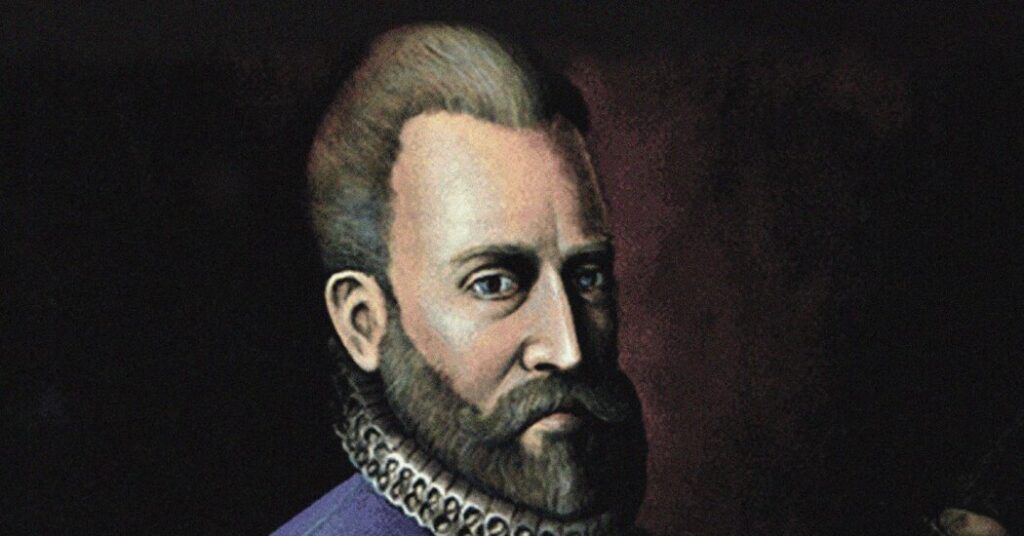
NOTHING IS KNOWN about Dowland’s early life. “There are no extant records — at least, none that anybody has found yet — that tells where he was born, who his parents were, or how he got his training,” Grapes said. Scholars agree that he was born around 1563, probably in Westminster, England. But it’s a mystery how he got his start in musical life, or how he looked.
Dowland’s relationships with institutions, however, show an ambitious man keen to improve his standing in life. He received a bachelor of music degree from the University of Oxford in 1588, in the same year as the madrigal king Thomas Morley. At a time when social class was extremely stratified, Dowland proudly repeated his learned title across his published works as a sign of status.
He secured numerous important jobs in royal courts and became an unusually well-traveled musician for his time. In the 1590s alone, he moved to France, toured the courts of present-day Italy, was employed by the landgrave of Hesse in Germany, and then by Christian IV of Denmark. He was among the most highly paid court musicians of his day.
What made Dowland’s cosmopolitanism more remarkable, Grapes said, “was that Dowland always had to ask permission to seek other employment.” He “must have been a great observer,” she added, “and had some canny insight into the workings of the political situation of the day.”
The most important document in understanding Dowland’s life is a letter written to Queen Elizabeth I’s privy counselor Sir Robert Cecil in 1595. Alongside its description of Dowland’s life, it also shows him at his most anxious. He believed that he had missed out on the vacant, coveted lutenist position in the queen’s Protestant court because she thought him “an obstinate papist.” His fears were exaggerated — Elizabeth engaged Catholic musicians, such as William Byrd — but his dream position eluded him.
Despite that setback, Dowland became one of the most widely published musicians of his era. His first of three songbooks was reprinted four times, making it the most popular English songbook at the time. In 1612, a few years after returning to England from Denmark, he finally gained a position in the English court, which coincided with the last of his published musical volumes, “A Pilgrimes Solace.” Its final number is titled “A Galliard to Lachrimae.”
TODAY, DOWLAND IS an important figure in Britain’s national musical story. But he has gone through many transformations since his death.
For a short time at the end of the 19th century, Dowland was taken up by Britain’s choral societies, his delicate four-part textures awkwardly arranged for massive civic choirs. But it was during the 20th century that his revival truly began.
Elizabethan revivalism took hold of British society after World War I. The first wave was with the Bloomsbury Group, exemplified by texts like Virginia Woolf’s “Orlando,” and it took on a different character through the late 1930s and ’40s. “The Lion Has Wings,” a wartime propaganda film that drew on the Elizabethan historical drama “Fire Over England” (starring Laurence Olivier and Vivien Leigh), drew parallels between England’s victory over the Spanish Armada and the war against Nazi Germany.
Imani Mosley, a musicologist at the University of Florida, said that Dowland in this period “became a very easy shortcut for directors like Alexander Korda and others to signify not only that we are in the Elizabethan period, but that England is great.” Dowland, she said, “became a signifier of England’s might.”
For the next generation, living through the reign of Elizabeth II, Dowland was an important touchstone. Performers like Anthony Rooley, Emma Kirkby, Alfred Deller and Julian Bream committed to creating complete recordings of his work, spurred by the budding historically informed performance movement.
Though perhaps more associated with Henry Purcell, Benjamin Britten also projected his strong connection to Dowland. “I feel as close to Dowland,” Benjamin Britten told Donald Mitchell in 1968, “as I do my youngest contemporary.” He foregrounded that relationship in “Lachrymae” (1950), “Nocturnal after Dowland” (1963) and his 1953 opera “Gloriana,” a continuation of the Elizabethan revivalism that featured two Dowland-esque lute songs sung by the Earl of Essex.
“Britten saw in both Purcell and Dowland a kind of modernity for their time that resonates with him,” Mosley said. “And so he wanted to amplify their compositional modernity with the way he saw himself.”
A long line of British composers have since responded to Dowland, including Peter Maxwell Davies, Sally Beamish, and Thomas Adès. But Dowland’s music also has had impact outside classical music. The music producer Danny L Harle, who has worked on recent albums by Dua Lipa and Caroline Polachek, also feels a connection to Dowland.
“I’m not entirely sure what drew me to Elizabethan music,” Harle said in an email. (Previously, he trained in composition and played cello. Recently, he took up the viol.) “But I feel like it’s strangely connected to my love of European dance-pop — something to do with hitting the perfect turn of melancholic phrase with the perfect arpeggio.”
Dowland is at his best, Harle said, in pieces like “Go Crystal Tears,” where there’s “a voice sitting in the abyss accompanied by a lute playing one note at a time.”
Dowland’s commitment to a melancholy aesthetic may have also helped him achieve a special level of musical focus.
“As much as it was an understood practice for composers to repeat and repurpose the same melodies, Dowland’s way of doing it has such an aura,” Harle said. “Like, he was orbiting this vivid musical goal that was gradually being realized over his compositional career.”
The post How John Dowland Built a Music Career on Tearful Melancholy appeared first on New York Times.