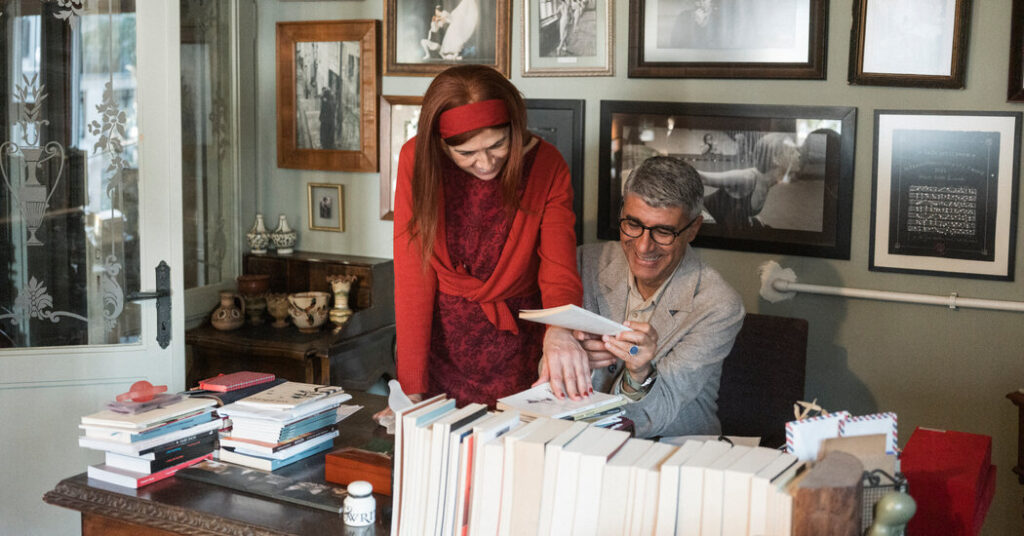
When the Kurdish poet first declared his love, the woman who was the focus of his feelings didn’t take him seriously. “How could I?” asked his beloved, Ipek Ozel. “I was the only woman he had seen in decades.”
At the time he conveyed his affections, in 2019, the poet, Ilhan Sami Çomak, was serving a life sentence in a Turkish maximum security prison. Ms. Ozel was a volunteer, who, amid a life of glamour and parties, visited inmates to offer assistance and fellowship.
Their love story, which has surprised even their closest friends, is also a tale of a bitter and brutal decades-long conflict.
Mr. Çomak was born in 1973 in a tiny village near Bingöl, in eastern Turkey, to humble farmers who practiced Alevism, a heterodox Muslim sect.
“Perfect,” he said of his rural childhood. “Adoring a tree or a flower or a river. That was god to me as an Alevi child.”
He didn’t realize his family’s beliefs or their Kurdish ethnicity made him a minority. He didn’t even realize he lived in a Turkish-speaking country until elementary school. “Turkish” — the language that would later give him solace in prison — “was drilled into me by schoolteachers,” he said.
His parents encouraged his studies, and in 1992, he moved to Istanbul for college. The mid-1990s was the height of an insurgency being waged by the separatist Kurdish Workers Party, or P.K.K., and Kurdish students were being arrested en masse.
The Istanbul police arrested Mr. Çomak in 1994, accusing him of starting forest fires and of belonging to the outlawed P.K.K, which is designated as a terrorist organization by Turkey, the United States and the European Union. He said he was tortured for 19 days, signed a forced confession and was sentenced to death.
Mr. Çomak, 53, denies all the charges. “Three fires in different far away locations in one day,” he said, “I must be Superman.”
He does look Clark Kentish. Tall, bespectacled and fit, he sits upright as he answers politely what he is asked and Ms. Ozel, 55, translates.
In prison, he had to figure out a way to pass the time, and he soon realized many of his fellow inmates did so by reading.
He picked up the habit, and he didn’t just read, he devoured, everything from Marx to Mayakovsky, Baudelaire to Borges.
“When it became clear that I would not be leaving prison anytime soon, I began to look for something that could make my life inside meaningful, and I turned to poetry,” he said.
But it wasn’t easy to find his voice. “A lot of poetry is based on memory,” he said, “and I had mostly childhood memories. I was too young. Not many experiences.”
His breakthrough came when he realized that, even within his constricted circumstances, he was still surrounded by boundless subjects. “Anything became a reason for a poem,” he said. “Music, a movie, a beautiful novel, a photograph of Catherine Deneuve.”
He could, he discovered, “invite life and my passions with my pen,” and it was like a faucet opening, with poems pouring out, mostly in Turkish.
When Turkey abolished capital punishment in 2004, Mr. Çomak’s sentence was commuted to life in prison. His lawyers took his case to the European Court of Human Rights, which declared in 2007 he had not been given a fair trial — and called for a new one.
Margaret Owen, a British human rights lawyer who has become a friend of the couple, remembers being struck by the subject matter and tone of the poems by a man with every reason to be resentful. “Not one poem is political or angry,” she marveled.
When Mr. Çomak published “Hymns Composed by Cats” in 2013, he sent Ms. Ozel a copy, even though they’d never met.
Ms. Ozel had just started visiting Izmir Prison, on the Aegean Coast, where Mr. Çomak was being held. Although she had no legal training, she would travel from Istanbul once a month to provide what help she could, offering practical casework assistance — a role known as a McKenzie friend — to three Kurdish students serving time with Mr. Çomak.
“They spoke about her with such good emotion,” Mr. Çomak said of the students.
After receiving her copy, Ms. Ozel, impressed by the tenderness of the poems, sent a thank-you note, jump-starting their correspondence.
“We wrote about everything,” she said. “He was more flirtatious than me.”
Some of his letters — 20- and 30-pages long — came with feathers that fell from the pet birds he kept in his cell. “He said that he would make me angel wings with them,” Ms. Ozel said.
While committed to her volunteer work with prisoners, Ms. Ozel also had an active professional and social life in Istanbul. The daughter of secular engineers, she attended college in London, worked in advertising, danced the tango and traveled the world.
The first time they met in person was in 2016 at an Istanbul courthouse, where a hearing about his retrial was taking place.
As he was escorted into court by guards, Mr. Çomak blew a kiss into the air.
In her next letter, she wrote, “I didn’t know if it was intended for me, but I took it.”
“I’m glad it didn’t get lost,” he wrote back.
The court decided his trial had been fair, and he was later transferred to Silivri Prison, another maximum-security facility, outside Istanbul.
He asked Ms. Ozel if she’d act as his McKenzie friend, and she said yes. They could now talk through dirty glass for 45 minutes each week. “I woke up at 5 to make sure I was there by 9:30,” Ms. Ozel said.
She also had a mission: “I told him I didn’t want him to be another imprisoned Kurdish poet. I wanted him to be a recognized poet. His poems are so beautiful, so innocent. They are not the poems of a terrorist.”
Ms. Ozel knew that goal would be tough, but she was up for it. “Give me a challenge and watch me,” she said.
She persuaded PEN Norway to launch a campaign calling for Mr. Çomak’s release. Eighty-eight poets from around the world each sent him a poem. Mr. Çomak replied to each with a poem of his own.
But the campaign failed to free him; instead, Mr. Çomak would have to wait until he was eligible for parole after serving 30 years of his life sentence.
He was finally released in November 2024, after publishing 11 volumes of poetry, a play and an autobiography from his cell.
One of the first lessons Mr. Çomak learned in prison was never to expect anything. “That way there is no disappointment,” he said. But that doesn’t mean he didn’t dream, in his poetry, of the freedom he finally found, as this excerpt from “Things That Are Not Here” shows:
Life, separated from the sun.
There’s no direction here.
But there is a way out.
Always, a way out.
Ms. Ozel was waiting outside the prison gates. They hugged — “as friends,” she said — and he went to be with his family.
But he never doubted he had fallen in love with Ms. Ozel — and anyone who read the poem he wrote for her, “I Came to You, Life,” probably knew, too.
He didn’t want to hurt his parents, however, who expected he would stay near them and give them grandchildren.
For Ms. Ozel, the prospect of losing Mr. Çomak saddened her, but she had her own needs and expectations. “It’s one thing to be a McKenzie friend, another to be his girlfriend,” she said. “Kurdish families are very tight and traditional, and I am not.”
It would take them a month and many daily phone calls after their prison-gate hug before seeing each other again. When Mr. Çomak learned she would be flying to a wedding in Adana, Turkey, he enlisted his cousin to buy him a ticket — he didn’t know how — on the same flight.
“I had decided I wanted to live my own life, and that meant with her,” he said.
After his romantic surprise on that flight, they became a couple and now live in an Istanbul apartment.
Freedom has kept them busy traveling around Europe, with Ms. Ozel arranging packed poetry readings.
“Ilhan is the best poet of our generation,” said Burhan Sönmez, the president of PEN International and a Kurdish novelist. This renown is largely thanks to Ms. Ozel’s efforts. “If it weren’t for Ipek, no one would have heard of him,” Mr. Sönmez added.
With such different backgrounds, their partnership has been a mutual learning curve.
“My great bohemian life ended when I met the imprisoned students and through them Ilhan,” said Ms. Ozel, whose recent cancer diagnosis has posed another test for the couple.
Still, the new life has been rich in its rewards.
On New Year’s Eve, Ms. Ozel posted a picture of the couple in Berlin. “I spent perhaps one of the happiest years of my life,” she wrote.
Mr. Çomak expressed his feelings about his freedom in a recent poem, “What Would I Resemble?”:
I found it at last, the ladder rising to freedom and the sky
In the moonlight, life grew more beautiful
The post A Turkish Love Story, With Prison, Poetry and an Airplane Exploit appeared first on New York Times.