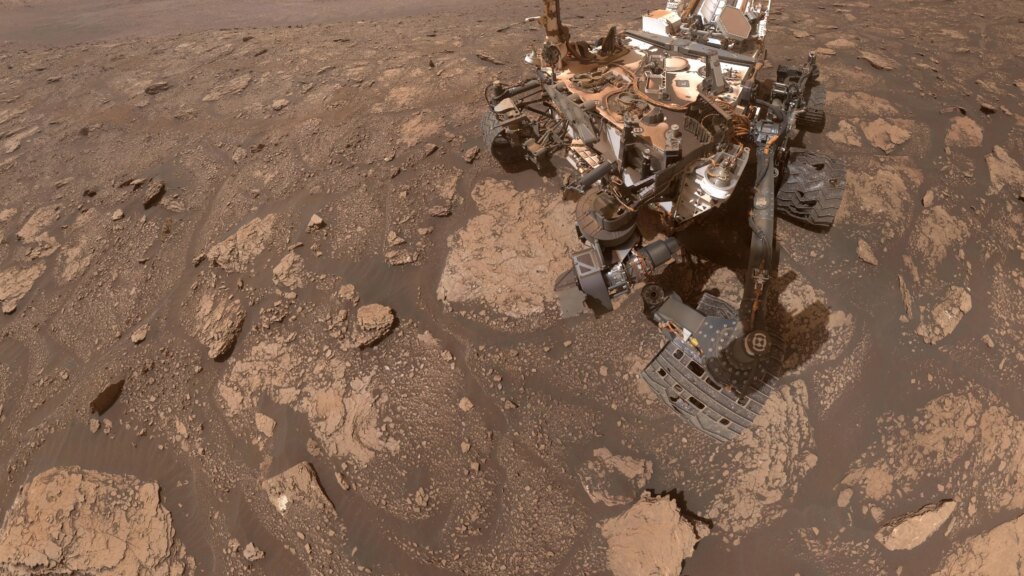
The Curiosity rover landed on Mars way too late to observe barren Gale Crater when it was potentially lush Gale Lake. Three and half billion years ago, the 95-mile-wide basin sloshed with water, as did much of the rest of the planet, until Mars lost its magnetic field, the solar wind stripped away its atmosphere, and most of its water sputtered away into space. In 2012, NASA’s Curiosity rover landed in Gale Crater, looking for clues that the planet’s ancient, wet environment could have supported life. Now, as a study in Nature Communications reports, Curiosity may not have only found conditions that could have hosted life, but chemicals that, on Earth at least, are building blocks of biology.
The new research was led by Amy Williams, professor of geological sciences at the University of Florida, and a mission scientist for both Curiosity and the later Perseverance rover. Their work involved experiments begun in 2020 on an especially clay-rich region of the crater; on Earth clays are known to preserve organic compounds and minerals. The work relied on a highly toxic, highly corrosive chemical known as TMAH. On Earth, TMAH is used in semiconductor manufacturing, etching away unwanted material on the surface of a microchip. About 500 microliters—or millionths of a liter—were carried aboard Curiosity. On Mars, the chemical can be used to dissolve chemicals in rocks and clay, releasing them as gasses, and allowing them to be analyzed by an onboard instrument known as Sample Analysis at Mars, or SAM.
“TMAH is very, very alkaline, and it’s able to break apart what we call macro molecular carbon, really large, complex aromatic materials,” says Williams. “It makes those smaller components [that result] detectable to the SAM instrument.”
In the course of its analysis, SAM found 20 telltale molecules, none of which were proof of extant or even past biology, but many of which could be related. “We can’t really tell if any of them were formed by biology,” Williams says. ”But what we can say is that there’s a diversity of organic materials, that they came from something larger, more complex, and some of them we know are related to precursors for the building blocks for life as we know it.”
One of the more tantalizing of the chemicals the study uncovered is benzothiophene, a two-ringed molecule containing carbon and nitrogen. It’s actually no surprise that SAM sniffed out the chemical on Mars, since it’s in a whole lot of other places as well. “Benzothiophene is one of the ones that we’re excited about, because it actually forms in the interstellar medium, on meteorites,” says Williams. “If this did rain down from meteorites, you might be seeing some of the oldest organic molecules formed in the Solar System preserved in these rocks.”
Benzothiophene is not the only one of the chemicals that could have been carried to Mars aboard meteors; so could most of the other ones the SAM instrument detected. That, actually, is not a surprise, as a growing body of evidence has shown that space rubble teems with organic material. A 2025 paper in Nature Astronomy reported the discovery of 14 amino acids that could be used to make proteins in samples from the asteroid Bennu. The Murchison meteorite, which fell in Australia in 1969, was later found to contain a prebiotic organic molecule called hexamethylenetetramine.
If organic building blocks did hitch a rise to Mars on meteorites, their presence today might not necessarily indicate that anything living arose from them. The ingredients for life may have simply landed on the planet without ever having been baked into biology. In the alternative, native chemistry on the planet may have combined with immigrant chemistry on the space rocks to produce something living. That, at least, is what many scientists believe happened on Earth.
“The consensus is building that for the origin of life on Earth, there’s probably stuff made geologically in situ, and stuff delivered exogenously from meteorites,” says Williams. “And it’s probably that combination that led to the origin of life.”
More research is to come. Williams and her colleagues have performed similar experiments at another site in Gale Crater and are now processing the results. Meantime, SAM systems are set to fly on the European Space Agency’s Rosalind Franklin Mars rover, scheduled for liftoff in 2028, as well as on NASA’s Dragonfly roto-copter probe that will be launched to Saturn’s moon Titan in 2027. Whether any of these studies will discover proof of biology is impossible to know, but there is some cause for optimism
“We do see building blocks on meteorites,” says Williams. “If those same kinds of seed stocks were raining down on Mars at a time when Mars had water and was more habitable, is it possible that that contributed to an origin of life? We don’t know, but [if] that’s what happened on Earth, you can remain hopeful.”
The post A New Discovery Brings Fresh Clues to the Search for Life on Mars appeared first on TIME.