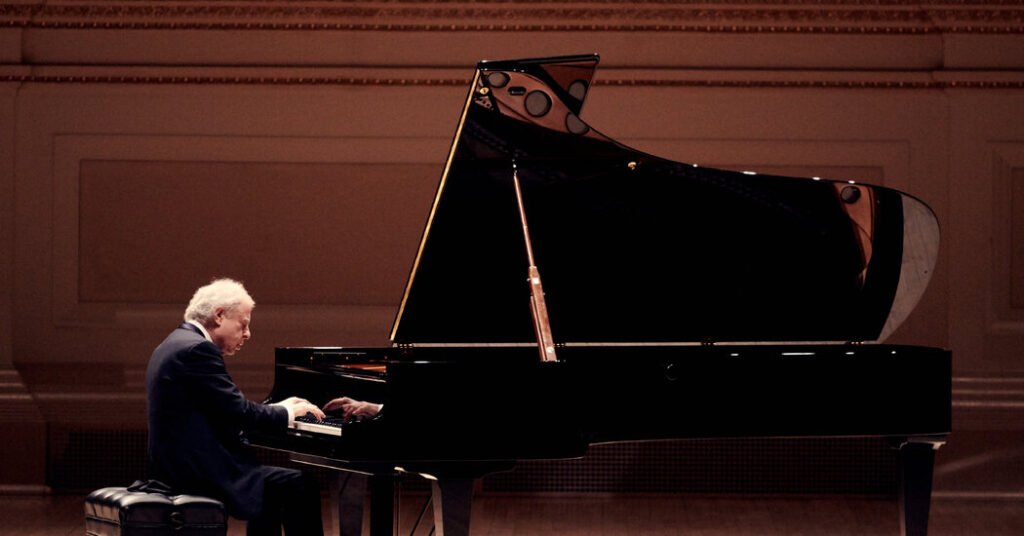
András Schiff was born in Hungary, but he has not been there since his mother’s funeral in 2010. Schiff, one of the world’s most esteemed pianists, has not performed in the country since Viktor Orban was elected prime minister that same year. Hungary is on a list of countries — including Russia and the United States — Schiff refuses to set foot in, a high-profile protest of what he describes as strongmen leaders.
But after the overwhelming defeat of Orban in Hungarian elections last week, by an opposition movement led by Peter Magyar, Schiff said he intended to return to Hungary by the end of the year. In a phone interview from Italy, Schiff said that he was stunned and gratified by the election results — and that he would keep his word about performing there again once Orban steps off the public stage.
Schiff, 72, a Grammy Award winner, is known as a distinguished interpreter of Mozart and Bach and has long been a popular performer in the United States. But in recent years, he has also become known as one of the most outspoken artists in classical music. He denounced Orban as a threat to democracy when he decided in 2010 not to play in his home country. And he joined artists who boycotted Russia after it invaded Ukraine in 2022.
Last year, Schiff announced he would no longer perform in the United States, protesting President Trump’s “unbelievable bullying” of other nations. That meant canceling appearances with the New York Philharmonic, the Philadelphia Orchestra and a performance at Carnegie Hall.
Schiff discussed his feelings about the outcome of the Hungarian election, as well as his plans to return to his home country as well as his decision to speak out. (He has no plans to return to the United States.) Here are edited excerpts from the conversation.
Tell me about your decision to return to Hungary.
I said if he’s no longer in power then I will come back. And this is what’s happening now.
Did you expect him to lose?
I didn’t expect it, and not with such a landslide majority. And maybe it sends a very strong signal to America and to the free world in general, as there has been a very strong tendency for people to look at Orban and others as a role model. So maybe it’s the beginning of a new era.
Do you have a return concert scheduled?
Nothing definite yet. We are trying now to find out the right date and the right venues and to try to coordinate that. So it’s going to happen certainly in this calendar year.
Are you optimistic about what is going to happen in Hungary?
Peter Magyar is like a dark horse. The only thing we know is that he used to belong to Orban’s circle, and something went very sour and he turned against them. I have a quite a bit of suspicion; I don’t quite know who we are dealing with.
But, yes, I’m hopeful. And at least I have to say let’s give him a chance. Because there are all those skeptics who say, “Oh, this is just a charade and he’s just from that circle and it’s going to be just the same or even worse.” I don’t think it can be the same and it cannot be. It can only be better. Because he’s much younger, he’s very intelligent.
I assume you are not going to perform in the United States anytime soon?
Yes, it is a difficult situation for me. I’m going to wait for a change.
In other words, when President Trump is out?
Correct. It was Trump himself who made Orban a role model. Somebody to admire and follow. And yes, this was quite extraordinary and very upsetting.
What concerns you about President Trump?
You knew very well what you were getting. I just cannot comprehend how people can vote for a monster like this, excuse my words.
He is really just unacceptable. Not just what he does or what he stands for, but the rhetoric, the language. I just cannot accept that the president of the United States uses language like that. And words do matter. And also to be a compulsive liar and an egocentric narcissist. (The White House did not immediately respond to a request for comment.)
Do you think that artists have a responsibility to speak out about situations like this, to take a role in politics?
To me, it’s an obligation for my own conscience. But I cannot dictate this to others. Each person has to decide for himself or herself. Most artists and even a lot of people say: “Oh, just shut up and play. You don’t know about politics.” It may be true, you don’t know about politics, but to me, I can name some very important examples of artists who have spoken out in politics and it did make a difference.
So my examples are Beethoven, who crossed out the dedication of the Third Symphony to Napoleon. And my great countryman Béla Bartók, who left fascist Hungary in 1940 because he said he couldn’t live and work under such an atmosphere. Or Toscanini, similar reasons, having left Fascist Italy.
And on the other side, there are all those opportunists who just keep quiet or look the other way. And to me, it’s no question which approach is right and which one is wrong. History gives the answer.
You consider some of your fellow artists who are standing by the sidelines opportunists?
Yes. As I said, I cannot dictate to others what to do. But look at the case of the Kennedy Center. How can somebody now go to the Kennedy Center and perform there? I think what happened is so outrageous, so at least one should not play there.
You saw the Washington National Opera left the Kennedy Center, but the National Symphony Orchestra under Gianandrea Noseda decided it would be more effective to stay there and keep performing.
We are friends actually, yes. I’m amazed that he’s doing this. He must have his reasons, like “Oh, yes, I have to support my orchestra and all that.” It’s his decision. But I couldn’t do what he’s doing.
Adam Nagourney is the classical music and dance reporter for The Times.
The post With Orban Out, the Pianist András Schiff Plans a Return to Hungary appeared first on New York Times.