Oil prices have fallen from their peak after weeks of war have choked off the Persian Gulf, but gasoline prices are likely to descend more slowly. One of the reasons is Alex Weatherall.
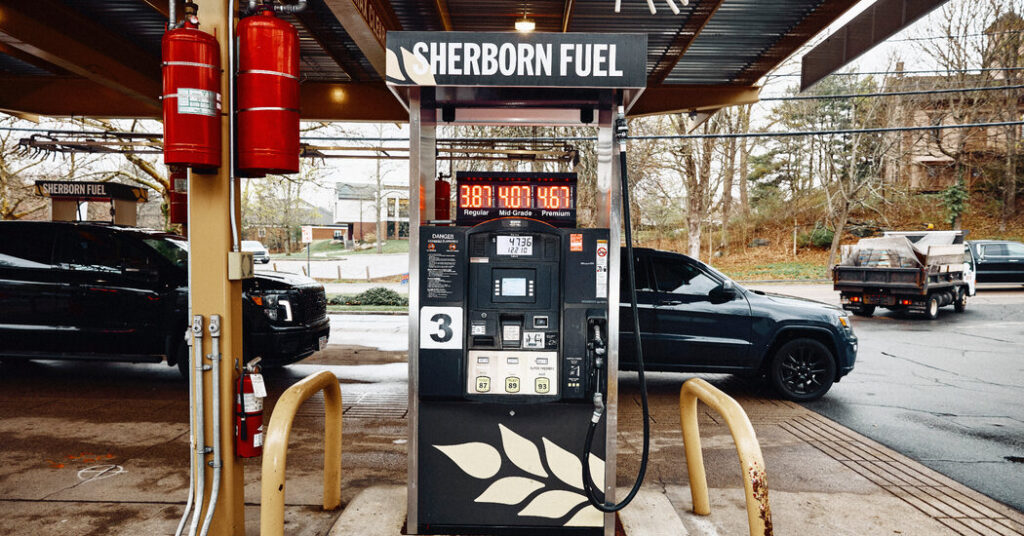
He owns a gas station in Sherborn, Mass., a small town about 45 minutes southwest of Boston. He refills his tanks about every four days, and the “rack price” that his wholesale gasoline provider charges jumped to $3.347 per gallon last week from $2.398 on Feb. 25 — an increase of 39.6 percent. His last truckload cost $39,488.
“Think about the cash flow impact of that on one guy — it’s brutal,” said Mr. Weatherall, who learned about retail pricing in his earlier career at Wegmans, the supermarket chain. He has raised the price of regular gas to $3.879 from $2.899, an increase of 33.8 percent. He would charge more, but he feared losing business if his competitors did not follow. Fewer visits also mean lower sales at his convenience store and restaurant.
“Because of the pressure, it feels to us like the price can never go up high enough to protect your margins,” Mr. Weatherall said, noting that additional credit card fees that come with higher prices also eat into his profits. “That’s why we’re temperamentally slow to take the price down.”
As oil prices climbed in recent weeks to their highest level since 2022, people like Mr. Weatherall are a key layer between the cost of a barrel unloaded from tankers and what consumers pay to fill up their vehicles. And gas station owners don’t like price spikes any more than their customers do.
Part of the reason is an age-old pattern in behavioral economics. Businesses far down on a commodity supply chain have a difficult time with price volatility, because consumers hate abruptly paying more. The good news, for gas stations, is that drivers base their expectations for how much gas should cost on last week’s price.
“So if the costs fall 20 cents, and the station lowers the price by 5 cents or 10 cents, the consumers say, ‘That looks like a great deal, compared to what I think is supposed to be there,’” said Matthew Lewis, a professor of economics at Clemson University who has studied retail gas markets. “Everyone just stops searching when the prices start to fall.”
There is no guarantee, however, that gas vendors will recoup margins they lost on the way up by holding prices up slightly as rack prices come back down. Also, there is a newer problem: Gas stations make most of their money on stuff other than gas.
This shift began in the early 2000s. Oil refiners like Exxon Mobil, Chevron, Valero and Shell used to own their own gas stations as a retail distribution network for their product. Aiming to focus more on their core operations, the oil companies sold off most of their gas stations to independent operators. Today, if a gas station bears the name of an oil company, it probably licenses the brand and is under contract to buy that company’s gas.
But many of those independent companies have since built their own brands. Regional portfolios of megastations, such as Sheetz and Wawa in the Mid-Atlantic, Buc-ee’s in Texas and Kwik Trip in the upper Midwest, have loyal followings in their areas. Others have been bundled into international conglomerates like EG Group, which owns about 1,800 stores across Cumberland Farms, Turkey Hill and other chains.
Adding expansive menus and shopping selections has most likely allowed these chains to keep gas prices a bit lower. According to the National Association of Convenience Stores, fuel accounts for 65 percent of the industry’s sales but only about 39 percent of its profits. For that reason, gas station owners are often loath to raise their prices above $4, a psychological barrier for drivers.
“There’s something about the $4 that’s so unusual that makes people stop,” said Jeff Lenard, a spokesman for the association. “It was a lot easier to sell in-store items when gas was $2.80 a gallon.”
James Linton is the president of Folk Oil, which started as a fueling station in 1921 and now owns 35 gas stations across southern Michigan. They are all attached to convenience stores called PS Food Mart, which has a rewards app and a selection of franchise restaurants.
“If I had to solely rely on fuel as my only source of profit, I wouldn’t stay in business,” Mr. Linton said. “I want the consumer to come in the store, and we do everything we can to entice them to come in.”
The company’s gasoline sales are not down much since the war in Iran began, but Mr. Linton’s convenience sales have taken a hit. “People only have so much disposable income,” he said.
Consumers are also coping with higher gas prices by shifting to lower fuel grades, according to Upside, a consumer data firm, and filling their tanks in smaller amounts. They may feel that they are spending less, even if they have to visit the station more often.
Of course, when one company has a lot of stores in a confined area, that can give drivers fewer options — and in the oil and gas industry, cartel behavior is a time-honored tradition. As the retail gasoline sector has consolidated, the Federal Trade Commission has reviewed mergers to try to prevent any one company from gaining enough power in a market to raise prices unilaterally. Last fall, the agency required Circle K to divest 35 stations as a condition of a deal to acquire 270 stations from Giant Eagle, a grocery chain.
It is difficult to know whether those efforts have succeeded in keeping the industry competitive. Holly Vedova, who led the F.T.C.’s Bureau of Competition until 2023, said it was difficult to more aggressively challenge mergers or extract concessions because the burden of proof that the transaction would cost consumers was high.
“I truly think that to really solve the problem, there need to be changes in the antitrust laws,” Ms. Vedova said. Studying what happened after a merger was approved could build the case for more aggressive enforcement, she said, but it is time-consuming and expensive work that the agency has not prioritized.
Larger companies — such as PDI Technologies, which owns the popular gas price tracking app GasBuddy — use software programs to optimize pricing and send personalized offers to customers. Such platforms can allow for tacit collusion, as Mr. Lewis, the economics professor, found in Australia; he said the data was not available to study their impact in the United States.
Some of the bigger chains are not too worried about the price spike. Take Casey’s General Stores, a publicly traded company that is the third-largest owner of convenience stores in the United States. On an earnings call in March, Darren Rebelez, its chief executive, said that in the past the company had managed to make larger profits through oil price spikes like the one in 2022 set off by Russia’s invasion of Ukraine.
“Over the course of the cycle, it historically has ended up being a net positive from a fuel margin standpoint,” Mr. Rebelez said. “But it is a little bit of tightening on the front end, a little bit of expansion on the back end.”
For smaller operators, pricing is more art than science. Take Chuck Nietsche, who has owned a 14-pump, Gulf-branded gas station about an hour north of New York City for 33 years. His method is simply to add his cut on top of the rack price, while keeping an eye out to make sure he is not too far above the competition. And if he can, he will avoid changing the prices at all.
“I don’t like to shake up the customers every time they drive in, that it’s a different price,” Mr. Nietsche said. He also does not have the digital signage that would make changing prices easier. “It also is a pain, because those little prices on the pumps, they’re magnetic,” he said. “You have to take that little magnet number off and put the new number in.”
Most independent gas station owners will make it through this disruption with a modest hit to their profits. The bigger concern is that, if prices stay elevated for a longer period, drivers may shift their behavior in ways that do not bounce back.
Sanjiv Patel knows this firsthand. He owns five gas stations in the Central Valley of California and San Francisco, where gas is already pricier because of taxes and regulation. The last time prices went above $5 a gallon, Mr. Patel started car pooling with some colleagues, and they kept doing it even when prices went back down.
“The behavior change happens when it goes above $5, and some of it sticks,” Mr. Patel said. “Then we are stuck with that, and it reduces the number of trips to the store.”
Lydia DePillis reports on the American economy for The Times. She has been a journalist since 2009, and can be reached at [email protected].
The post Why Gas Prices Go Up Fast and Take So Long to Fall appeared first on New York Times.